If you have ever watched your child spend three hours memorising answers the night before a test, only to forget everything a week later, you have already seen the problem with rote learning up close.
Most Indian parents went through the same system. Memorise, reproduce, score marks, move on. For a long time, it worked, at least on paper. But something has shifted. The world your child is entering does not reward the ability to recall stored answers. It rewards the ability to think, create, adapt, and solve
That is exactly what the debate between rote learning vs experiential learning is really about. Not just teaching methods but what kind of person your child becomes by the time they leave school.
This blog breaks down what the research actually says, what the difference looks like in a real classroom, and most importantly what you can do at home to support deeper learning for your child.
What Is Rote Learning and Why Is It Still So Common?
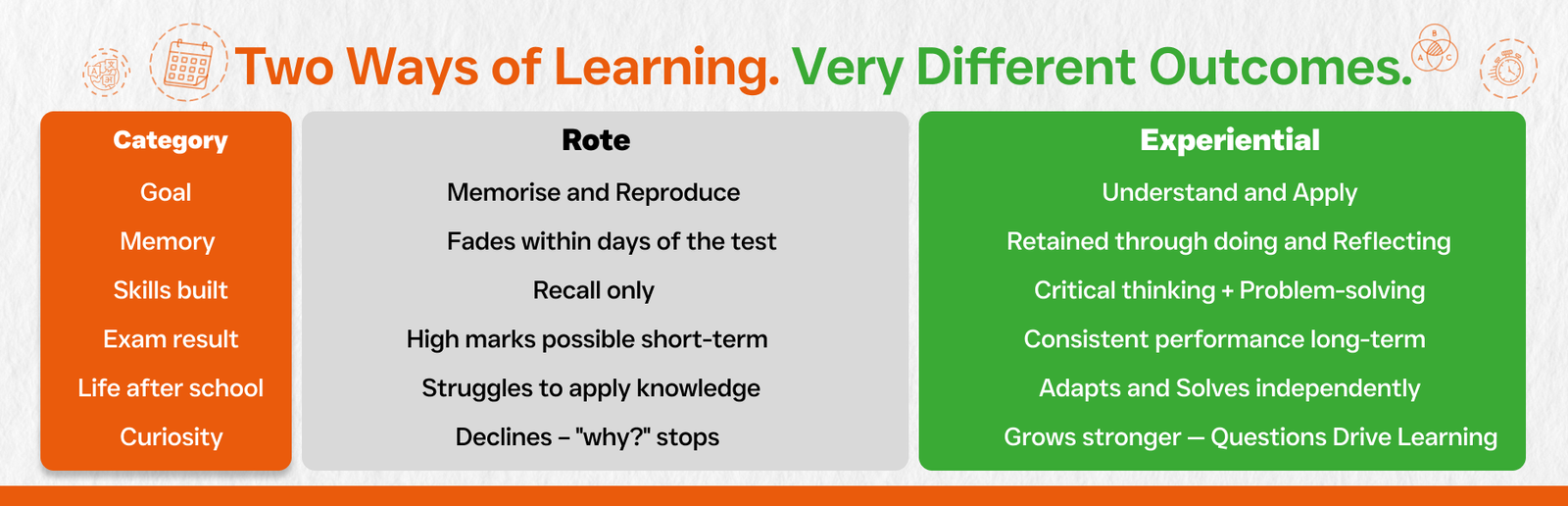
Rote learning means memorising information through repetition, without necessarily understanding it. You read it again and again until you can reproduce it. Flash cards, chanting multiplication tables, copying definitions word for word, all of this falls under rote learning.
It is still common in Indian schools for a few practical reasons: it is easy to test, easy to standardise, and it produces results that look good on a mark sheet in the short term.
A nationwide survey by EZVidya found that 80% of school principals believe the emphasis on rote learning is directly contributing to poor quality education. A WIPRO study went further, finding that rote learning is equally common in India’s top schools, not just government ones.
The deeper problem? Rote learning kills curiosity. When children are only asked to remember, they stop asking why. And a child who stops asking why is a child who has stopped truly learning.
What Is Experiential Learning?
Experiential learning is exactly what it sounds like: learning by doing. Rather than being told how something works, children experience it through experiments, projects, conversations, building, making mistakes, and reflecting on what went wrong.
The theory was developed by American educator John Dewey in the early 20th century, but its principles have been validated by decades of modern neuroscience. When children engage with a concept physically or emotionally, not just visually, the brain forms stronger, longer-lasting connections.
- A child who reads about water pressure will understand it. A child who builds a working fountain in class will never forget
- A child who memorises the definition of fractions may pass a test. A child who divides a real pizza into equal parts for friends understands fractions.
- A child who reads about conflict resolution will recognise the word. A child who has navigated a real disagreement in a group project will carry that skill into adulthood.
This is the core difference. Rote learning fills the memory. Experiential learning shapes the mind.
Rote Learning vs Experiential Learning
What Does the Research Actually Say?
The science here is consistent and clear. Study after study points in the same direction.
On memory and retention
A 2020 longitudinal study in Early Childhood Research Quarterly found that information learned through rote methods showed significantly lower long-term retention compared to conceptual or experiential approaches. Children taught through memorisation struggled to apply what they had “learned” in new situations.
On creativity and critical thinking
A 2021 study in the Journal of Educational Psychology found that an emphasis on rote learning in early education negatively impacts creative and critical thinking development. Children from rote-heavy classrooms showed lower creativity scores and struggled more with open-ended problem-solving.
On experiential learning outcomes
A 2025 evidence review published in The Curriculum Journal, which analysed peer-reviewed studies from 2013 to 2023, found that experiential learning consistently produced higher academic achievement in science subjects and demonstrated stronger qualitative outcomes in concept understanding and student engagement.
On India’s workforce gap
A survey of 200 Indian and foreign companies found that only 14% of Indian graduates were considered prepared for the workforce, primarily because most could not apply their knowledge to solve real problems. This is not a talent gap. It is a learning gap, built in school.
The research does not say rote learning is entirely useless. Memorising multiplication tables or the periodic table has its place. But when memorisation is the dominant mode of learning, when it replaces understanding rather than supporting it, the damage is measurable and lasting.
What Does This Look Like in a Real Classroom?
The difference between the two approaches is not abstract. Here is what it looks like in practice.
A rote learning classroom
The teacher explains a concept. Students copy the definition into their notes. Homework is to read the chapter again. The test asks them to write the definition back. The child who memorised it correctly gets full marks. The child who understood it differently but expressed it in their own words may lose marks.
An experiential learning classroom
The teacher introduces a concept through a question, a problem, or a challenge. Students work in groups to explore it, building, testing, discussing. They make mistakes, adjust, and try again. The teacher guides but does not give the answer. Assessment looks at the process, not just the product. The child who asked the most interesting question may be celebrated more than the child who gave the fastest answer.
One system teaches children what to think. The other teaches children how to think. Both have academic outcomes, but only one prepares children for a life that will constantly demand adaptation.
What NEP 2020 Says About This
India’s National Education Policy 2020 explicitly calls for a shift away from rote learning. It advocates for hands-on learning, critical thinking, and competency-based assessments, moving away from high-stakes exams that reward memorisation.
This is a significant policy shift. But policy and practice are different things. Many schools acknowledge NEP 2020 in their brochures while continuing to run classrooms in the same way they always have.
The question for parents is not whether a school has adopted NEP language. It is whether the classroom itself has actually changed.
5 Things Parents Can Do at Home to Encourage Deeper Learning
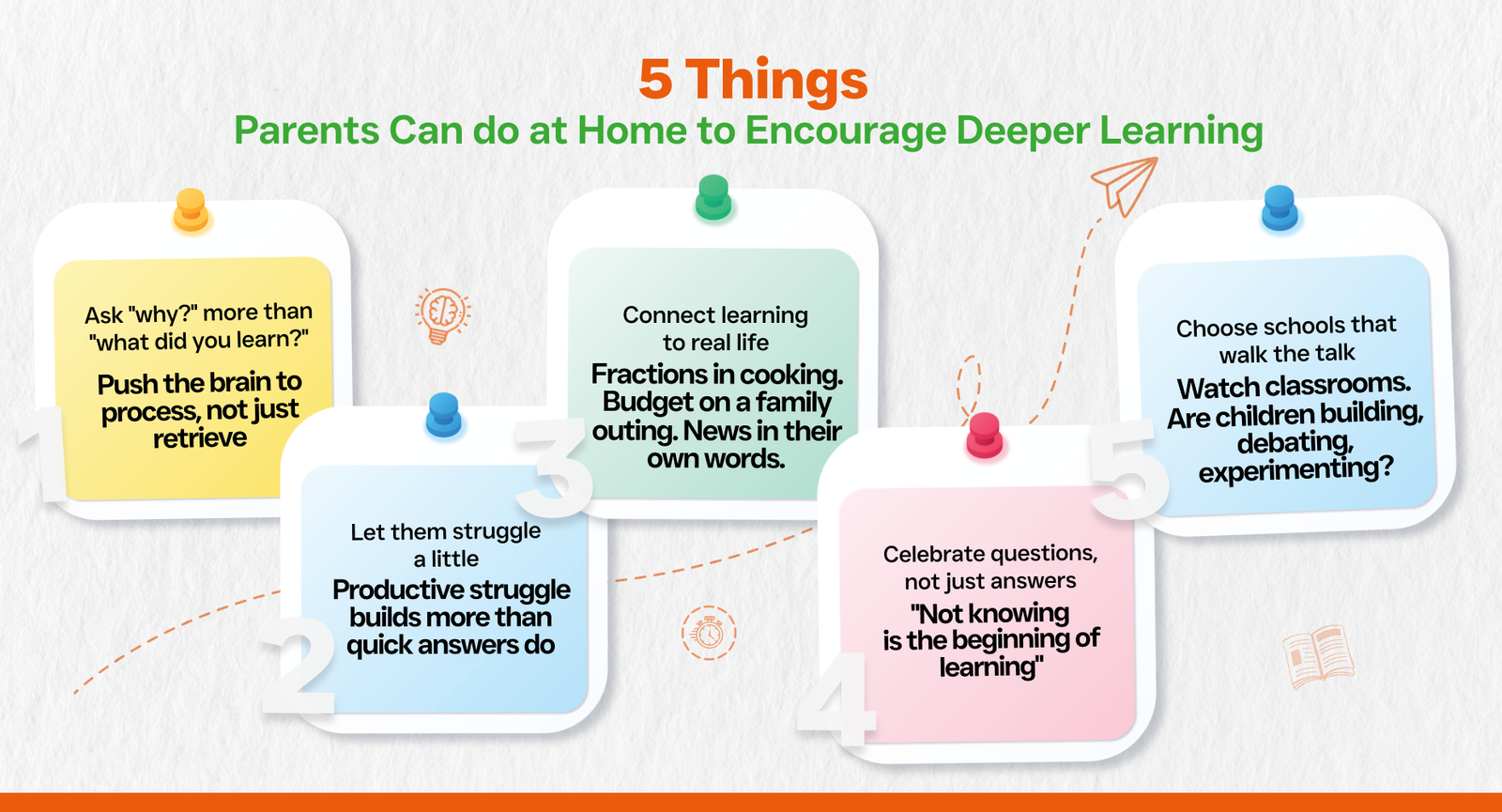
Schools set the environment, but parents shape the habits. Here are practical things you can do at home to encourage deeper, more experiential thinking in your child, regardless of which school they attend.
- Ask ‘why’ and ‘what do you think?’ more than ‘what did you learn today?’
When your child comes home from school, resist asking them to recite what was taught. Instead, ask: ‘Why do you think that happens?’ or ‘If you were the teacher, how would you explain this?’ These questions push the brain to process, not just retrieve. - Let them struggle a little
The instinct to immediately help a frustrated child is natural but counterproductive. Productive struggle, where a child works at a problem without immediately getting the answer is one of the most powerful learning experiences available. Stay nearby, stay calm, but let them try. - Connect learning to real life
Ask your child to help you cook and use fractions. Let them manage a small budget for a family outing. Have them read the newspaper and explain a story to you in their own words. Real-world application is the bridge between memory and understanding. - Celebrate questions, not just answers
One of the most powerful things a parent can do is celebrate curiosity. When your child asks a question you cannot answer, say so, and figure it out together. The message this sends is enormous: ‘Not knowing is the beginning of learning, not the end.’ - Choose schools that walk the talk
Read between the lines of a school’s marketing. When you visit, watch what happens in classrooms. Are children talking, building, disagreeing, experimenting? Or are they copying from the board in silence? The physical environment of a school tells you more than its brochure ever will.
Signs Your Child’s School Is Prioritising Experiential Learning
- Children are regularly working on projects, not just exercises
- Assessment includes presentations, portfolios, or demonstrations not only written tests
- Teachers ask open-ended questions rather than giving single correct answers
- Children can explain what they’re learning in their own words, not just definitions
- The classroom involves collaboration, children work with each other, not just at each other
- Mistakes are treated as part of learning, not just marked wrong
- Your child comes home curious about something, not just relieved the day is over
How Aurinko Academy Approaches This
At Aurinko Academy in Bangalore, the shift away from rote learning is not a goal on a policy document. It is the way every school day is designed.
Aurinko’s classrooms are built around project-based learning, student agency, and real-world application. Children are not asked to memorise definitions, they are asked to build, test, question, and reflect. Studios for carpentry, clay work, and visual arts sit alongside science labs and reading spaces, because the school believes that the hands and the mind learn together.
The school deliberately keeps class sizes small so that teachers can know each child, how they think, where they get stuck, what makes them light up. This is not possible in a room of 40 children copying from a board.
Children at Aurinko are assessed on their thinking process, not just their final answers. Industry mentors visit regularly to show students what real-world problem-solving actually looks like. And parents are active participants in the learning community, not just informed of results.
The result is children who are not just prepared for exams, but genuinely prepared for what comes after.
Final Thoughts
The research is clear. The instinct of frustrated Indian parents is correct. Rote learning alone is not enough and in many cases, it is actively working against the kind of thinking skills children need for the world they are growing into.
The good news is that change is possible in schools, and at home. The first step is knowing the difference between a child who has memorised something and a child who has truly understood it. Because those are two very different children when the real world eventually calls their name.
If you would like to see experiential learning in practice, Aurinko Academy welcomes parents for open school days throughout the year. Come and watch. That is where the real answer lives.