
Curriculum
An Educational Framework Built Around the Child
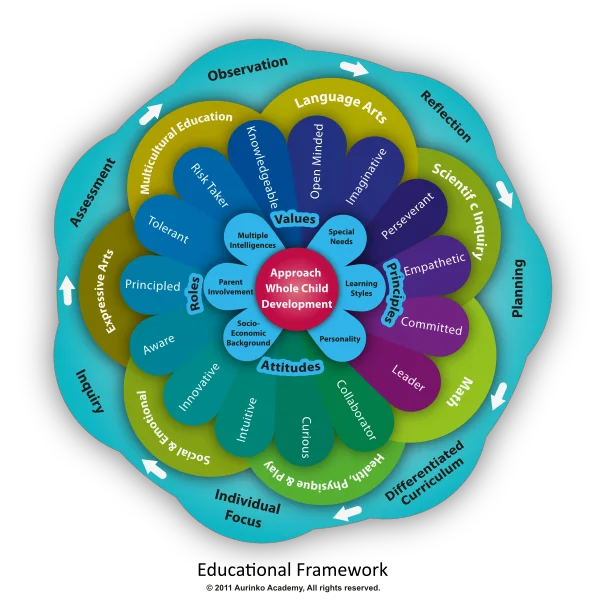
The Aurinko curriculum is not a fixed syllabus delivered the same way to every child. It is a living framework, one that maps the relationship between academic content, child development, values, and the way we teach. It shows what we enable children, families, and teachers to explore throughout their time at Aurinko.
It spans six interconnected areas: Academic, Social, Emotional, Cognitive, Community, and Physical. Teachers bring these together by offering multiple ways into every concept, the same idea explored across different environments, tools, and contexts, so children develop genuine understanding rather than surface familiarity.
Educational Framework
Aurinko Academy’s school curriculum is inspired by the Co-Constructivist theory, the Universal Laws of Karma, Teachings of Great Gurus, the Ancient Indian Gurukul System and a widely researched and successful approach devised by its founders.
The Academic Framework is Supported by Cambridge Programs.
Global Perspectives
Seeing the World Clearly
Rather than conventional Social Studies, Aurinko teaches Global Perspectives, a subject that connects classroom learning to real-world issues and challenges. Children develop critical thinking, the ability to reflect, and the confidence to collaborate across differences.
They explore their own identities and relationships while gaining an understanding of the experiences, cultures, and perspectives of communities around the world. The goal is not just awareness, it is the ability to engage thoughtfully with a complex world.
Curriculum Clusters
Subjects That Work Together
Each cluster is designed to connect to the others as dimensions of a child’s growth that inform and strengthen each other.
Language Arts
Expressive arts
Mathematics
Aurinko develops a mathematical mind, not just mathematical ability. Concepts begin in the physical world: patterns in the body, rhythms in daily life and gradually build toward abstraction. Children apply mathematical thinking to real problems: surveys, graphs, temperatures, quantities, and planning. By the time they reach geometry and algebra, they have a grounded understanding of why mathematics matters, not just how to perform it.
Scientific Inquiry
Social and Emotional Learning
Physical Awareness, Health and Play
Social Sciences
Social Sciences at Aurinko connects academic content to real life. Children explore their own identity and relationships, then extend that understanding outward to the characteristics, histories, and experiences of diverse cultures and populations across the world. The focus is always on relevance: why this matters, what it means for how we live, and what it asks of us.
Teaching & Assessment
Learning in Progress
How It Works
Inquiry — Every learning cycle begins with a question or a thread worth exploring
Observation — Teachers observe and document each child’s learning in class, on field trips, and in workshops — building a unique Learner Profile for every student
Planning — Observations are mapped to each child’s needs, strengths, and challenges. Field notes, portfolios, and documentation all feed into this stage
Reflection — Teachers reflect on children’s work to personalise and differentiate what comes next Assessments, projects, quizzes, presentations are designed with care. Marking is transparent, detailed, and constructively critical so children can reflect on their own performance and learn from it. Over time these records become a full narrative of each child’s learning history.
Children are active participants in this process, not subjects of it. They learn to track their own progress, understand how they learn, and take increasing ownership of how they develop.
Cambridge International
Global Standards. Personal Learning.
The Cambridge curriculum gives Aurinko students a globally recognised, rigorous academic foundation respected by universities worldwide. It builds thinking skills, encourages inquiry, and is designed around how children actually learn.
We bring it to life through our own methodology. A Cambridge concept does not stay on the page, it becomes a Makerspace challenge, a field investigation, a project brief, or a class debate. The academic rigour stays intact. The experience of learning becomes something children genuinely engage with.
Why choose Cambridge and the Aurinko Methodology ?
- Internationally Recognised
- Research-based and child-centric
- Builds thinking and problem-solving skills
- Builds confidence and independence
- Activity-based — children co-construct learning with teacher guidance
- Encourages inquiry and original thinking
- Homework is purposeful and promotes independent working
- Children are encouraged to speak up and engage without fear
- Trains children to persist, write in their own words, and complete work on their own
- Builds in reflection at the end of every lesson
NIOS
NIOS is National Institute of Open Schooling. We have used this Board for our Secondary and Senior Secondary Programs from the past 5 years.
The reasons for us to use this Curriculum are as follows
- Exhaustive Curriculum that is empowering and in line with the current world
- Choice of subjects
- Flexibility in Time
- Fair Practices
Over the past 21 years, NIOS has
- Tutored and certified 931,290 students aged 14-years-plus as class X school leavers
- Tutored and certified 641,000 senior secondary (class XII), students
- Provided 111,220 with vocational education and training.
Over the past 21 years, NIOS has
- Vocational education and training is supplemented by 1,106 study centres and open basic education programmes by 664 accredited agencies.
- National Award for e-Governance 2008-09 for Excellence in Government
- National Award for Process Re-engineering (SILVER) in Feb., 2009
- The Times of India Social Impact Award for education 2013 in the government category to the National Institute of Open Schooling