
Our Approach
Education With Intention
Most schools teach the way schools have always taught. Aurinko was founded by people who looked at that and asked whether it was actually working for children, not just for systems. What came out of that question, refined over 15 years of daily practice, is the approach you will find here.
It draws from the ancient Indian Gurukul tradition, the co-constructivist theory of education, and the Cambridge International curriculum brought together into something that is distinctly, practically Aurinko.
Children Learn by Doing, Not by Watching
At Aurinko, learning is physical before it is theoretical. Children build things, run experiments, grow food, take apart problems and put them back together differently. This is not enrichment, it is the main event. The Makerspace, the science labs, the art rooms, and the open campus are not facilities that sit alongside the curriculum. They are where the curriculum happens.
Project-based learning is central to how we work. Children take on real challenges, work through them over time, and present their findings to genuine audiences. The process of researching, collaborating, failing, revising, completing builds capabilities that stay with them long after the project is done.
A child who has built something with their hands understands it in a way no textbook can replicate.
Cambridge International, Taught the Aurinko Way
The Cambridge curriculum gives our students a globally recognised, rigorous academic foundation, one that is respected by universities and institutions worldwide. It builds thinking skills, encourages inquiry, and is designed around how children actually learn rather than what is easiest to test.
We take that framework and bring it to life through our own methodology. The same concept a child encounters in a Cambridge textbook will be explored again through a hands-on project, a field trip, a Makerspace challenge, or a group investigation. The academic rigour stays intact. The experience of learning it becomes something children actually enjoy.
What Cambridge and the Aurinko approach build together
Critical thinking, problem-solving, independent working, confidence in expressing ideas, the ability to reflect on learning and improve, these are not separate goals. They emerge naturally when the right framework meets the right method.
We Meet Every Child Where They Are
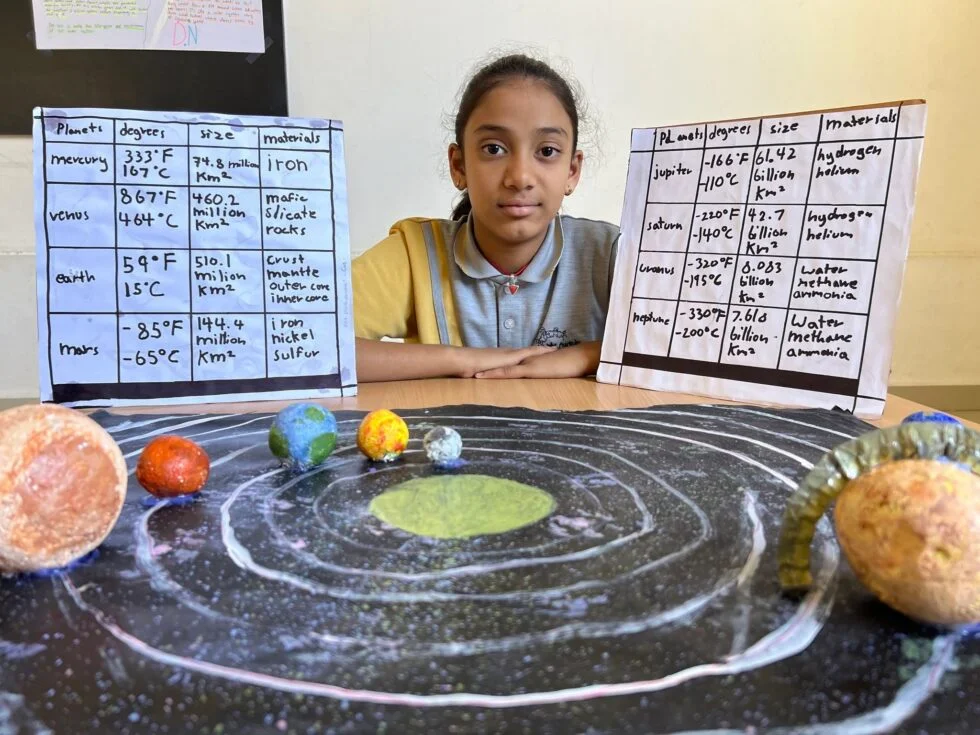
No two children learn at the same pace or in the same way. Our teachers plan for that range deliberately, adapting how a concept is introduced, how much time a child gets with it, and what kind of support they receive. A child who struggles with written expression might flourish when the same idea is explored through building or conversation. We find that entry point and use it.
Assessment at Aurinko is continuous, not periodic. Teachers observe and document each child’s learning across the day, building a picture of where every child is and what they need next. That picture drives what gets taught, and how.
Children are part of this process too. They learn to reflect on their own work, understand how they learn, and take increasing ownership of their progress as they move through the school.
An Approach That Grows With the Child
The way we teach shifts as children develop because what a five-year-old needs from school is genuinely different from what a fifteen-year-old needs.
Sensory exploration, play, movement, and the building of confidence. Children learn to feel at home in the world before they are asked to study it.
Academic foundations through STEAM-integrated, project-based learning. Reading, writing, mathematics, and scientific thinking explored through doing, not just instruction.
Application, leadership, and executive functioning. Children run projects, mentor peers, and begin to take real ownership of their learning and their environment.
From Grade 8, specialised programmes and career-focused partnerships open pathways forward. Students leave with academic depth, practical capability, and a clear sense of direction.
An Approach Built on Respect for the Child
Everything at Aurinko, the Makerspace, the projects, the Cambridge curriculum, the way teachers observe and adapt comes back to one thing: a genuine belief that children are capable of far more than conventional schooling tends to ask of them. We ask more. We support more. And consistently, children rise to it.
The best way to understand our approach is not to read about it. It is to come and see a school day in motion.