You have probably heard the word. It comes up in parenting groups, in school meetings, in articles about education. But for many parents, neurodiversity still feels like a clinical term, something that applies to other children, not theirs.
Here is the truth: neurodiversity is not a special category. It is a description of the simple, research-backed fact that human brains differ from person to person, in how they take in information, how they process it, how they focus, and how they communicate. Every classroom contains a range of neurological profiles. The question is whether the school has been designed with that range in mind.
In India, approximately 12% of children between the ages of two and nine have some form of neurodevelopmental difference, according to research cited by IDR Online. That is roughly one in eight children, sitting in classrooms built, in most cases, for a single type of learner.
This blog explains what neurodiversity actually means, which conditions fall under it, why it matters so deeply for how schools teach, and what parents can look for when choosing a school that takes it seriously.
What Neurodiversity Actually Means
The term was first used by researcher Judy Singer in 1998 and has since become a cornerstone of modern educational thinking. At its simplest, neurodiversity is the natural variation in how human brains work, variation that is not a defect, but a feature of human biology, much like variation in height or blood type.
The framework makes a distinction between two groups. Neurotypical people are those whose brains process and respond to the world in ways that align with the social norm. Neurodivergent people are those whose neurological profiles diverge from that norm, not because something is broken, but because their brains are wired differently.
Crucially, neurodivergence is not the same as low intelligence. Many neurodivergent children have high cognitive ability in specific areas. What changes is not their capacity to learn, it is the method by which they learn most effectively. A child with dyslexia may have exceptional verbal reasoning. A child with ADHD may have remarkable creative thinking and hyperfocus when engaged. A child on the autism spectrum may have extraordinary depth of focus and pattern recognition. These are not consolation prizes. They are genuine strengths, ones that go unrecognised in a classroom built only for one type of mind.
Common Neurodivergent Conditions and What They Look Like in a Classroom
Neurodiversity is an umbrella term. Under it sit several specific conditions, each with its own profile of strengths and challenges. Here is a brief, practical overview of the most common ones, not as a medical reference, but as a guide for parents and educators.
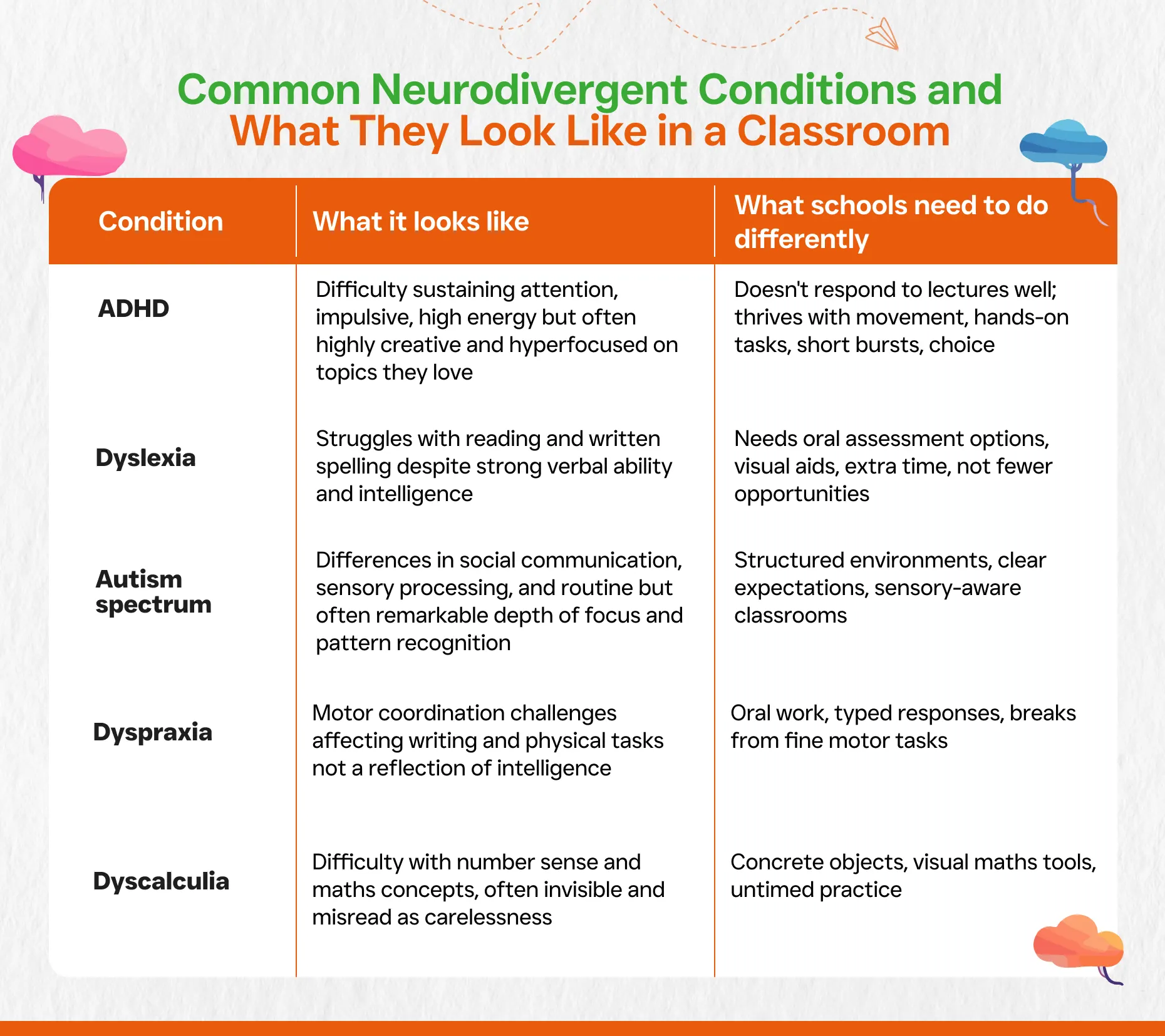
It is worth noting that many children have more than one of these profiles overlapping, ADHD and dyslexia together, for example, or autism alongside dyscalculia. This is common, and it means schools need genuinely flexible approaches, not just single-condition checklists.
Why Most Schools Are Still Built for One Type of Brain
Traditional school design: rows of desks, teacher at the front, silent individual work, single written test at the end was developed in the industrial era to produce a standardised output from a standardised input. It works well for children whose neurological profile matches the format.
For children who do not and there are many of them, the same system produces a very different experience. They are not behind. They are not lazy. They are not disruptive. They are simply being asked to process the world in a way that conflicts with how their brain actually works. And when that mismatch persists, day after day, year after year, the damage is not just academic. It is to the child’s sense of who they are.
This is important. The research consistently shows that classrooms designed to accommodate neurodivergent learners actually improve the experience for neurotypical children too. Flexible teaching is simply better teaching.
The situation in Indian schools
In India, children with autism, ADHD, dyslexia and other neurodivergent conditions have the legal right to attend mainstream schools under the RPWD Act (2016) and the Right to Education Act.
However, a Free Press Journal investigation into Mumbai schools found that in practice, many schools are still inclined to decline enrollment when a diagnosis is disclosed. Awareness is growing, but access and genuine inclusion remain uneven.
This makes choosing the right school one that actively understands neurodiversity, rather than simply tolerating it, one of the most important decisions parents of neurodivergent children make.
What Good Neurodiversity-Affirming Teaching Actually Looks Like
The phrase ‘inclusive school’ appears on many brochures. But what does it actually look like in a classroom? Here are the concrete practices that distinguish schools that genuinely support neurodivergent learners from those that merely accommodate them reluctantly.
Multiple ways to show understanding
A neurodiversity-aware school does not rely solely on written exams to assess what a child knows. It offers multiple means of expression: oral presentations, project work, drawings, demonstrations, portfolios. A child who struggles with handwriting but can explain a concept brilliantly should have a way to show that brilliance.
Flexible pacing and structure
Some children need more time. Some need fewer distractions. Some need movement breaks. A school that builds flexibility into its structure rather than treating every deviation from the norm as a problem is a school that respects how brains actually work. This is not lowering standards. It is removing unnecessary barriers.
Small class sizes and individual teacher attention
Research from the Child Mind Institute consistently shows that neurodivergent children need teachers who know them individually who understand their specific profile of strengths and challenges, not just their diagnostic label. This is simply not possible in a room of 40 children. Small class sizes are not a luxury for neurodivergent learners. They are a necessity.
A classroom culture where difference is normal
Neurodivergent children in mainstream classrooms face not just academic barriers but social ones. A 2024 study in SAGE Open showed that teaching all children about neurodiversity, what it is, why brains differ, and how to support classmates who learn differently, significantly improved attitudes and peer relationships across the class. The classroom culture matters as much as the teaching method.
Strengths-first, not deficit-first
The most effective approach to neurodivergent children is what researchers call a strengths-based approach, beginning with what the child is good at and building from there, rather than leading with everything they cannot do. This does not mean pretending challenges do not exist. It means refusing to let challenges define the child.
What Parents Can Do
Whether or not your child has a formal diagnosis, understanding neurodiversity makes you a better advocate for how they are taught. Here is what parents can do.
Observe, do not just diagnose
You do not need a report to notice that your child learns better in some environments than others. Keep track of what engages them, what frustrates them, when they thrive, and when they shut down. This pattern is information and it is exactly the kind of information a good teacher needs.
Ask schools direct questions
- How does the school support children who learn differently?
- What does assessment look like beyond written tests?
- What is the class size, and how much individual attention can a teacher give?
- Has any teacher here had training in learning differences?
- What happens when a child is struggling, is the first response to adapt the teaching or to label the child?
Trust what you observe over what you are told
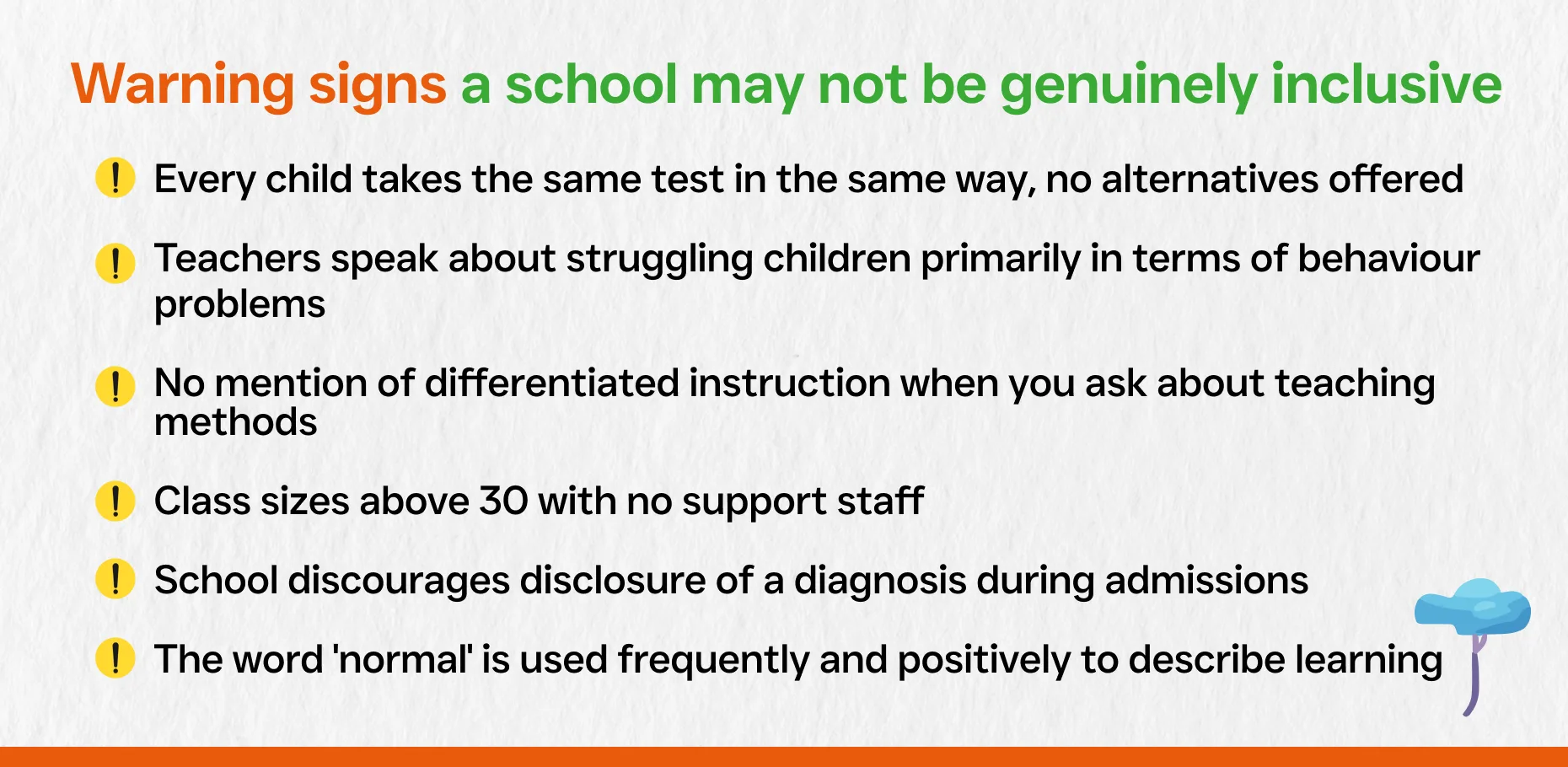
A school that says all the right things during an admissions visit but has no flexible seating, no varied assessment, and no individual attention time is a school that has not yet moved beyond policy language. Watch the classrooms. Watch how teachers interact with children who are visibly struggling. That will tell you more than any brochure.
How Aurinko Academy Approaches Neurodiversity
At Aurinko Academy in Bangalore, neurodiversity is not a support programme that exists alongside the main school. It is built into the philosophy of how the entire school works.
Aurinko explicitly identifies itself as a school that respects learning preferences and accepts learning differences. It shapes every decision about how classrooms are structured, how children are assessed, and how teachers are trained.
Class sizes are deliberately small so teachers can know each child individually their interests, triggers, specific profile of strengths and challenges. Assessment at Aurinko includes projects, demonstrations, carpentry work, art, oral explanation, and collaborative output not just written tests. A child who cannot express what they know on a test paper but can build it, explain it, or draw it has a genuine way to show their understanding.
The school’s carpentry studio, clay modelling room, and outdoor spaces are not extracurricular additions. They are central to how learning works here because Aurinko understands that for many children, the hands learn first. The school environment itself is designed to reduce sensory overwhelm and increase comfort. Children sit on the floor, work with their hands, move freely between activities, all of which support a much wider range of neurological profiles than a traditional desk-and-board classroom does.
Aurinko also works closely with parents through training, regular communication, and active co-parenting to ensure that what happens at home and what happens at school are aligned. For a neurodivergent child, this consistency between environments is not just helpful. It is essential.
Final Thoughts
Every classroom in India and across the world contains neurodivergent children. They are not edge cases or special categories. They are a significant, naturally occurring part of any group of children. The question is not whether to include them. It is whether schools have been designed with them in mind.
A school that teaches well for neurodivergent children teaches well for all children. That is not a compromise. It is simply better education.
If you are a parent trying to find a school that sees your child clearly, their strengths as much as their challenges, the questions in this blog are a good place to start. And if you would like to see what a neurodiversity-aware classroom actually looks like in practice, Aurinko Academy welcomes visits from parents throughout the year.