Picture two children finishing Class XII with identical marks. One handles a job interview with composure, manages a disagreement with a flatmate without drama, and knows how to organise her time when no one is telling her what to do. The other, equally intelligent, equally qualified on paper, struggles with all three. The difference between them is not intelligence. It is not even hard work. It is a set of capabilities that most Indian schools have historically treated as optional, peripheral, or somebody else’s job to teach.
That is changing. Slowly, unevenly, but genuinely. And understanding why it is changing and what good life skills education actually looks like, matters enormously for parents choosing a school today.
What Are Life Skills in Education?
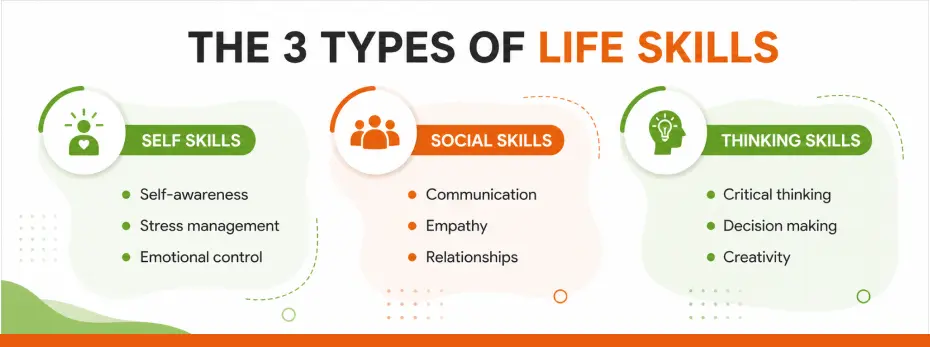
These are not soft extras. Research consistently shows that life skills are stronger predictors of adult wellbeing, career success, and mental health than academic results alone. Yet for most of India’s schooling history, not one of these ten items appeared on a syllabus or a report card.
The gap between what schools teach and what life requires
This is where many schools lose the thread. STEAM as a philosophy is compelling. STEAM as a timetabling exercise, forty minutes of science, then forty minutes of art is not STEAM at all. It is just the old curriculum with a new label.
Why Life Skills Education Is Becoming Essential in India
India’s National Education Policy 2020 is the most consequential reform to the country’s schooling framework in over three decades. Among its many provisions, NEP 2020 makes an unusually direct call for life skills to be woven into the curriculum, not as a standalone subject, but as a thread running through every subject and every year of schooling.
The policy names critical thinking, creativity, communication, collaboration, and social-emotional learning as core competencies, distinct from and in addition to subject knowledge. It calls for reducing the curriculum load of “rote memorisation” precisely to make room for these capabilities to be developed.
“The goal of education is not only cognitive development but also the building of character, enabling individuals to be ethical, rational, compassionate, and caring.”
— NEP 2020, Section 4.6
That is a notable sentence in a government policy document. It signals a formal, top-level acknowledgment that schooling has been measured against the wrong outcomes for a very long time.
Life Skills vs Academic Skills: What Schools Often Miss
Many schools have responded to this shift by adding a “life skills” class to the timetable on Fridays. Children sit, a teacher reads from a worksheet about the importance of communication, and the bell rings.
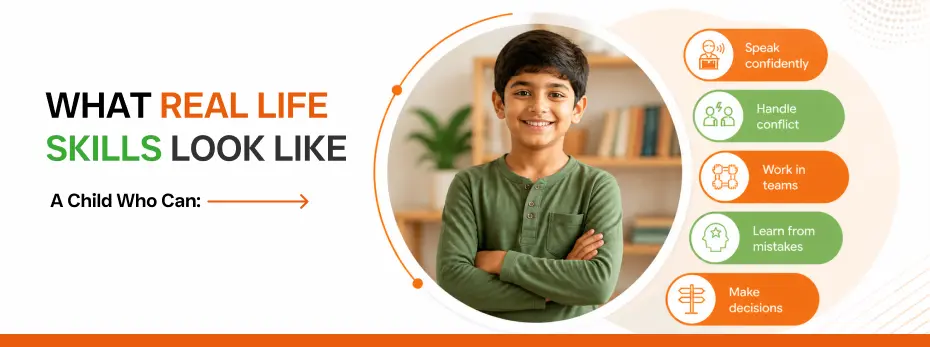
Genuine life skills development is not a subject, it is a method. It happens when a Science teacher asks a child to defend her hypothesis rather than simply write it down. When a group project requires students to divide tasks, manage disagreements, and present findings together. When a child who has made a mistake is guided through what went wrong and how to repair it, rather than simply penalised.
How to Identify a School That Teaches Life Skills
When you visit a school, it is easy to be impressed by facilities, board results, and brochure language. Life skills integration is harder to see, but not impossible. One question cuts through the noise very effectively:
“If a student handles conflict with a classmate badly, perhaps becomes aggressive or shuts down, what does your school actually do? Walk me through what happens next.”
A school that has genuinely built life skills into its culture will walk you through a process: a conversation, a reflection exercise, a restorative circle, a follow-up check-in. A school that hasn’t will tell you the child is spoken to and parents are informed. The second answer is not wrong, but it is a missed opportunity, every single time.
How Aurinko Academy Integrates Life Skills into Learning
At Aurinko Academy, life skills are not a box to tick, they are the architecture around which learning is built. The understanding that a child who cannot manage stress, navigate disagreement, or advocate for herself will struggle regardless of her marks is not a new idea here. It is why our classrooms are designed the way they are, and why our teachers are trained the way they are.
Social-emotional learning is integrated across all year groups, not confined to a single class or a single counsellor. Students from the earliest years are given a language for their emotions and a structure for working through difficulty with peers. By the middle years, that foundation supports real critical thinking: students debate, lead, and build together, with teachers as facilitators rather than arbiters of every outcome.
Our counselling team is embedded in daily school life, not a last resort for crisis moments. Regular check-ins, peer support structures, and a culture where asking for help is visible and normal are things we have built intentionally. Because a child who feels safe develops the confidence to grow. And a child who is growing is a child who is learning.
When you visit Aurinko Academy, bring the checklist above. Ask us every question on it. A school serious about life skills education should be able to answer, specifically, confidently, and with examples.
Final Thoughts
India’s schools are at a genuine inflection point. The pressure of board exams is not going away, and nor should it, academic rigour matters. But the conversation is broadening, slowly and necessarily, toward a more honest accounting of what education is actually for.
A child who leaves school knowing how to think clearly, communicate honestly, recover from failure, and treat others with consideration that child will navigate adulthood well regardless of what the job market looks like. A child who leaves school with excellent marks and none of those capabilities will struggle in ways that no rank on a list could have predicted.
The ranking tells you the school is good. The visit and the right questions, tell you whether it is building the right things in your child. Start with the numbers. End with the people.