At some point in the last decade, someone looked at STEM – Science, Technology, Engineering, Mathematics and said: something is missing.
They were right. What was missing was the A. Art. And when it was added, something shifted in how educators understand what children actually need to learn, and how they need to learn it.
STEAM is not STEM with a creative elective bolted on. It is not art class on a Friday afternoon as a reward for sitting through physics. When it is done properly, STEAM is a completely different way of approaching a problem. It asks students to bring their full intelligence to bear. The analytical and the imaginative, together, on the same challenge, at the same time.
This is the blog that explains what that actually looks like and why it produces something that neither pure science nor pure arts education can produce on its own.
What are STEAM Activities?
STEAM stands for Science, Technology, Engineering, Art, and Mathematics. But the acronym, as helpful as it is for conversations, slightly misrepresents what makes STEAM powerful.
STEAM is not about studying all five disciplines simultaneously. It is about solving problems in a way that draws on all five. The integration is the point. A student designing a bridge does not stop being a mathematician when they start thinking about what the bridge should look like, or an engineer when they start thinking about the communities it will connect. The best thinking happens when those boundaries are not there at all.
This is not a new idea. Leonardo da Vinci was the original STEAM learner, his scientific journals and his paintings came from exactly the same place in his mind. What is new is the recognition that we have spent a century separating these ways of thinking in schools, and the evidence is now clear that this separation has cost us something.
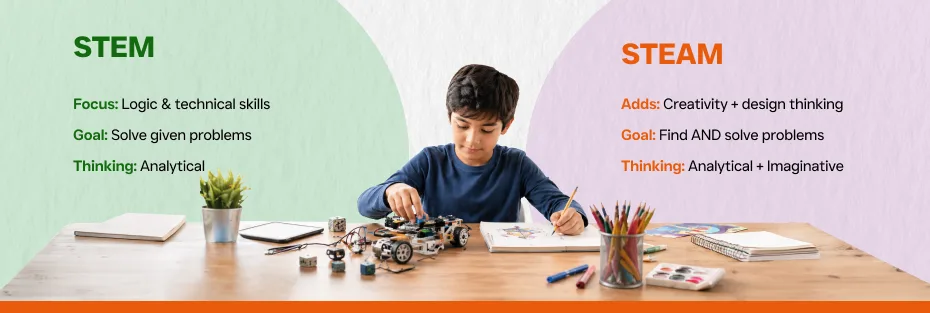
STEAM vs STEM: Why Adding Art Changes Learning
For years, the conversation in schools was about STEM. Coding. Robotics. Data literacy. Mathematics. These are genuinely important, and any school that is not taking them seriously is failing its students. But STEM without Art has a problem.
It produces people who can solve the problems they are given. It struggles to produce people who can identify the problems worth solving. It builds excellent executors. It does not always build visionaries.
Art in the STEAM sense is not decoration. It is the discipline of asking: what do we want this to mean? What should it feel like? Who is it for? How do we communicate it in a way that lands?
These are not soft questions. They are the questions that separate a functional product from one that changes how people live. They are the questions that the most successful technologists, scientists, and engineers in the world have learned, sometimes painfully late to ask.
When you teach children to move between analytical and creative thinking fluidly, you give them a cognitive flexibility that is extraordinarily difficult to develop later. The brain that learns to ask both how does this work? and why should it exist? is a different brain from one that only ever asks the first question.
What Real STEAM Learning Looks Like in Schools
This is where many schools lose the thread. STEAM as a philosophy is compelling. STEAM as a timetabling exercise, forty minutes of science, then forty minutes of art is not STEAM at all. It is just the old curriculum with a new label.
Real STEAM integration happens around problems. Open-ended, genuine, messy problems that do not have a single correct answer and that cannot be solved by applying one subject alone.
At Aurinko Academy, a STEAM unit might begin with a question: How can we design a community space that serves both children and elderly people? That one question requires students to research human behaviour and developmental needs (Science). To prototype and test structural ideas (Engineering). To use measurement, ratio, and spatial reasoning (Mathematics). To think about accessibility, digital modelling, and communication tools (Technology). And to consider aesthetics, cultural significance, and emotional experience (Art).
No one in that room is doing science separately from art. They are doing something richer than either.
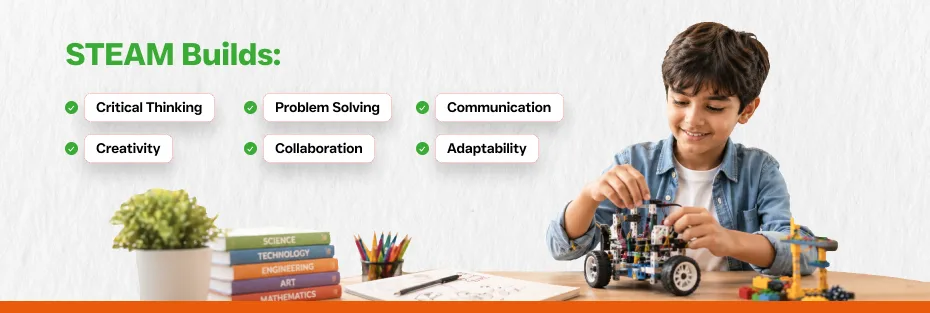
Best STEAM Activities for Children
Building Structures That Must Be Beautiful and Strong
Give students a structural challenge, build the tallest freestanding tower using only newspaper and tape, or design a bridge that holds the most weight using only craft sticks and string. Then add one constraint: it must also be visually compelling. It must be something you would want to look at.
That single extra constraint transforms the activity. Students suddenly have to negotiate between strength and aesthetics. They discover that sometimes a design choice made for beauty also improves function. They argue about what looks good and why. They discover, practically, that form and function are not opposites.
This works from age five to age fifteen. The materials change. The intellectual stakes rise. The insight that beauty and utility are not enemies stays the same.
Coding a Story
Coding is taught in many schools as a technical skill. At its best, it is something much more interesting: a creative medium.
Ask students to code an interactive story. Not a game with a single outcome, but a narrative with choices, where the decisions a reader makes change what happens next. Suddenly, students are not just practising loops and conditionals. They are thinking about character, consequence, moral complexity, and the reader’s emotional experience. They are writers and programmers at the same time.
The students who struggle with coding as an abstract exercise often flourish when it becomes a storytelling tool. The students who flourish with coding discover, sometimes for the first time, that they also have something to say.
Biomimicry Design Challenges
Biomimicry is the practice of solving human problems by studying solutions that nature has already developed. It is one of the most natural STEAM activities that exists.
Ask students to observe a natural structure or system, the hexagonal geometry of a honeycomb, the water-channelling grooves on a cactus spine, the shock-absorbing design of a woodpecker’s skull and then design something that borrows from that solution. The scientific observation, the mathematical analysis of pattern, the engineering of a prototype, and the aesthetic rendering of the design are all inseparable here. You cannot do one well without the others.
Data as Visual Art
Numbers do not have to live in tables. Ask students to take a dataset, local weather patterns over a year, the demographics of their school community, global migration figures over a century and represent it visually in a way that tells a story. Not a bar chart. A piece of visual communication that makes someone feel something about the numbers.
This activity teaches data literacy and visual communication simultaneously. Students discover that the same data can tell completely different stories depending on how it is presented, which is one of the most important critical thinking lessons a young person can learn. It is both a maths lesson and a media literacy lesson. It is STEAM.
Architecture and Community Design
Ask students to design a building for a specific community and a specific purpose. A library for a village with no electricity. A playground for children with limited mobility. A market for a coastal fishing community.
The constraints are the curriculum. Students research the community (Social Science and Humanities). They calculate materials, load, and cost (Mathematics and Engineering). They consider digital tools for modelling (Technology). They study vernacular architecture and aesthetics (Art and History). And they present their design to a real or simulated client audience, which requires communication, persuasion, and the ability to defend a creative decision with evidence.
This is a two-week project, not a forty-minute lesson. That matters. Real STEAM activities take time because real problems take time.
STEAM Activities at Home for Parents
STEAM does not stop at the school gate. Some of the most powerful STEAM learning happens at a kitchen table or in a back garden, in the small moments of a regular day.
Cook together and talk about the chemistry of what is happening, why does bread rise, what does heat do to an egg, what happens when you mix an acid and a base? Cook something from a culture your family knows nothing about and research it before you start.
Watch a film or read a book and then ask: how was this made? What technology was used? Who designed the poster, and what choices did they make? Why does the music feel the way it feels in that particular scene?
These are not structured activities. They are habits of inquiry and habits of inquiry are exactly what STEAM education is trying to build. The school does its part. But the home environment that asks questions, notices things, and takes problems seriously is the environment that makes the school’s work go deeper.
STEAM Education in Bangalore: Why Schools Are Adopting
At Aurinko Academy, STEAM is not a special programme or an after-school club. It is the lens through which we look at education. Our project-based approach for which we have been recognised as one of Bangalore’s leading schools is built on the belief that the most meaningful learning happens when students are solving real problems with the full range of their abilities.
Our students do not study subjects in isolation and then hope they connect. They work on challenges that demand connection from the start. The mathematics student in our classroom is also a designer. The scientist is also a communicator. The engineer is also an artist or at the very least, someone who understands why the artist’s questions matter.
This is not idealism. It is preparation. The world your child will graduate into does not need people who are good at one thing in isolation. It needs people who can move between modes of thinking, who can hold a technical problem and a human question at the same time, who can build something rigorous and make it beautiful.
STEAM, properly taught, builds exactly that person.
Final Thoughts
There is a version of education that asks a child to sit down, be quiet, and receive information that someone else has decided is important.
And there is a version that hands a child a problem, steps back, and says: what do you think?
STEAM activities, at their best, are the second version. They are the version that produces children who are genuinely equipped, not just credentialed for whatever comes next.
At Aurinko Academy, we believe your child deserves that version. Not eventually. Now.
Come and see it for yourself. Book a visit to Aurinko Academy and watch what happens when science, technology, engineering, art, and mathematics stop being separate subjects and start being one way of seeing the world.
Frequently Asked Questions
Q: At what age do students start the IGCSE programme?
STEM covers Science, Technology, Engineering, and Mathematics. STEAM adds Art and with it, design thinking, creative problem-solving, aesthetics, and human-centred inquiry. The addition is not cosmetic. It fundamentally changes the kind of thinking students are asked to do and the kind of problems they are equipped to solve.
Q: At what age should children start STEAM learning?
From the earliest years. A three-year-old building a structure with blocks and then deciding it needs to look a certain way is already doing STEAM thinking. The vocabulary and complexity grow with the child, but the fundamental integration of making, thinking, and creating can begin from the moment a child is curious, which is from birth.
Q: Does STEAM work for children who are not naturally interested in science?
Often, STEAM is precisely what reaches children who have switched off in traditional science classes. When science is taught as a body of facts to memorise, some children disengage. When it is taught as a tool for solving real problems that also involve creativity and human meaning, many of those same children come alive. STEAM does not require a science brain. It requires a curious one.
Q: How is STEAM assessed?
Unlike traditional subjects, STEAM learning is typically assessed through the quality of the process and the product, the thinking documented in a student’s design journal, the evolution of a prototype, the coherence of a final presentation. At Aurinko Academy, assessment in STEAM units reflects what students can actually do with knowledge, not just what they can repeat about it.