There are two parents at every school gate.
The first checks the homework planner every evening, reviews every piece of work before it is submitted, emails teachers regularly, attends every event, and knows the syllabus as well as the child does. Their child’s school bag is always packed. Their project is always on time. Everything is in order.
The second drops their child off, trusts the school to handle what schools handle, and waits for the end of year report to find out how things are going. They are not disengaged, they love their child, they ask questions over dinner, they show up for the important things. They have simply decided that school is school, and home is home.
Both of these parents are trying to do right by their child. Both of them, in different ways, may be getting something wrong.
Because the research on parental involvement in education is more nuanced than either of these positions allows for. It does not say more involvement is always better. It does not say stepping back is always wise. What it says is that the type of involvement matters far more than the amount and that the involvement which helps children most looks quite different from the involvement that feels most helpful to parents.
This is that conversation.
Why Parental Involvement Becomes More Complicated as Children Grow
When a child starts school for the first time, parental involvement feels natural and obviously necessary. You communicate with the teacher constantly. You know what is happening in the classroom. You support every new skill with patience and repetition at home. The boundary between school life and home life is porous, and that porousness feels appropriate for a five-year-old who is still finding their feet.
When a child starts school for the first time, parental involvement feels natural and obviously necessary. You communicate with the teacher constantly. You know what is happening in the classroom. You support every new skill with patience and repetition at home. The boundary between school life and home life is porous, and that porousness feels appropriate for a five-year-old who is still finding their feet.
A ten-year-old who struggles with a maths concept needs something different from their parent than a five-year-old does. A fourteen-year-old navigating a difficult friendship dynamic needs something different again. And a seventeen-year-old choosing university pathways is approaching a moment where the most valuable thing a parent can do may be to have an opinion without imposing it.
The involvement that serves a child at five actively undermines one at fifteen, if it has not evolved. And in many families, it has not. Not because parents are not paying attention, but because the evolution required is genuinely counterintuitive. Doing less, at the moment your child needs you most, is hard. It is also, frequently, exactly right.
What Research Says About Parental Involvement in Education
The evidence on parental involvement in education is substantial, consistent, and routinely misrepresented in the popular conversation.
Studies consistently show that parental involvement is positively associated with academic achievement, school attendance, and children’s overall wellbeing at school. That part is widely reported. What is less widely reported is what kind of involvement drives those outcomes.
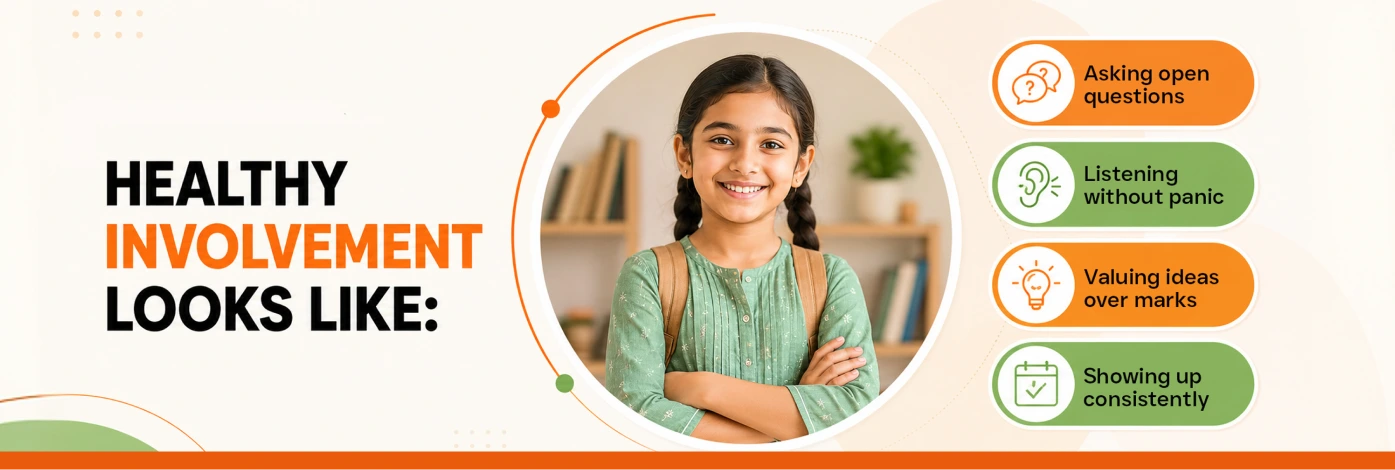
The involvement that predicts positive outcomes is primarily what researchers call process-focused involvement: showing genuine interest in what a child is learning, asking open questions about their school day, reading together, having conversations about ideas, demonstrating that education matters to the family as a whole. This type of involvement communicates to a child that learning is valuable, not because of grades, but because understanding the world is inherently worthwhile.
The involvement that does not predict positive outcomes and in several significant studies actively predicts worse ones is what researchers call performance-focused involvement: monitoring grades obsessively, completing or heavily editing children’s work, pressuring children around results, and communicating anxiety about academic performance. This type of involvement communicates something different entirely: that your child’s value is conditional on how well they do, that mistakes are failures rather than information, and that they cannot be trusted to manage their own learning.
The distinction is not about intensity of care. Both types of involved parents care deeply. The distinction is about what the involvement is actually communicating to the child about themselves.
How Much Should Parents Help with Homework?
No aspect of parental involvement generates more daily conflict in more families than homework. And it is worth addressing directly because the conventional wisdom, that helping with homework is always supportive, is not supported by the evidence.
A 2014 meta-analysis by researcher Harris Cooper, who has spent decades studying the effects of homework, found that parental help with homework had no significant positive effect on academic achievement in primary school and in some cases had a negative effect, particularly when that help shaded into completing the work for the child or creating significant stress around it.
This does not mean sitting with your child while they work is wrong. It means that the goal of homework support should be removing obstacles, not removing difficulty. A parent who sits nearby and is available for questions is doing something useful. A parent who pre-explains every concept before the child attempts it, corrects errors before the child has a chance to notice them, or takes over when things get hard, is accidentally teaching their child that they cannot do it without help.
The effort of struggling with something, genuinely, independently, without rescue is where the learning happens. A child who has always been caught before they fall never discovers they can land on their feet.
For children in the primary years, the most valuable thing a parent can do around homework is provide a consistent time, a consistent space, and the quiet company of someone who is present but not hovering. For secondary students, even that presence may need to be reduced. A sixteen-year-old who cannot organise their own study schedule because a parent has always managed it is a sixteen-year-old who will struggle considerably when that management disappears at university.
The Difference Between Advocacy and Over-Parenting
There is a version of parental involvement that is not about homework or grades but about being a voice for your child within the institution, communicating concerns, ensuring your child’s needs are met, pushing back when something is not right.
This kind of involvement is not only appropriate. It is important. Children, particularly younger ones, cannot always advocate for themselves. A parent who notices that their child is struggling socially, that a learning difficulty has gone unidentified, or that something in the classroom dynamic is consistently making their child’s experience harder, and who brings that observation to the school calmly and specifically, is doing something genuinely valuable.
The line that this shades into something less useful is the line between advocating for your child and fighting every battle on their behalf.
A child who watches their parents intervene every time something is difficult, every friendship conflict mediated, every unfair grade challenged, every uncomfortable experience smoothed away, learns something from that pattern. They learn that difficulty is something that happens to them, and that it requires adult intervention to resolve. They do not learn, because they have never had to, that they are capable of resolving it themselves.
The most effective parental advocacy is targeted and strategic. It is reserved for the things a child genuinely cannot navigate without support, systemic issues, safeguarding concerns, learning needs that require formal identification and provision. It is not deployed for every disappointment, every conflict, or every moment of institutional imperfection.
Picking your battles is not apathy. It is one of the most important things you can model for your child about how to move through a world that will never be entirely fair or comfortable.
Helicopter Parenting and School Anxiety
This is the piece of the parental involvement conversation that is most uncomfortable and therefore most important.
Children are extraordinarily sensitive to parental anxiety. Not to the words parents say, but to the emotional state underneath them. A parent who says I’m sure you’ll be fine with a tight jaw and worried eyes is communicating something very different from the words. Children read the emotional truth, not the verbal reassurance.
When parents are significantly anxious about their child’s academic performance, about grades, about exam results, about university prospects, about whether the school is good enough, that anxiety transfers. The child who internalises their parent’s academic anxiety does not become more motivated. They become more fearful. The fear of disappointing a parent is one of the most corrosive forces in a young person’s relationship with learning. It does not produce excellence. It produces a very convincing performance of excellence, wrapped around a core of dread.
The parents who do most for their children’s genuine academic development are often the ones who have found a way to care deeply about education without attaching their own anxiety to their child’s outcomes. This is not easy. For many parents, their child’s school success is entangled with their own identity, their own aspirations, their own unfinished relationship with their own education. Untangling that is work, but it is among the most valuable work a parent can do.
A child who knows their parents are genuinely interested in their learning and genuinely unconcerned with their ranking is free to be curious, to try things, to fail, and to try again. That freedom is the condition in which genuine academic growth actually happens.
What Healthy Parent Involvement Actually Looks Like
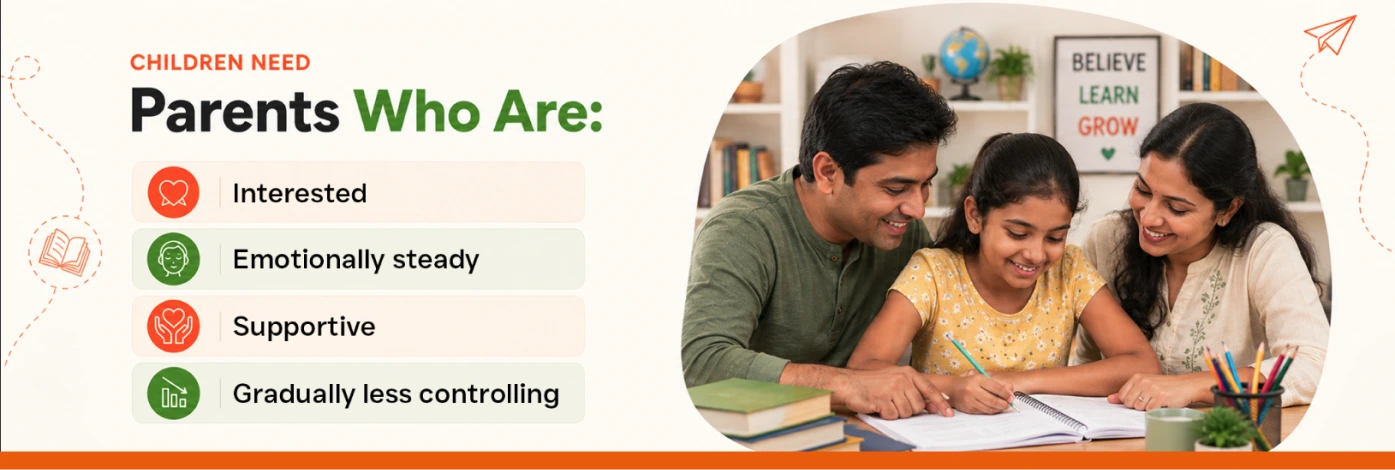
So what does the involvement that actually helps look like, in practice, across the school years?
It looks like asking what did you find interesting today? rather than what did you get in your test? It looks like reading alongside your child, not to them, but alongside them, as someone who is also a reader. It looks like talking about ideas at dinner about something you read, something in the news, something that made you think and treating your child’s opinion as genuinely worth hearing.
It looks like showing up for the things that matter to your child, not only the things that matter to you. The performance they are nervous about. The match they have trained for. The project they are proud of. Being present for those moments, fully present, not filming communicates something no homework help can: that you see them, not just their results.
It looks like knowing their teachers’ names and having a genuine relationship with the school, not a surveillance relationship, but a collaborative one. Attending parents’ evenings prepared with specific questions rather than general anxiety. Emailing a teacher when you have noticed something at home that might be relevant, and being genuinely open to what the teacher notices in return.
And it looks like stepping back, deliberately and repeatedly, in the face of the instinct to step in. Letting your child manage the difficult conversation with the teacher themselves. Letting them pack their own bag, organise their own timetable, manage their own deadlines and experience the natural consequences when they do not. These small withdrawals of support are not neglected. They are the training ground for the independence your child will need for the rest of their life.
How Parent-School Relationships Should Work
None of this is solely a parental responsibility. The school that makes genuine partnership possible is one that communicates clearly, proactively, and honestly, not just when there is a problem, but as a consistent practice.
At Aurinko Academy, we believe the relationship between family and school is one of the most powerful forces in a child’s education. We work to make that relationship genuinely collaborative, sharing what we are observing in the classroom, being transparent about how we approach learning and wellbeing, and creating the conditions where parents feel informed without needing to monitor.
We also talk honestly with families when involvement patterns are becoming counterproductive. Not judgementally, parental anxiety about a child’s education comes from love, and it deserves to be met with understanding. But honestly, because a school that allows damaging patterns to continue unchallenged is not serving the family it is trying to support.
The best version of this partnership is one where parents and teachers are working from the same understanding of the child, trusting each other’s expertise, and both focused on the same outcome: a child who loves learning, knows their own capability, and is equipped to manage the world on their own terms.
That child is not produced by maximum involvement or minimum involvement. They are produced by the right involvement, informed, warm, boundaried, and genuinely focused on the child rather than the grade.
Final Thoughts
There is a version of parental involvement that comes from fear, fear that without constant oversight, something will go wrong, a grade will slip, a chance will be missed, a door will close. That fear is understandable. Education carries real stakes, and parents who care feel those stakes acutely.
But the child raised inside that fear, whose every academic move is monitored, whose every difficulty is rescued, whose parent’s anxiety is a constant weather system overhead, does not thrive under it. They perform under it, sometimes very well, for a surprisingly long time. And then, usually at the moment the monitoring finally lifts, they discover they do not know how to do it themselves.
The child raised by a parent who is interested without being anxious, present without being controlling, and genuinely focused on who they are becoming rather than how they are ranking, that child carries something into every classroom, every challenge, and every independent chapter of their life that no grade can confer and no school alone can build.
It is the quiet certainty that they are capable. That they are seen. That the person at home who loves them most is not counting on them to perform, just watching, with genuine delight, as they figure out who they are.
That is what the right involvement looks like. And it is available to every parent who is willing to ask, honestly, whether what they are doing is for their child or for themselves.