Most of us have a very clear picture of what a classroom looks like.
Rows of desks facing a board. A teacher at the front. Children in assigned seats, facing forward, receiving instruction delivered to the whole group at the same pace. The bell rings. Everyone moves. The next subject begins in exactly the same configuration.
This picture is so familiar that most people have never thought to question it. It is simply what school looks like. It is what school has looked like for over a century.
But it is not the only way learning can be organised. And for a growing number of educators, researchers, and schools, it is not the best way.
The open classroom is a different answer to the question of how a learning environment should work. Not a cosmetic difference. Not simply a room without walls. A fundamentally different set of beliefs about how children learn, what they need from their environment, and what the purpose of the teacher actually is.
This is what open classrooms are, what they do, and why the evidence behind them is worth taking seriously.
What Is an Open Classroom?
The term is sometimes misunderstood, so a definition first.
An open classroom is not simply a large room. It is not an absence of structure. It is a learning environment designed around flexibility, movement, and the understanding that different children, doing different things, need different kinds of space at different moments.
Physically, an open classroom typically involves configurable furniture rather than fixed rows, tables that can be arranged into groups, pairs, or individual workstations depending on what the activity demands. There are defined areas within the space, a reading corner, a making area, a discussion space, a quiet zone for focused individual work. The boundaries between these areas are permeable. Children move between them as their work requires.
In a genuinely open classroom, multiple things are often happening simultaneously. A small group might be working through a problem together at a central table. Two children might be reading independently in a corner. Another group might be building something at a making station. A student might be in conversation with the teacher while others work autonomously nearby.
The teacher in this environment is not performing in the room. They are moving through it, observing, questioning, supporting, challenging, present to each child’s learning rather than delivering a single stream of instruction to a passive audience.
This is the open classroom in practice. And it is considerably more demanding, of teachers, of children, and of school designers, than the traditional model it replaces.
Where the Idea Comes From
Open classroom education has roots in the progressive education movements of the early twentieth century, in the work of John Dewey, Maria Montessori, and Jean Piaget, each of whom, from different angles, argued that children learn best through active engagement with their environment rather than passive reception of instruction.
The open classroom movement gained significant momentum in the 1960s and 1970s, particularly in the United Kingdom, where the Plowden Report of 1967 explicitly advocated for child-centred, activity-based learning in informal classroom environments. American schools experimented widely with open education through the same period.
The movement stalled in the 1980s, partly because of poorly implemented versions that mistook absence of structure for freedom, and partly because of a political shift toward standardised testing and measurable outcomes that open education was not always well-positioned to demonstrate.
What has returned, more carefully, more rigorously, and with a much stronger evidence base, is not the idealistic version of the 1970s but a thoughtfully designed, pedagogically grounded approach to learning environments that takes seriously both the research on how children develop and the practical demands of contemporary schooling.
The difference between the two versions is the difference between removing walls and replacing them with something better.
The Science Behind Open Classrooms
Why does the physical and pedagogical design of a classroom actually matter? The answer lies in what we now know about how learning happens in the developing brain.
Learning requires active cognitive engagement
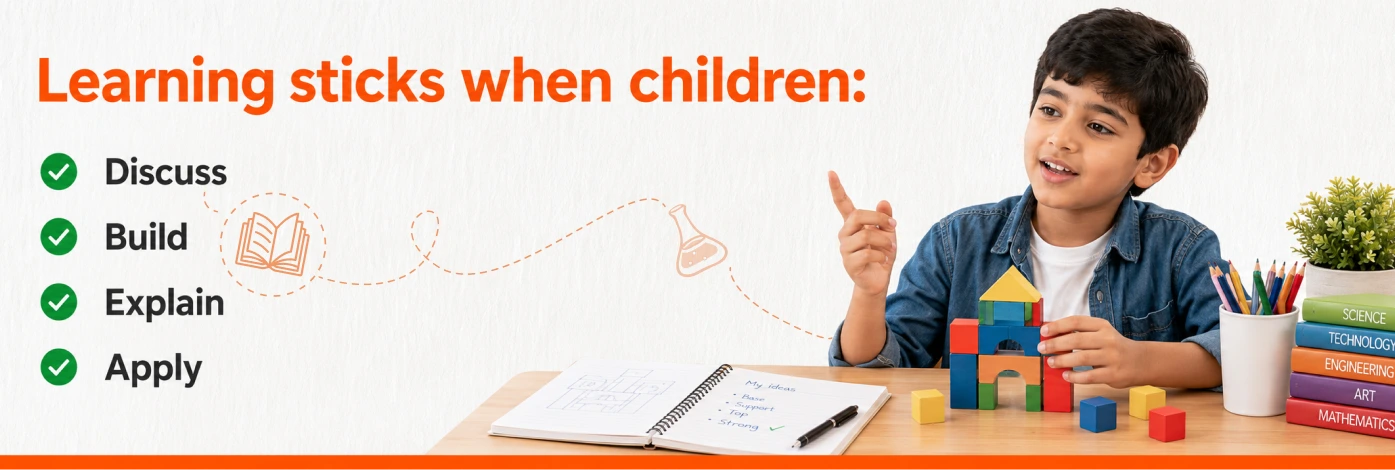
Decades of cognitive science research, summarised most accessibly in the work of researchers like John Hattie and Graham Nuthall, consistently shows that passive reception of information produces shallow encoding and rapid forgetting. The student who sits, listens, and attempts to retain what they have heard retains far less than the student who has to do something with the information, explain it, apply it, debate it, build with it. Open classrooms are designed around active engagement because active engagement is how learning actually sticks.
Children have different attentional needs at different moments
A classroom designed around a single configuration, everyone seated, facing forward, attending to the same thing, serves children well for exactly the proportion of their learning that benefits from whole-group instruction. Which is not all of it. Research on attention spans, learning styles, and the natural rhythm of cognitive engagement suggests that children need variation, moments of focused individual work, moments of collaborative discussion, moments of physical movement, moments of quiet reflection. A classroom that can accommodate all of these without requiring everyone to stop and reconfigure is a classroom that works with children’s natural learning rhythms rather than against them.
The physical environment communicates values
This is the point that is most often missed in conversations about classroom design. A room full of fixed rows facing a board communicates something to every child who walks into it: the knowledge lives up there, the teacher holds it, your job is to receive it. An open classroom communicates something different: the knowledge is built here, by the people in this room, and your participation in that process is essential. Children read these messages without being told them. And the message they receive shapes their relationship with learning in ways that persist far beyond any individual lesson.
Benefits of Open Classrooms for Students
They make collaboration the default
In a traditional classroom, collaboration requires a specific instruction, turn to your partner, work in groups. It is an interruption to the normal mode of operation.
In an open classroom, collaboration is simply how things work. The environment is designed for it. Children who have grown up in open classroom environments develop collaborative instincts, the habit of thinking together, of checking their understanding with peers, of offering and receiving feedback, that children from traditional classrooms frequently have to be explicitly taught, much later and with considerably more difficulty.
They develop self-direction
This is perhaps the most significant long-term benefit and the one most relevant to what children will actually need in the world they are growing into.
In a traditional classroom, the teacher directs. The child follows. The child’s job is to attend to what is being presented, to complete what is assigned, and to perform when assessed. The metacognitive work of managing one’s own learning, deciding what to work on, monitoring one’s own understanding, identifying what help is needed, is almost entirely handled by the adult.
In an open classroom, children are progressively given responsibility for these decisions. Not immediately, not without scaffolding, but deliberately and systematically across the school years. A child who has practised self-direction from an early age arrives at secondary school, university, and professional life with a capacity for independent learning that the traditionally schooled student frequently has to develop from scratch, often at a moment when the stakes are considerably higher.
They allow teachers to teach individuals, not rows
The most fundamental limitation of whole-class instruction is that it is designed for the average child in the room. The child who is ahead is underchallenged. The child who is behind is lost. The children at either end of the ability distribution are being systematically underserved by a model that targets the middle.
In an open classroom, the teacher who is moving through the space, rather than performing to the front of it, has constant access to information about where each child actually is in their learning. They can challenge the child who needs more, support the child who needs help, and leave the child who is deeply focused in the flow state that produces their best work. The instruction is responsive rather than broadcast.
This is not easier for the teacher. It is considerably more demanding. But it is more effective, which is the point.
They reduce the social cost of not knowing
In a traditional classroom, not knowing the answer is a public experience. You are called on, you do not know, and everyone in the room is aware of it. For many children, particularly those who are perfectionistic, anxious, or whose first language is not the language of instruction, this dynamic is genuinely inhibiting. They learn to stay quiet. They learn that not knowing is something to conceal rather than something to investigate.
In an open classroom, the social texture of learning is different. Questions are asked and received in smaller groups, in quieter conversations, in the one-to-one interaction between student and teacher. The experience of not knowing is more private, more comfortable, and more frequently followed by genuine help rather than social exposure.
Children who feel safe not knowing learn more. It is a straightforward connection and it is one that open classroom environments make considerably more available than traditional ones.
Common Misconceptions About Open Classrooms
Because the term is sometimes misunderstood, it is worth being explicit.
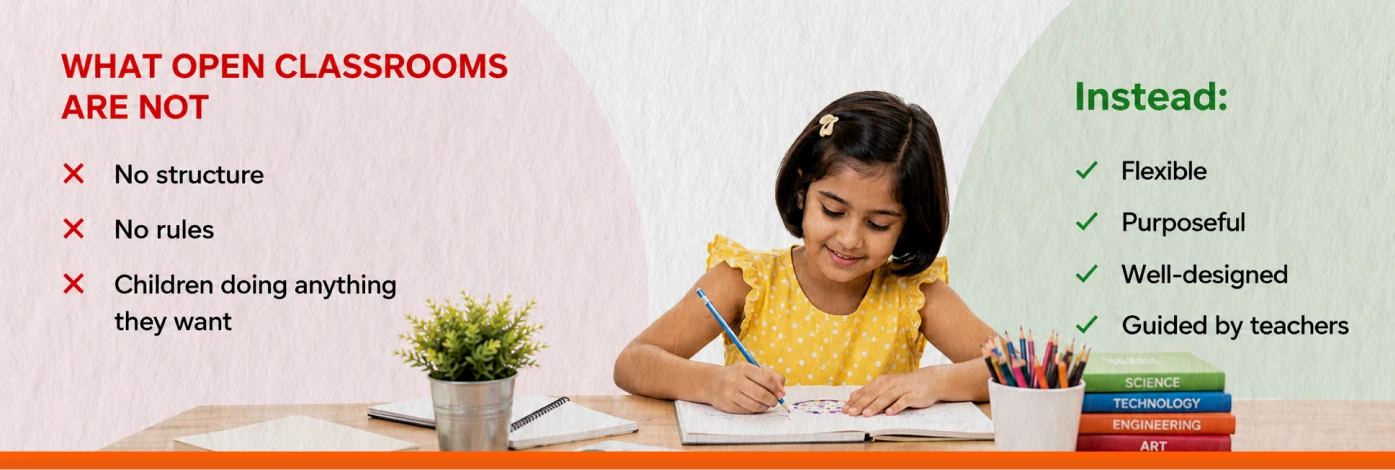
Open classrooms do not mean unstructured. The structure in a well-designed open classroom is real, it is simply less visible than a row of desks, because it is embedded in the environment, the routines, and the expectations rather than imposed through configuration. Children know where things are, what the expectations are, and what they are working toward. The structure is there. It has simply been designed to support rather than restrict.
Open classrooms do not mean the teacher is absent or passive. A teacher moving through an open classroom is doing some of the most sophisticated pedagogical work that teaching involves, reading each child’s progress, making rapid decisions about when to intervene and when to let a struggle continue, holding the whole room in awareness while attending to one child at a time. It demands more professional skill than delivering a uniform lesson to a silent room, not less.
Open classrooms do not mean every child does whatever they want. They mean every child is actively engaged in learning that is appropriate to where they are, which is a more ambitious and more demanding goal than ensuring every child is compliant with the same instruction.
How Aurinko Academy Uses Open Classrooms
At Aurinko Academy, the open classroom is not a design choice made for its visual appeal. It is the physical expression of a pedagogical commitment to project-based learning, student agency, the belief that children learn most deeply when they are active participants in their own education rather than its recipients.
Our learning spaces are designed to be reconfigured daily as the work demands. Our teachers are trained in the specific craft of facilitating rather than broadcasting, of moving through a learning environment, reading what is needed, and responding to it with precision and care. Our students are progressively taught to manage their own learning, to know what they are working on, why it matters, and what they need to move forward.
The open classroom works because learning works in a specific way: active, social, iterative, and deeply responsive to context. We build our environment around that understanding. Not because it is fashionable. Because it is accurate.
A Final Word
The classroom is not a neutral container. It is a statement of what a school believes about children, about learning, and about what education is for.
A room of fixed rows facing a board says: knowledge flows from the front. Your job is to receive it.
An open classroom says something different. It says: knowledge is built here, by the people in this room. Your curiosity, your questions, and your thinking are not interruptions to the learning. They are the learning.
That difference is not cosmetic. It shapes everything, how a child thinks about themselves as a learner, how they relate to difficulty, how they collaborate, and what kind of thinker they become over the years they spend inside it.