A parent opens a school bag and finds a painting, a worksheet, three photographs and a short note from a teacher. It is tempting to ask one simple question: how is my child doing? Yet none of those pieces answers it on its own. A neat page may show care. A finished model may show persistence. A comment beside a first draft may show something more important: a child learning to improve an idea.
This is the quiet difficulty of following a child’s learning. Marks can feel reassuring because they are compact. They also flatten a great deal. They rarely show where a child started, what was hard, which feedback they used, or whether they can explain their thinking. Parents do not need to reject marks to notice that limitation.
A learning portfolio can make that fuller picture visible. It gathers selected work over time, alongside observations, feedback and a child’s own reflection. The question is not whether the folder looks impressive. It is whether it helps adults and children see learning clearly enough to choose the next step.
What Is a Learning Portfolio?

A portfolio is a purposeful collection, not a storage box. It might hold an early attempt at a piece of writing, a later revision, photographs of a science investigation, a teacher note, and a child’s explanation of what changed. The relationship between the pieces matters more than the number of pieces.
Guidance from the Irish National Council for Curriculum and Assessment describes portfolios as evidence of progress that can include a child’s work, teacher comments and assessment against learning goals. A practical literacy guide from Western Australia makes a similar point: work samples collected across time help teachers and families see individual development rather than compare children with one another.
In plain terms: a portfolio should answer ‘what is this child learning, and what would help next?’ It is not a competition for polished products, a photograph album, or a substitute for every test.
| A collection of work | A learning portfolio |
| Keeps everything | Selects evidence for a purpose |
| Shows a finished product | Shows process, feedback and revision |
| Asks: “Is it good?” | Asks: “What changed, and why?” |
| Can be assembled by adults | Invites the child to explain their learning |
Why Are First Attempts and Mistakes Important in a Learning Portfolio?
Many children learn an unhelpful lesson early: the first answer should be the right answer. A portfolio can gently challenge that idea. When an early design sits beside a later version, the child can see that improvement is not evidence of failure. It is evidence of work.
This matters because reflection is the engine, not the decoration. Reviews of reflective portfolios in professional and higher education find that a collection alone does not guarantee reflection; the learning value depends on clear purpose, useful prompts and feedback. That limitation is helpful for parents to know. A glossy folder can still be empty of thinking.
The critical word in all of this is **evidence**. A portfolio should not ask a child to say ‘I worked hard’ in the abstract. It should invite a closer account: Which part did you change? What did the teacher suggest? What would you try differently?
A useful question for a portfolio conversation
Instead of “Why did you get this wrong?”, try “What did you notice when you compared these two attempts?” The second question keeps the focus on learning rather than judgement.
What Can Parents Learn From a Student Portfolio?
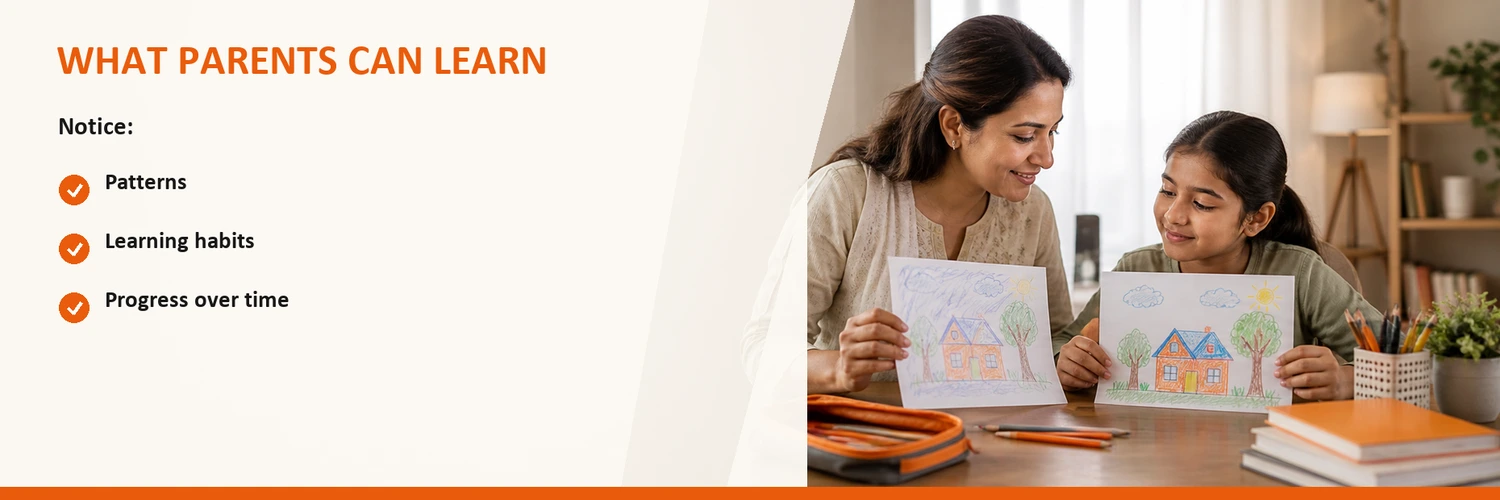
A good portfolio often reveals three things that a report card cannot show alone. First, it can reveal patterns. Your child may be confident when explaining an idea aloud but rush written work. They may begin cautiously and become absorbed once a task has a real audience. Patterns give parents and teachers something specific to discuss.
Second, it can reveal habits. Does your child use feedback? Can they persist through a difficult part? Do they plan before they start? These are not vague ‘soft skills’. They shape how children approach complex work in every subject.
Third, it can reveal progress in a way a single score cannot. An early reading response beside a newer one may show more precise vocabulary. A series of maths explanations may show that a child is moving from a method they copied to a method they can justify. The evidence can make growth concrete.
None of this means parents should inspect every page or turn every evening into a review meeting. The portfolio belongs to the child’s learning process. Your role is to be interested, not to become the editor.
When Does a Learning Portfolio Become Pressure?
| When a portfolio supports learning | When it becomes pressure |
| The child chooses and explains pieces | Adults select only the most flattering work |
| Feedback points to a next step | Feedback becomes a verdict |
| Early drafts are welcome | Only perfect work is displayed |
| Conversation is curious | Conversation becomes comparison |
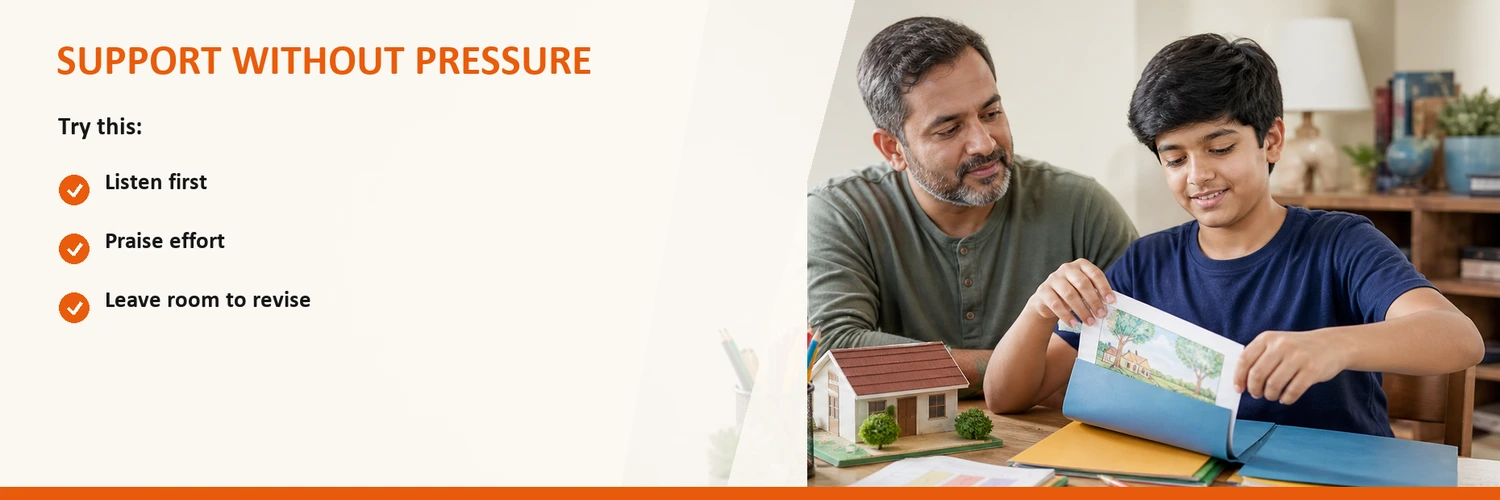
This is a central paradox: parents want evidence because they care deeply, but too much attention to presentation can make a child protect their image instead of take a risk. If a child believes every draft will be judged, they may choose safe work. If they believe a draft is a place to learn, they are more likely to attempt something difficult.
Recent discussion among parents often circles this anxiety. One parent described trying to build a strong academic foundation while worrying about pushing too early. That concern is reasonable. The answer is not to become less interested. It is to be interested in the process as much as the result.
What Should Parents Ask During a Portfolio Meeting?
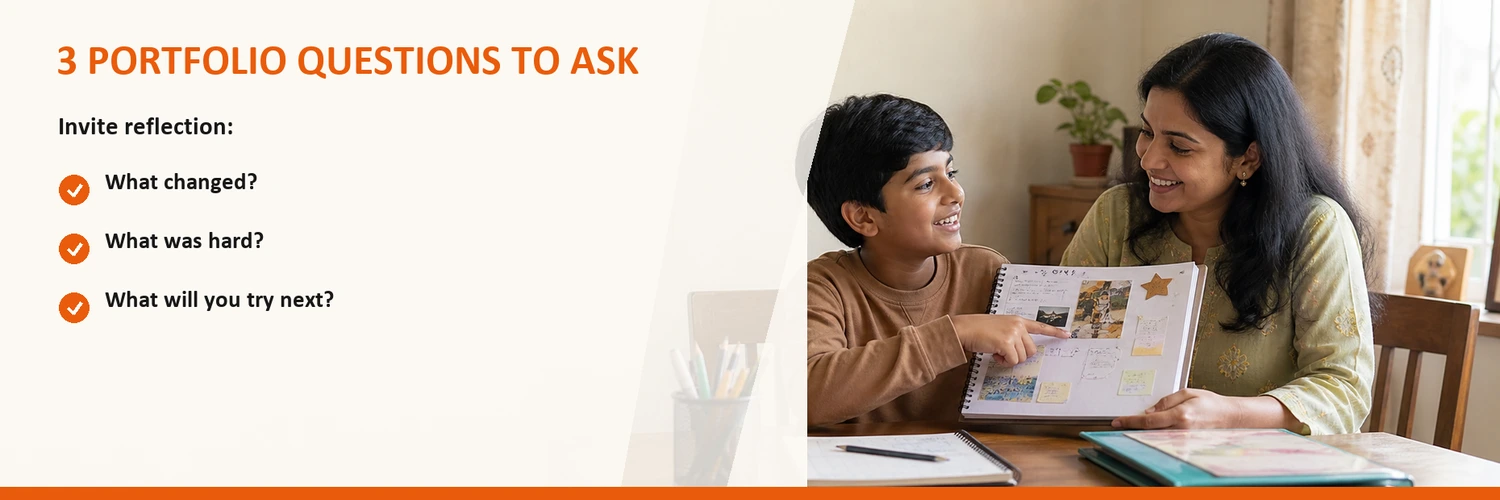
A portfolio meeting is most useful when it becomes a three-way conversation: child, teacher and parent. Begin with the child’s voice. Ask for one piece they are proud of, one that was difficult, and one they would change now. Listen before you interpret.
Then ask the teacher questions that look forward. What does this collection suggest about the child’s next learning goal? Which skill is becoming more secure? Where does the child need a different kind of support? Is there a gap between how the child understands something and how they show it?
Avoid treating a portfolio as proof that everything is fine. Its purpose is not reassurance at any cost. It should make strengths visible and make next steps clearer. That is more useful than a folder designed only to impress.
How Aurinko Academy thinks about learning portfolios
Aurinko Academy, a Cambridge International (IGCSE) school in Bangalore offering learning from Kindergarten to Grade 10, treats assessment as part of learning rather than a separate event at the end. The school’s educational framework describes assessment as an illustration of a child’s learning process and a guide for teaching, re-assessment and differentiation.
That philosophy fits a progressive classroom. In a carpentry studio, an early measurement choice, a revised plan and a finished object can each tell part of the story. In the clay modelling room or an inquiry project, a photograph may be useful only when it is paired with a child’s explanation: what was the problem, what changed, and what was learned?
Small classes make those conversations more possible. The aim is not to turn every activity into a display. It is to help each child become an increasingly accurate observer of their own work, while teachers and parents remain attentive partners.
Final Thoughts
A learning portfolio is not there to prove that your child is ahead. It is there to make their learning easier to see.
The early attempt, the changed idea and the work still in progress all matter. They show a child that growth is not something that happens between report cards. It happens in the small decisions they make when something feels difficult.
The most useful question is not, “Is this good enough?” It is, “What did you learn while making it?”