It often starts with too many tabs open. A parent searches for the best IGCSE school in Bangalore and finds rankings, school portals, fee pages, glossy campus photographs and confident claims. Each page appears to offer an answer. Yet the more a family reads, the harder the decision can feel.
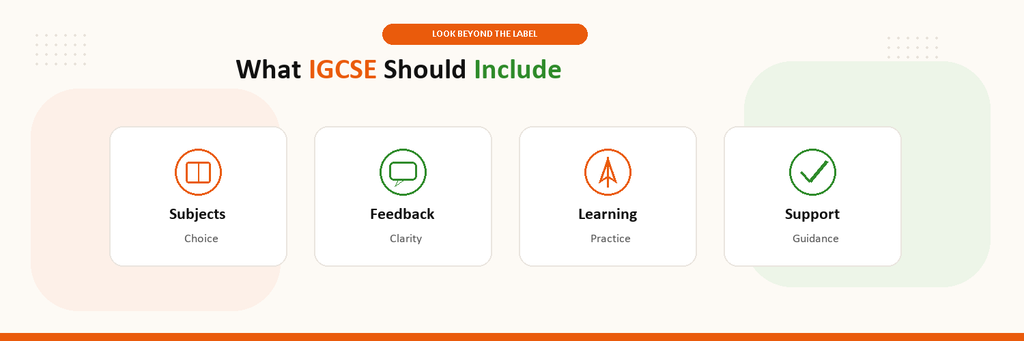
That is because a school choice is not really a search for the highest name on a list. It is a search for a place where your child can learn well, be known well and grow steadily over years. Two schools may both offer Cambridge IGCSE. They may still differ greatly in their teaching, feedback, class culture, learning support, subject choices and daily rhythm.
Parents also carry understandable questions that no ranking can settle: Will my child be prepared for serious exams? Will they be supported if they struggle? Is this curriculum right for our family’s future plans? How much does the journey matter? And how can we tell whether a progressive learning approach is rigorous in practice?
The most useful question is not ‘Which school is best on paper?’ It is ‘Which school offers the right conditions for my child to learn deeply and confidently?’ This guide helps you make that distinction.
What Should You Look for in an IGCSE School?
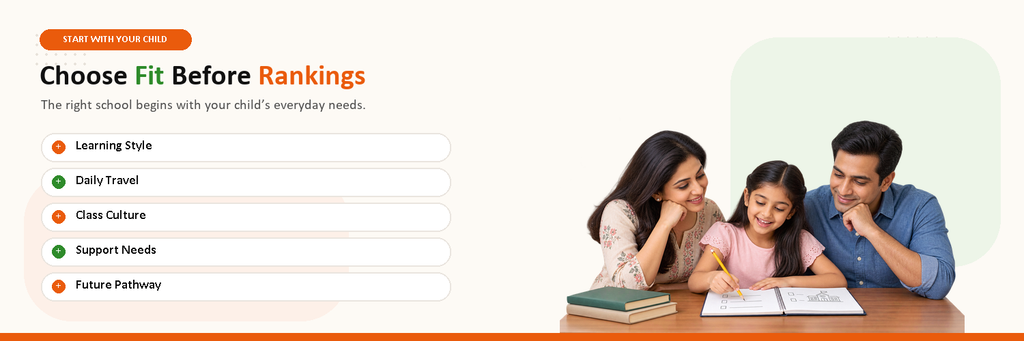
Before comparing schools, write down what your child needs now. A confident, highly social child may thrive in a large, busy setting. A child who needs time to speak, settle or process may need smaller groups and teachers who notice quieter forms of participation. Neither profile is better. They simply call for different conditions.
Think about the school day your child has had so far. When have they been most engaged? Is it during discussion, making, sport, reading, experiments, performance or structured practice? What tends to make school harder: noise, long travel, fast transitions, a fear of mistakes, or a lack of challenge? These observations are more useful than a generic checklist because they let you ask sharper questions on a school visit.
A strong school does not expect every child to respond in the same way. It has clear standards, but it also has ways to understand the learner in front of it.
What Is the Cambridge IGCSE Curriculum?
Cambridge IGCSE is an international qualification usually taken in the final two years of secondary school. Cambridge International explains that IGCSE combines subject knowledge with intellectual enquiry and offers more than 70 subjects across its wider programme. Assessment may include written papers, oral work, coursework and practical tasks, depending on the subject.
That flexibility is valuable, but it does not remove the need to investigate how a school uses it. Ask which subjects are actually offered at the school, how choices are guided, and whether the timetable permits the combinations your child may want. A brochure can describe the Cambridge framework accurately while leaving the everyday experience unclear.
The Cambridge pathway also has stages before IGCSE. Cambridge Primary and Lower Secondary are designed to build knowledge and learning habits over time. For a younger child, ask how the school develops reading, mathematical thinking, scientific curiosity and independence long before Grade 9. For an older child, ask how the school helps students move from guided learning to the more demanding IGCSE years.
Reassuring because Cambridge provides a clear framework and recognised qualifications. Challenging because the framework alone cannot tell you how thoughtful, responsive or well-supported the teaching will be. That is what your visit must uncover.
Should You Trust School Rankings When Choosing an IGCSE School?
| A ranking may tell you… | A school visit should help you discover… |
|---|---|
| The school appears in a popular list. | How teachers explain learning and respond to a child who is stuck. |
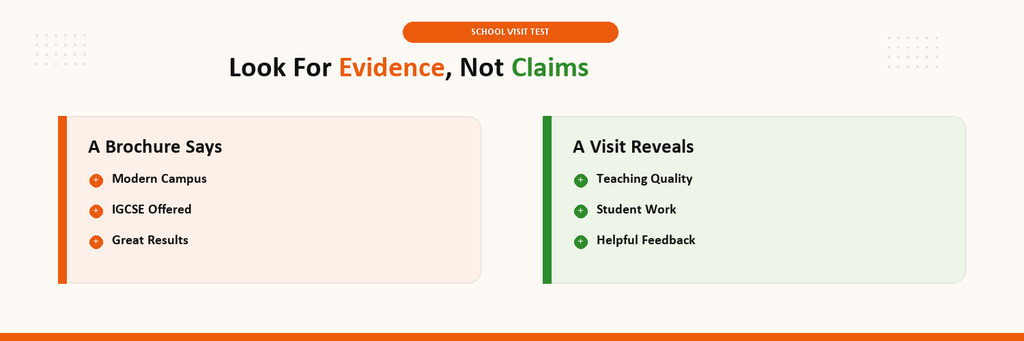
| The campus looks impressive. | Whether classrooms show children’s thinking, revision and meaningful work. |
| The school offers IGCSE. | Which subjects, assessments and pathways are genuinely available. |
| Fees are within your range. | What is included, how communication works and whether the daily routine is sustainable. |
| Parents have posted positive reviews. | How the school handles disagreement, learning support and transitions. |
A ranking is a starting point, not a verdict. It may use criteria that matter to some families but not yours. It may reward facilities, marketing visibility, results data or parent reviews, while giving little weight to classroom culture. None of those measures tells you how your child will feel at 10.30 on a difficult Tuesday morning.
Instead, ask for evidence. Can the school show you examples of student work over time? Can a teacher explain how feedback is given? Can they describe what happens when a child is doing well in one subject but losing confidence in another? A school does not need perfect answers. It does need specific ones.
How Can You Tell if an IGCSE School Has Good Teaching?
Many schools now use the language of inquiry, projects and critical thinking. These can be meaningful practices, but only when children are also taught the knowledge and skills needed to think with confidence. India’s National Education Policy 2020 calls for core concepts, critical thinking, inquiry, discussion, analysis and experiential learning. It is not an argument for less learning. It is an argument for learning that goes beyond memorising disconnected facts.
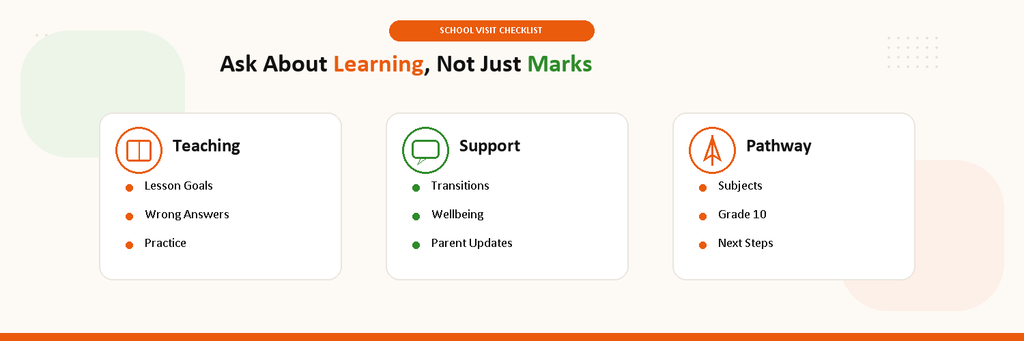
Ask to observe, if the school permits it, or ask teachers to describe a recent lesson. What was the learning goal? How did pupils practise? What counted as evidence of understanding? How did the teacher know who needed another explanation? Concrete answers matter more than fashionable language.
A rigorous progressive classroom still teaches carefully. Children may investigate a question, build a model, debate an idea or complete a project. They should also learn subject vocabulary, practise core skills, receive feedback and revisit misconceptions. The named paradox is this: good experiential learning is often more demanding than a worksheet because children must make choices, explain their reasoning and improve their work.
Does Progressive Education Still Provide Academic Rigour?
Families sometimes worry that a child-centred school will not prepare students for assessment. The better question is whether assessment is used only to sort children or also to help them improve. Cambridge IGCSE has end-of-course assessment, and in some subjects schools can choose different assessment forms or tiers. Preparation matters. So does the feedback before the final examination.
Ask how often teachers assess understanding informally and formally. What do progress reports show? Do they merely list scores, or do they explain next steps? Are students taught how to revise, self-check and use feedback? Cambridge’s learner guidance materials use examples of candidate work to help students understand different levels of performance. A strong school should make that kind of clarity part of the learning process, not save it for a result day.
For younger children, look for assessments that show development across time: writing samples, mathematical reasoning, projects, reading records and teacher observations. A single score cannot capture the whole child, but vague reassurance is not enough either. You want a school that can make progress visible.
How Should an IGCSE School Assess Student Progress?
A useful admission question: “When a child is struggling, what happens in the first two weeks, the first term and after that?” Listen for a sequence of observation, communication, targeted support and review.
Every child will find some part of school difficult. The quality of a school often becomes clearest at that point. Ask what learning support looks like, who coordinates it, how teachers communicate concerns and how parents are included without being made to feel blamed.
Support is not only for a formal diagnosis. It can include a child who is new to English, a learner returning from another board, someone whose confidence has fallen after a poor term, or a child who needs more stretch. Ask how the school makes transitions into a new class or curriculum manageable. If you are moving from CBSE, ICSE or another international system, ask for an honest account of the adjustment period.
Also ask about wellbeing in ordinary language. Who does a child speak to after a difficult friendship issue? How are routines taught to new pupils? How does the school balance expectations with rest, play and activities? Academic success is easier to sustain when a child feels safe enough to ask for help.
What Questions Should You Ask During an IGCSE School Visit?
“What would a typical lesson look like for my child’s age?”
“How do teachers respond when a child gives a wrong answer?”
“Can you show us an example of feedback a student might receive?”
“Which IGCSE subjects do students currently take, and how are choices made?”
“How do you support a child joining from a different curriculum?”
“How are parents kept informed about progress, concerns and next steps?”
“What does a successful first year here look like beyond marks?”
Notice what happens between the formal moments. How do adults speak to children in corridors? Do pupils look comfortable asking questions? Is work displayed only when it is polished, or can you see drafts, models and learning in progress? These are not superficial details. They reveal what a community treats as normal.
Travel deserves the same seriousness as curriculum. A long, unpredictable journey can affect sleep, friendships, family routines and a child’s ability to enjoy after-school interests. Bangalore traffic makes this a real part of school fit. Test the route at the time your child would travel, and ask about transport, arrival routines and the practical rhythm of the day.
What Questions Should You Ask During an IGCSE School Visit?
For Kindergarten and primary children, prioritise belonging, warmth, play, language-rich classrooms and the foundations of literacy and numeracy. Ask how the school uses materials, movement, discussion and outdoor spaces. A five-year-old does not need an admissions plan for university. They need a secure start that makes learning feel possible.
For middle-school children, ask about challenge, friendships, executive skills and growing independence. This is often the stage where a child begins to compare themselves with peers. Find out how teachers help students organise work, use feedback and communicate when something is difficult.
For learners approaching IGCSE, ask detailed questions about subject pathways, exam preparation, past performance data where it is appropriately shared, and options after Grade 10. Do not assume all Cambridge schools offer the same journey beyond IGCSE. Make sure the school is transparent about what it offers and how it helps families plan the next transition.
How Aurinko Academy Thinks About School Fit
Aurinko Academy, a Cambridge International (IGCSE) school in Bangalore offering learning from Kindergarten to Grade 10, approaches school choice as a relationship rather than a sales decision. The important question is whether the way a school teaches will help a particular child become more capable, curious and self-directed over time.
At Aurinko, progressive learning is grounded in real experiences: children make, discuss, test and revise ideas. Spaces such as the carpentry studio, clay modelling room, art areas and gardens are part of the learning environment, not decorative extras. A child can meet ideas through materials, collaboration and reflection as well as through books and direct instruction.
That does not mean avoiding academic rigour. Cambridge learning expects children to develop knowledge, understanding and the ability to apply ideas. The work of the teacher is to make that journey visible, guide children through challenge and help them grow into learners who can explain their thinking.
Final Thoughts
The best IGCSE school in Bangalore for your child may not be the one with the loudest claims, the newest building or the highest position on a list. It will be the school whose curriculum, teaching, support and daily life make sense for the learner your child is now, while giving them room to become someone more independent later.
Visit with questions. Ask for examples. Take your child’s response seriously. Then give yourself permission to choose a school not because it promises a perfect future, but because it shows you how it will meet the real child in front of you.