Walk into most schools and the age-sorting is immediate and total.
Every child born between two specific dates is placed with every other child born between those same dates. They move through the building together, year after year, progressing as a unit regardless of where any individual among them actually is in their development. The assumption is so deeply embedded in how we organise schools that most people have never thought to question it.
It is worth questioning.
Because outside of school, children have never learned this way. For the overwhelming majority of human history and in every traditional community that exists today, children learned in mixed-age groups. Older children taught younger ones. Younger ones watched and emulated older ones. Knowledge moved through a community rather than being dispensed in age-sorted batches by a designated adult.
The research that has emerged over the last four decades on mixed-age learning is not tentative. It is consistent, substantial, and points in one direction. Children who learn in thoughtfully designed mixed-age environments develop stronger academically, socially, and emotionally than children in rigid same-age cohorts.
This is what those findings actually say and why Aurinko Academy has built its learning environment around them.
What Is Mixed-Age Learning?
Before the research, a definition, because mixed-age learning is sometimes confused with simply putting different grades in the same room and hoping for the best.
Genuine mixed-age learning is a deliberate pedagogical design. It places children across a two to three year age range in the same learning environment, and structures activities, projects, and interactions in ways that intentionally leverage the developmental diversity of the group. Older children are given genuine opportunities to teach and mentor. Younger children are given consistent exposure to more advanced thinking, language, and behaviour. The curriculum is designed to be accessed at multiple levels simultaneously.
This is different from a combined class born of necessity, two year groups together because there are not enough students to fill separate rooms. It is different from occasional paired activities between grades. It is a coherent approach to learning that treats age diversity as a feature rather than a logistical problem.
The distinction matters because the benefits of mixed-age learning are not accidental. They are produced by specific dynamics that only occur when the environment is designed for them.
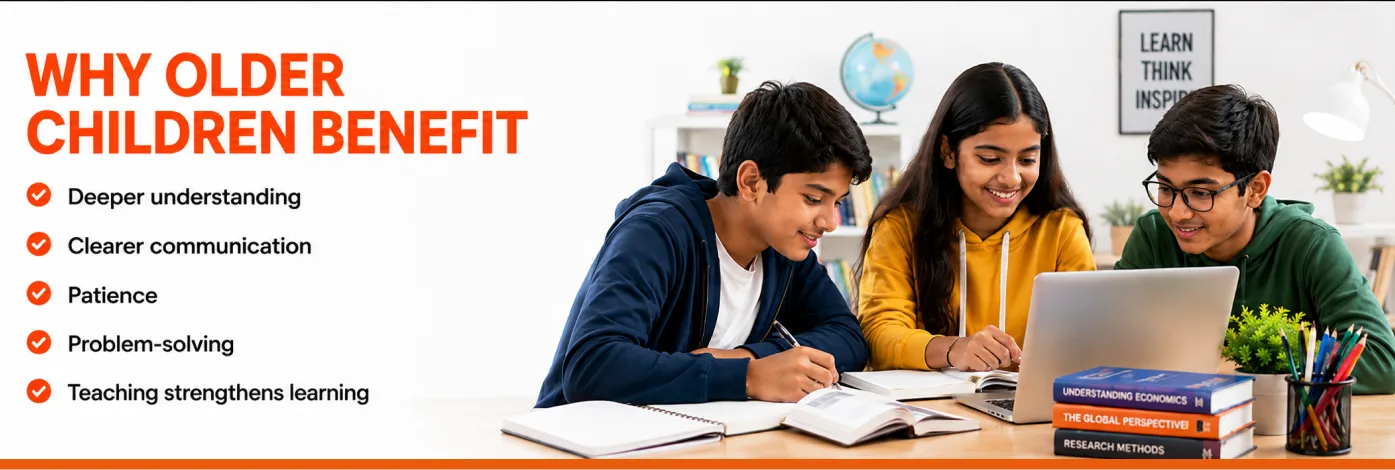
What Happens When Older Children Teach
The most counterintuitive finding in the mixed-age learning literature is also the most robust: the children who benefit most from mixed-age arrangements are frequently not the younger ones. They are the older ones.
The research on peer tutoring, the practice of an older or more advanced student teaching a concept to a younger or less advanced one, consistently shows that teaching something produces deeper learning in the teacher than receiving instruction produces in the learner. This phenomenon is sometimes called the protégé effect, and its mechanism is well understood.
When a child must explain something to another child, they cannot rely on surface familiarity with the material. They have to understand it well enough to translate it. To find an analogy. To answer a question they did not anticipate. To notice the moment when their explanation is not landing and try a different approach. Every one of these demands activates a level of cognitive processing that passive receiving of information simply does not reach.
A child who thinks they understand something discovers, the moment they try to teach it, exactly what they do and do not genuinely know. The gaps that a test might not reveal are immediately visible when a younger child asks but why? and the older child realises they cannot answer.
This is one of the most powerful learning mechanisms available in any educational setting. Mixed-age classrooms make it available constantly, naturally, and without the artificiality of adult-directed peer tutoring sessions.
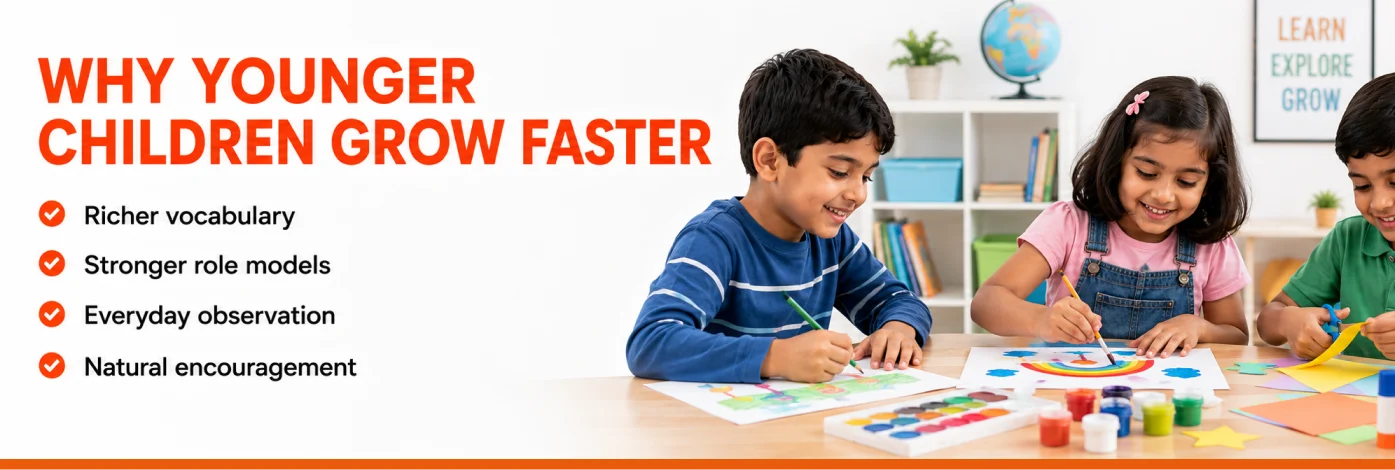
What Happens to Younger Children
For younger learners, the effects are different but equally significant.
The concept that explains much of what happens comes from Vygotsky’s Zone of Proximal Development, the observation that children learn most effectively when they are working just beyond what they can do independently, with support from someone more capable. In a conventional classroom, that support comes almost exclusively from the teacher. In a mixed-age environment, it comes from everywhere.
A five-year-old working alongside a seven-year-old is in a continuous, low-pressure Zone of Proximal Development. They hear vocabulary they have not yet mastered. They watch problem-solving approaches they have not yet developed. They see what reading fluency looks like before they have achieved it. They observe the older child navigate frustration and persist and they absorb that model without being explicitly taught it.
This ambient learning, the learning that happens simply by being in an environment with people who are slightly further along, is one of the least quantifiable and most powerful forms of development available to young children. It is exactly what younger siblings in large families have always benefited from. Mixed-age classrooms make it available to every child, not only those fortunate enough to have older brothers and sisters.
Research consistently shows that younger children in mixed-age settings develop language skills faster, demonstrate stronger numeracy earlier, and show significantly better social skills than peers in same-age classrooms. The exposure to older models accelerates development across every domain.
How Mixed-Age Classrooms Improve Social and Emotional Development
Human beings do not naturally spend their social lives exclusively with people born in the same twelve-month window. This is a school-specific, historically recent, and developmentally unusual arrangement. And it produces social skills that are, in important ways, incomplete.
A child who has only ever navigated social relationships with age-peers has learned to negotiate with equals. This is a genuinely important skill. But it is not the only social skill that adult life requires.
Adults routinely need to navigate relationships with people who know more than they do, and with people who know less. They need to ask for help without shame, and offer help without condescension. They need to mentor without losing patience, and be mentored without losing dignity. They need to find value in conversations with people at very different life stages.
Mixed-age learning develops all of these capabilities directly and naturally. An eight-year-old who has spent three years working alongside five and six year olds knows how to explain things clearly and patiently. They have had to. A five-year-old who has spent a year watching ten-year-olds work has a model for what older, more capable behaviour looks like and a path toward it that is visible and concrete rather than abstract.
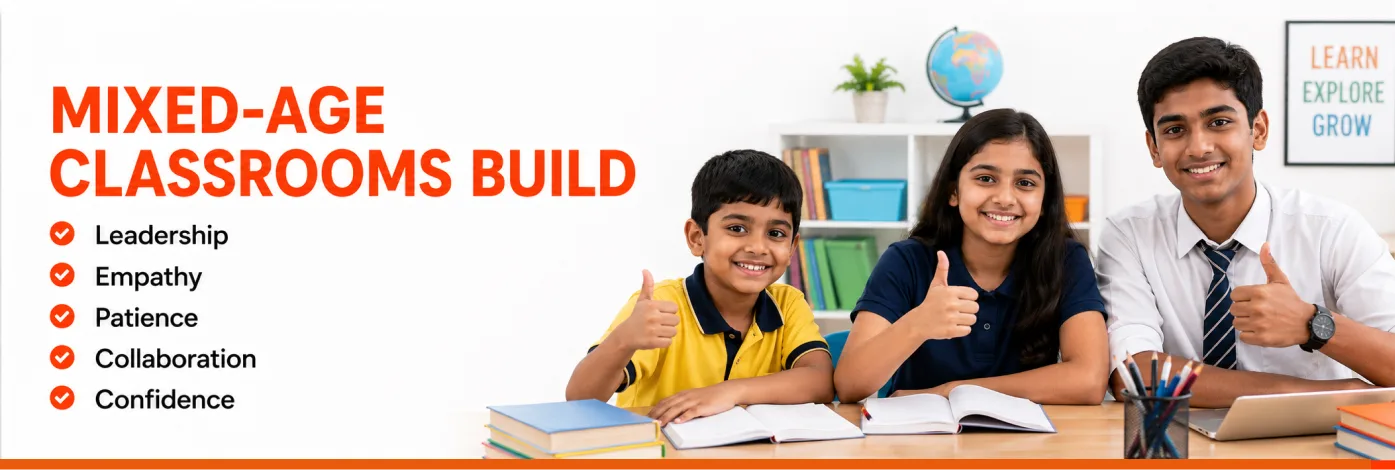
The social vocabulary that mixed-age learning builds leadership, mentorship, humility, patience, genuine collaboration across differences, is one of the most consistently reported benefits in the research. And it is one of the capabilities that employers, universities, and every person who has to work with other people will spend the rest of their life drawing on.
What Happens to Competition and Why That Matters
One of the least-discussed benefits of mixed-age learning is what it does to the comparison dynamic that dominates same-age classrooms.
In a class of thirty children who are all the same age, comparison is constant and largely unavoidable. Who finished first. Who got the highest mark. Who the teacher praised. Who is struggling with the thing everyone else seems to find easy. This comparison is not malicious, it is a natural human tendency activated by similarity. We compare ourselves most intensely to people who are most like us.
In a mixed-age environment, this dynamic shifts. A six-year-old does not compare themselves to a nine-year-old in the same way they compare themselves to another six-year-old, because the difference in capability is understood to be a function of age rather than a measure of relative intelligence or worth. The nine-year-old is further along because they have had longer, not because they are fundamentally more capable.
This reframing has a significant effect on how children relate to their own development. Research consistently shows that children in mixed-age settings demonstrate higher academic self-concept, a more positive sense of their own capability as learners than children in same-age classrooms, particularly for children who are near the bottom of the ability range in a same-age cohort. The child who would be the least able in a Year 3 class is simply the youngest in a multi-age group and that framing changes everything about how they approach learning.
Leadership as a Developmental Stage
In a conventional school, leadership opportunities are typically reserved for the oldest, the most academically accomplished, or the most socially confident. Leadership is something that a select few children are given, rather than something that all children develop through.
Mixed-age learning changes this structurally. Every child, at some point in their time in the group, is the oldest. Every child becomes the person the younger ones watch, ask questions of, and look to as a model. Leadership is not assigned, it arrives naturally as children move through the age range of the group.
This matters because leadership is not a personality trait. It is a set of skills, communication, responsibility, the capacity to see another person’s perspective, the ability to manage one’s own frustration while supporting someone else, that are built through practice. A child who has had genuine, regular, low-stakes practice at leading younger peers arrives in adolescence and adulthood with leadership experience that is real rather than decorative.
The Teacher’s Role in a Mixed-Age Classroom
Teaching a mixed-age group is demanding in specific ways that are worth being honest about.
A teacher who is skilled at delivering the same content to thirty students at the same stage is not automatically skilled at designing learning experiences that are simultaneously accessible to a five-year-old and challenging to an eight-year-old. The pedagogical demands are genuinely different.
What mixed-age teaching requires is a deeper understanding of each individual child — their current level, their next step, their particular way of engaging with difficulty — and the ability to design experiences that are open-ended enough to be meaningful at multiple levels simultaneously. It requires assessment that is observational and continuous rather than periodic and standardised. It requires a classroom culture of collaboration rather than competition, which does not emerge automatically but must be built deliberately.
The teachers who do this well produce something that highly structured same-age teaching rarely achieves: a classroom where every child is simultaneously a learner and a teacher, where capability is distributed across the group rather than residing exclusively in the adult at the front, and where the support a child needs at any given moment is available from multiple sources rather than one.
What Research Says About Mixed-Age Learning
Across four decades of studies in Montessori settings, in multi-grade rural schools, in progressive urban environments, and in controlled experimental comparisons, the findings on mixed-age learning are remarkably consistent.
Children in mixed-age settings demonstrate stronger academic performance in literacy and numeracy by the end of primary school. They show higher levels of prosocial behaviour, helping, sharing, including. They demonstrate greater academic self-confidence. They show lower levels of anxiety about school. They develop stronger perspective-taking ability. They are more likely to seek help when they need it and more willing to offer it when others do.
None of these outcomes happen automatically. They are the product of environments that are thoughtfully designed, well-facilitated, and genuinely committed to the principle that age diversity in a learning community is a resource rather than a problem.
How Aurinko Academy Puts This Into Practice
At Aurinko Academy, mixed-age learning is not an experiment. It is the structure within which our project-based curriculum operates and it is one of the things that makes that curriculum work.
Our project groups are deliberately composed across age ranges. The older students in a group are expected to take genuine mentorship responsibility, not to do the younger students’ work for them, but to explain, to model, to ask questions that extend thinking rather than giving answers. The younger students are expected to contribute genuinely rather than observe passively. The projects are designed to require exactly this: tasks that can be approached at different levels of sophistication, questions that do not have a single right answer, problems that benefit from multiple perspectives.
We have watched children arrive in our classrooms, children who in a conventional school might have been categorised as behind, or as ahead, or as difficult and find themselves in a learning community where those categories simply do not apply. Where being younger is not a disadvantage. Where being further along is a responsibility. Where every person in the room has something to offer and every person in the room has something to learn.
That environment does not emerge from age-sorting. It emerges from its deliberate opposite.
Come and watch our mixed-age classrooms at work. Visit Aurinko Academy and see what learning looks like when the age range is the point.