There is a question parents almost never ask when they are choosing a school.
They ask about the curriculum. They ask about the fees. They ask about ratings or board exam results or the ratio of students who make it to good universities. They ask about facilities, about extracurricular offerings, about the quality of the science lab and whether there is a swimming pool. They read reviews. They attend open days. They compare spreadsheets.
What they rarely ask, at least not with the seriousness they bring to the other questions, is this: will my child want to be here?
Not will my child do well here. Not will my child be safe here. Those are important questions and they deserve serious answers. But underneath both of them, prior to both of them, is a question that shapes everything else: will my child wake up on a Monday morning and feel something other than dread about the day ahead?
Because here is what the research says, and what experienced educators know from watching children across thousands of school days: a child who wants to go to school learns more, retains more, builds stronger relationships, develops greater resilience, and emerges from their education with a relationship with learning that serves them for the rest of their life. And a child who is enduring school, who is present in body but absent in spirit, who is managing rather than thriving, who has learned to survive the experience rather than inhabit it, loses something in those years that is genuinely difficult to recover.
School happiness is not a soft metric. It is the metric. And it is the one most parents systematically underweight when making one of the most consequential decisions of their child’s life.
Why School Happiness Matters More Than Most Parents Realise
Before anything else, a definition, because school happiness is not the same as school ease, and confusing the two is one of the most common parenting mistakes in education.
A happy child at school is not a child who finds everything effortless. It is not a child who never struggles, never feels frustrated, never comes home exhausted. Genuine happiness at school includes difficulty, the productive difficulty of a problem that requires real thinking, the social friction of learning to navigate a community of peers, the discomfort of being challenged to do something better than you did it last time.
What school happiness means is that underneath the ordinary ups and downs of academic and social life, a child has a stable, positive relationship with the experience of being at school. They feel known by the adults around them. They feel safe enough to try things and fail at them. They are curious about what comes next. They have something at school, a friendship, a subject, a project, a teacher, a corner of the building they love that makes the place feel like theirs.
The opposite of school happiness is not school difficulty. It is school alienation. The child who has concluded, somewhere beneath the level of words, that school is something happening to them rather than something they are part of. That their presence is required but their personhood is not. That the measure of their worth in that environment is their performance, and that their performance is never quite enough.
That child may still produce reasonable grades. They may still, externally, look fine. But they are paying a cost that the report card will never show, in confidence, in curiosity, in the quiet erosion of their belief that learning is something they are genuinely capable of and interested in.
Why Parents Often Choose Schools Using the Wrong Metrics
The school choice conversation in most cities and Bangalore is no exception, has been almost entirely colonised by metrics that are measurable, comparable, and fundamentally incomplete.
Board results and ratings are measurable. Fee structures are comparable. University placement rates are comparable. These things are not irrelevant, a school that consistently produces poor academic outcomes is not serving its students well, and parents are right to care about that. But they are measuring the outputs of education, not the experience of it. And the experience is both what produces the outputs and what persists long after the outputs are forgotten.
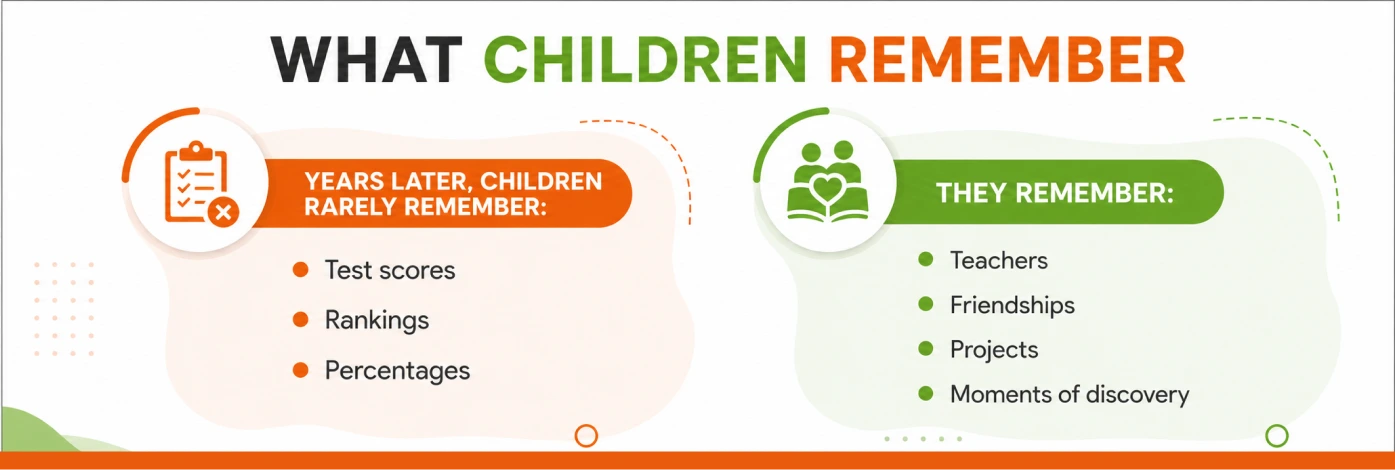
Consider what a child actually remembers from their school years. Not the exam results, those fade quickly into a general impression of having done reasonably well or not. What they remember is the teacher who saw something in them that nobody else had noticed. The project they worked on for three weeks turned into something they were genuinely proud of. The friendship that formed over a shared obsession with something no one else understood. The moment a subject they had written off suddenly opened up and made sense.
These memories are not incidental to education. They are education, the part of it that changes how a person thinks, what they believe about themselves, and what they are willing to attempt for the rest of their life.
A school that produces these experiences is producing something that no league table captures and no inspection framework fully measures. And the most reliable indicator that a school is producing them, more reliable than the prospectus, more reliable than the open day, more reliable than the ratings is whether the children inside it want to be there.
The Monday Morning Test: A Simple Way to Assess School Happiness
There is a simple, imperfect, surprisingly powerful diagnostic that parents can apply both when choosing a school and when evaluating the one their child already attends.
Watch your child on Sunday evening. Watch them on Monday morning.
A child who is genuinely thriving at school does not greet Monday with dread. They may prefer Saturday, most people do, but the arrival of the school week does not produce a sustained, physical response of reluctance. They eat breakfast. They get ready without the daily negotiation becoming a battle. There is some version of curiosity, or at least neutrality, about the day ahead.
A child who is surviving rather than thriving shows you something different. The Sunday evening that goes quiet and heavy. The Monday morning stomachache that resolves by mid-afternoon once the decision has been made. The persistent, specific reluctance that is not about laziness or tiredness but about something in the school environment that has become, for this child, a place of endurance rather than engagement.
The Monday morning test does not diagnose the problem. It signals that one exists. And that signal is worth taking more seriously than most parents do, because the instinct to normalise reluctance, to attribute it to ordinary childhood resistance to structure, to tell yourself it will improve, is one of the ways that small problems become entrenched ones.
What Happy Schools Do Differently
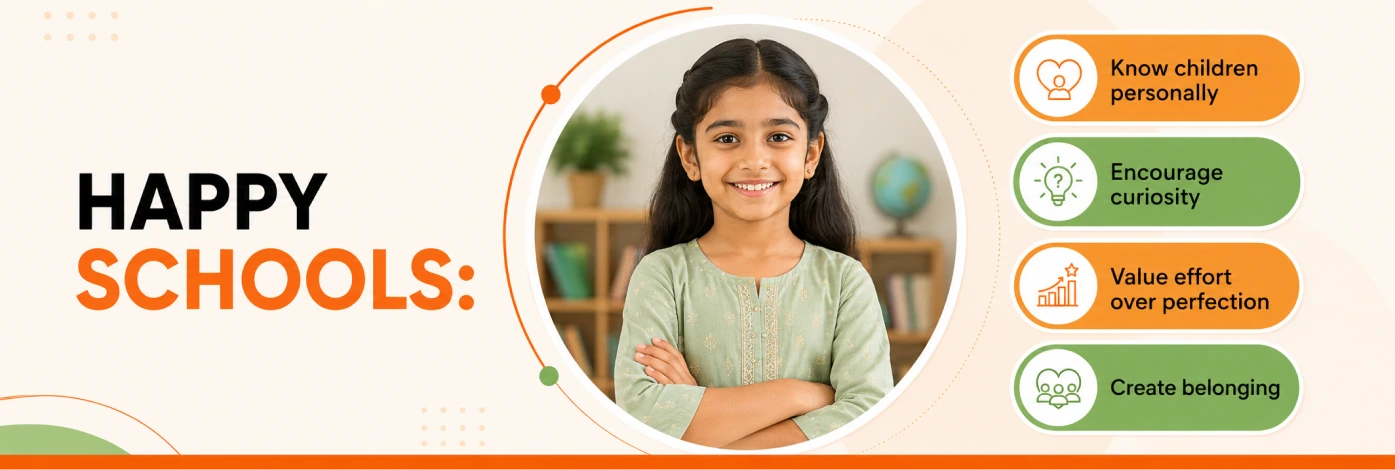
School happiness is not an accident. It is not a product of generous facilities or progressive marketing. It is a product of specific choices, about how teachers are trained, how classrooms are designed, how children are assessed, and what the school communicates to students about their own worth.
Happy schools know their students as individuals. Not as cohorts, not as data points, not as the aggregate of their test scores, as specific, particular people with specific, particular inner lives. The teacher who knows that this child is funny and self-conscious about it, that this one carries more responsibility at home than most adults realise, that this one has spent the last month working up the courage to try something they are afraid of, that teacher creates an environment where children feel seen. And children who feel seen at school want to be there.
Happy schools make space for genuine curiosity. They build curricula that ask children to wonder, to investigate, to follow a question somewhere unexpected, rather than curricula that ask children to receive information and return it accurately. There is a specific quality of engagement that arrives when a child is genuinely curious about something, a quality that no amount of external motivation produces and that no test pressure sustains. Schools that design for curiosity are designing for happiness, even if they do not use that word.
Happy schools allow children to be bad at things. This sounds simple and is actually radical. The school where it is safe to not know, to get it wrong publicly, to ask the question that reveals a gap in understanding that school is communicating something to every child in every room: your value here is not conditional on your performance. That communication, made consistently over years, produces a relationship with learning that is both more resilient and more joyful than the one produced by environments where performance is everything.
Happy schools take the social experience seriously. They understand that for a child, the quality of their friendships and social belonging at school is not separate from their academic experience, it is the container that the academic experience lives inside. A child who is lonely at school, or socially anxious, or navigating a peer environment that makes them feel consistently diminished, cannot learn well. Not because they are not trying, but because the brain under chronic social stress does not have full access to the cognitive resources that learning requires.
How to Identify a Happy School During a School Visit
Open days are curated. The classrooms are tidy, the children are on their best behaviour, and the tour guides are trained to show you the things that photograph well. None of this is dishonest, it is simply incomplete.
When you visit a school, look past the infrastructure and watch the children.
Watch a class that does not know it is being observed. Does the teacher seem like someone who genuinely enjoys being in that room with those particular children? Do the children seem absorbed, or managed? Is there evidence of genuine intellectual life, arguments in progress, work on the walls that is imperfect and individual and clearly theirs, questions being asked that did not come from the textbook?
Watch the corridors between lessons. Children between lessons, briefly unsupervised, show you the social culture of a school in a way that no classroom can. Is there ease and laughter? Or is there a low-level tension, a quality of watchfulness, a social hierarchy that you can feel without quite naming?
Ask the children you meet a question that requires a genuine answer. Not do you like it here?, which produces yes from every child in the presence of their teachers. But what is the most interesting thing you have done this term? or is there something you are working on right now that you are excited about? A child at a happy school will answer those questions with something specific. A child who is not will look uncertain, or glance at the teacher, or produce a general statement that sounds rehearsed.
What Parents Can Do After the Choice Is Made
Choosing a school is one moment. What happens every year after that choice is a continuous series of smaller choices, about how to talk about school at home, about what to communicate to a child about what school is for, about how to respond when the relationship with school becomes difficult.
The parent who talks about school primarily in terms of results, what did you get, how did you do, are you ahead, creates a child whose relationship with school is fundamentally performative. The parent who talks about school primarily in terms of experience, what did you find interesting, what was hard, what surprised you, who made you laugh, creates a child whose relationship with school is fundamentally engaged.
This is not a small distinction. It is one of the most significant ways a parent shapes their child’s inner life around education. And it is available to every parent, regardless of which school their child attends.
The happiest students at any school are not always the ones whose school experience is objectively the best. They are often the ones whose parents have consistently communicated, in a hundred small ways, that what they think about their learning matters more than what they produce from it.
Why Aurinko Academy Is Built Around This Idea
At Aurinko Academy, school happiness is not a marketing position. It is the organising principle behind how we design learning, how we train teachers, and how we make decisions about what belongs in our classrooms.
We believe that a child who wants to come to school is a child who is learning, not just retaining information, but genuinely growing in the ways that matter. Growing in curiosity. Growing in confidence. Growing in the ability to think, to collaborate, to face difficulty without collapsing, and to find meaning in the work they are doing every day.
Our project-based curriculum is designed to produce that wanting. Not through making school easier, but through making it feel purposeful. Not by removing difficulty, but by making difficulty feel worth it. The child who has spent three weeks on a project that genuinely mattered to them that connected to the real world, that required their full intelligence, that produced something they are proud enough to show a real audience, does not dread Monday morning. They have something to go back to.
This is what we are building. Not the school with the most impressive facilities, though our facilities are excellent. Not the school with the highest exam scores, though our students achieve strong results. The school where children wake up on Monday morning and feel, somewhere underneath the ordinary tiredness of a school day ahead, that there is something worth going back for.
That is the school Aurinko Academy is trying to be. Every single day.
Come and see whether your child would want to be here. Book a visit to Aurinko Academy and watch the children while you are with us. They will tell you more than we can.