You have made the decision. Or you are close to making it.
Something about your child’s current school is not working, not dramatically, not in a way that makes headlines, but in the quiet, persistent way that shows up at Sunday evenings and homework tables and in a child who has stopped asking questions they do not already know the answer to.
You have visited a progressive school and felt something shift. The classrooms looked different. The children looked different. Something about the way learning was happening made you think: this is what school should feel like.
And now you are wondering: what does the transition actually involve? How will my child adjust? What should I prepare them for and myself for?
This is that guide.
Why More Parents Are Switching to Progressive Schools
The move from a traditional school to a progressive one is not simply a change of building, uniform, or commute. It is a change of the entire relationship your child has with learning.
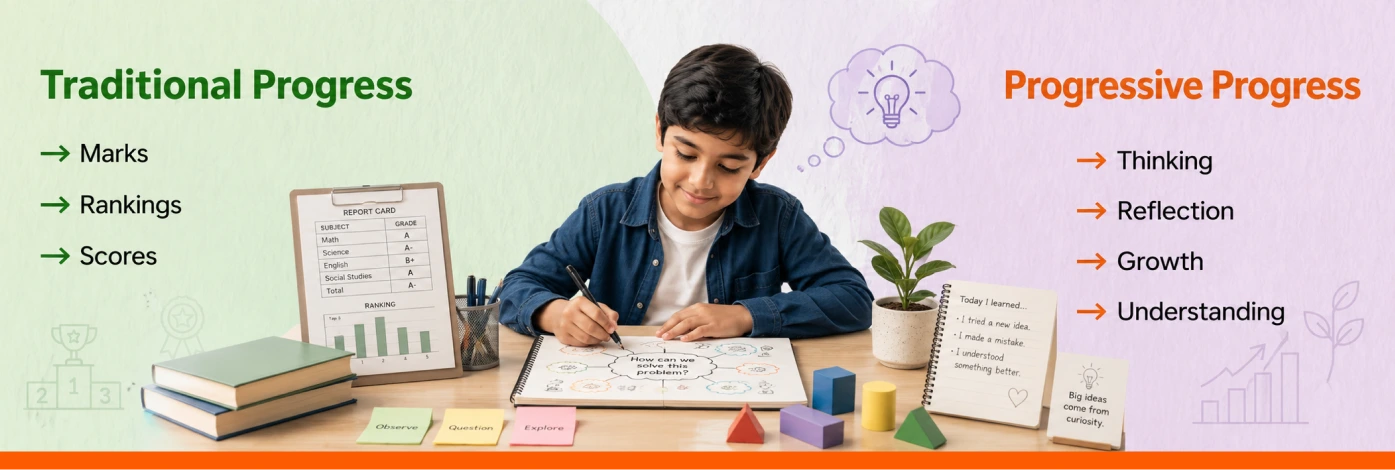
In a traditional school, the structure is clear. The teacher knows. The student receives. The work has the right answer. Progress is measured in marks. Your child has probably become quite good at this system, even if it has not made them love learning.
In a progressive school, particularly one built around project-based learning, like Aurinko Academy, the structure is different. Questions matter as much as answers. The student has genuine agency over how they demonstrate understanding. Assessment measures process, not just product. And the teacher’s role is to provoke thinking, not deliver content.
For a child who has spent years in one system, the other can feel disorienting at first. Not because it is harder, though it is, in different ways. But because the rules have changed, and nobody has handed them a new rulebook.
Understanding this is the most important preparation you can make.
What Really Changes When You Move to a Progressive School?
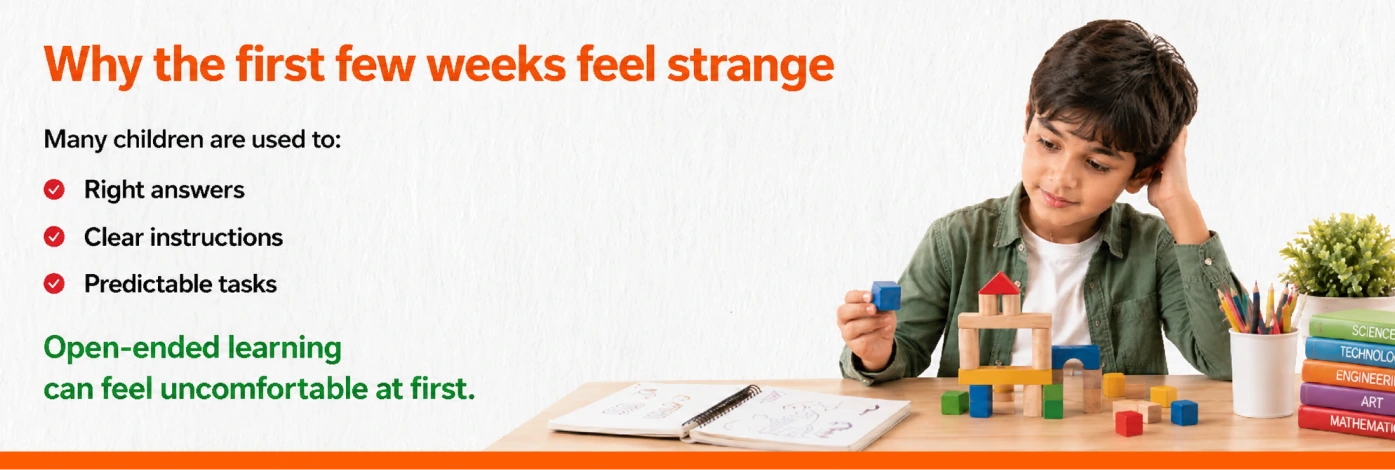
Disorientation is normal and temporary
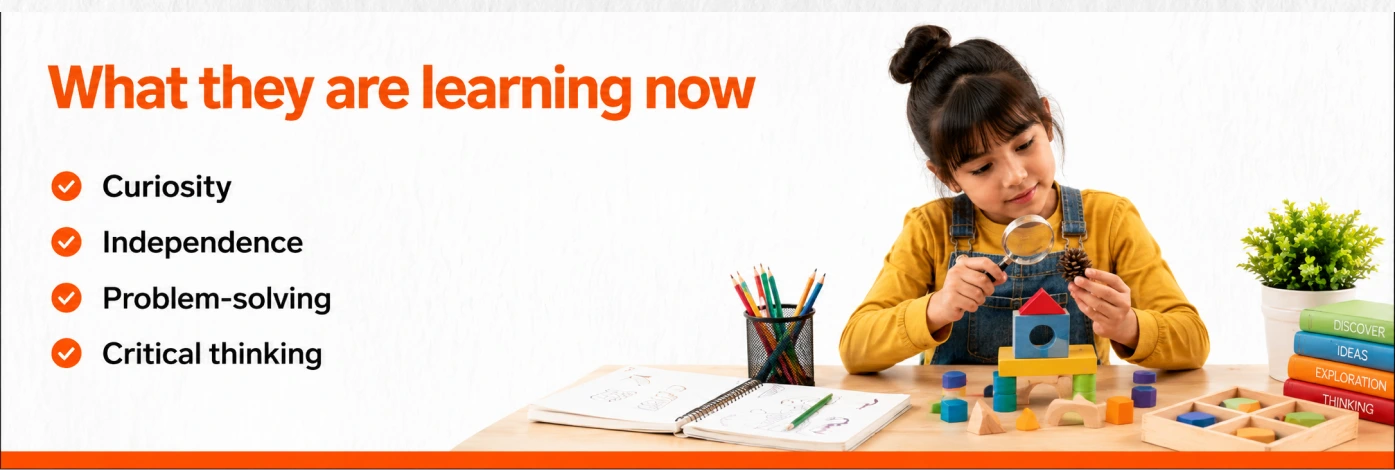
A child moving from a traditional to a progressive school often feels, in the first few weeks, that they are doing it wrong. They are looking for the worksheet. They are waiting to be told what the right answer is. They may find open-ended tasks frustrating in a way that surprises both of you.
This is not a sign that the school is wrong for them. It is a sign that they are recalibrating, adjusting from a mode of learning that rewards compliance to one that rewards curiosity. That recalibration takes time. Most children complete it within a term, sometimes faster.
They may feel temporarily less confident
A child who was a strong performer in their previous school, who knew how to play the game and played it well, can feel destabilised when the game changes. Grades were their feedback loop. Without that constant measurement, they may feel uncertain about how they are doing.
Reassure them that this uncertainty is normal. It is also, quietly, part of the education.
They may resist before they commit
Some children push back on progressive learning before they embrace it. Freedom feels uncomfortable. The lack of a single right answer feels like a trick. Watch for this not as stubbornness but as a child working out whether it is safe to invest.
When they do invest, when the first project captures their genuine interest, when they discover that their ideas are taken seriously, when they realise the teacher actually wants to know what they think, the shift is usually swift and significant.
What Parents Need to Adjust Too
Rethink what progress looks like
In a traditional school, progress is legible. Numbers on a page. A class rank. A percentage.
In a progressive school, progress is richer but less immediately readable. Your child might come home having spent three days investigating one question. They might not bring home a marked test for weeks. The portfolio of work they are building is deeper than a grade report, but it requires a different way of reading.
Ask the school to explain their assessment approach early. Understanding it removes the anxiety that comes from expecting one kind of feedback and receiving another.
Resist the urge to recreate the old system at home
Many parents, anxious about the transition, begin supplementing progressive school with traditional practice at home, drilling times tables, testing spellings, running through past papers. This is understandable. It is also, usually, counterproductive.
It sends a mixed message: school says explore, home says perform. Children pick up that contradiction immediately and it slows the adjustment rather than supporting it.
Trust the school’s approach for a full term before supplementing. If genuine concerns remain after that, bring them to the school directly.
Talk about learning differently
The question what did you get? has no good answer in a progressive school. Try what did you figure out today? or what question came up in your project that you hadn’t thought about before?
These are not just nicer questions. They are questions that reinforce the values of the new environment and help your child make sense of what they are doing there.
5 Practical Ways to Help Your Child Adjust to a New School
Visit before the first day
Familiarity reduces anxiety. If the school allows it, visit the classroom before term starts, let your child find their peg, meet one teacher, see the space when it is calm. The brain finds novelty less threatening when it has a prior map.
Find one anchor
One friend, one project strand, one teacher whose name they know before they arrive. A single point of connection makes the unfamiliar navigable.
Keep everything else stable
During the first term of any school transition, home should be the thing that does not change. Consistent routines, consistent mealtimes, consistent emotional availability from you. The more stable home is, the more capacity your child has for the adjustment happening at school.
Give it a full term before evaluating
A month is not enough. The first four weeks of a school transition are almost always the hardest, regardless of whether the change is right. Evaluate at the end of term one with the school’s input, not at the end of week three based on a difficult Monday.
Tell the school what you are seeing at home
If your child is anxious, unsettled, or struggling to articulate what is hard, say so. A progressive school genuinely wants this information. It changes how teachers support your child in the classroom, and it opens a conversation that would otherwise happen too late.
What Progressive Schools Should Do to Support New Students
The transition is not only the family’s responsibility. A school that understands progressive education also understands that children arriving from traditional backgrounds need specific support.
At Aurinko Academy, we build the first weeks of a new student’s experience around relationships before rigour. Before we challenge a child to think openly and independently, we make sure they feel known. We introduce them to the culture of inquiry gradually, starting with structured projects before moving to open-ended ones. We give them permission, explicitly and repeatedly, to not know the answer.
We also communicate with families consistently through the first term. Not just formal reports, but honest updates, what we are observing, what is shifting, what we think would help at home.
The partnership between school and family matters in every educational context. In a transition year, it is the difference between a child who adjusts and a child who does not.
The Long-Term Benefits of Moving to a Progressive School
There is a version of this transition that feels hard in October and is clearly right by March. A child who arrives anxious and performance-dependent and leaves the first year genuinely curious, genuinely proud of work they produced with their own ideas, genuinely excited about what comes next.
That transformation does not happen because the school is easy. It happens because the school is asking something different, something that takes longer to give, and means more when it arrives.
The child who learns to think for themselves, who discovers that difficulty is interesting rather than threatening, who builds something they are proud of rather than a grade they are relieved by, that child is being given something that no traditional metric will ever fully capture. It takes time to get there. It is worth the time.