It often arrives in the middle of an ordinary evening. A question takes longer than expected. Your child looks at the page, pushes the pencil away and says, ‘I am bad at maths.’ The sentence can feel larger than the homework itself. Parents want to rescue the moment, so we rush in with an answer, a correction or a promise that it will be fine.
Yet this is rarely only a question about one sum. It may be about feeling slow beside a classmate, remembering a difficult test, or fearing that one mistake proves something permanent. The child is asking, in effect, whether maths is a place where they belong.
That concern deserves a better response than either cheerleading or pressure. The aim is not to convince a child that maths is easy. It is to help them see that difficulty is information, not identity.
What to Do When Your Child Says “I’m Bad at Maths”
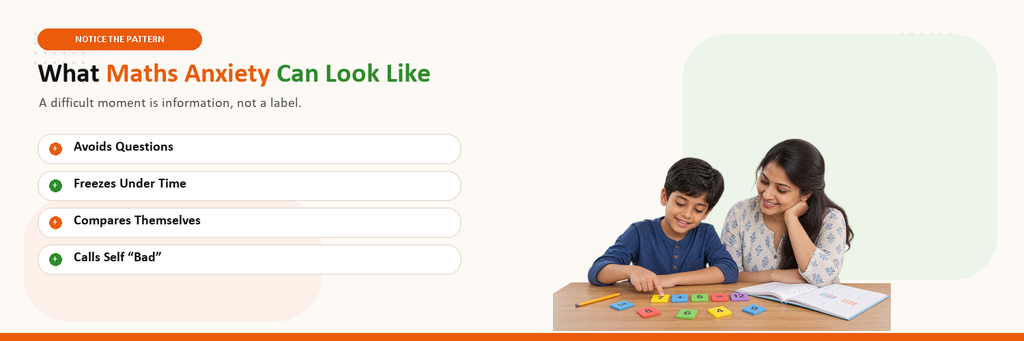
Maths anxiety is not the same as finding maths hard. A child may understand an idea and still freeze when asked to show it quickly. A 2026 review in Nature Reviews Psychology describes maths anxiety as an emotional response that can disrupt both performance and engagement, often emerging during the school years. It can become a loop: worry makes it harder to use working memory, a poor experience confirms the worry, and avoidance then reduces chances to practise.
The critical word in all of this is response. Your child notices the adult’s face, tone and pace. They hear whether a mistake is treated as evidence of carelessness or as a clue about what to try next. Research published in Child Development in 2022 found that parents who more often gave person-focused responses to maths success or failure had children with poorer later maths adjustment than parents who used process-focused responses.
In plain terms: ‘You are so clever’ and ‘You are not a maths person’ both make ability sound fixed. ‘Show me where it started to feel confusing’ keeps the door open. It is a small change in language, but it changes the job the child believes they have to do.
What to Say Instead of You Are Not Bad at Maths
| When you hear… | Try saying… |
|---|---|
| ‘I cannot do this.’ | ‘Which part makes sense already, and where does it stop making sense?’ |
| ‘I got it wrong again.’ | ‘Good, now we know which step needs another look.’ |
| ‘Everyone else is faster.’ | ‘Fast is not the same as finished. Let us make this one clear.’ |
| ‘I hate maths.’ | ‘Something about this feels unpleasant. Is it the question, the time limit or the fear of being wrong?’ |
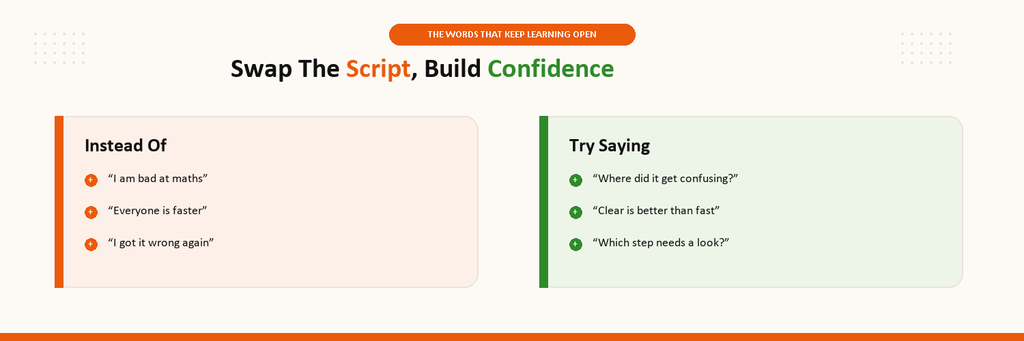
These phrases do not pretend that the work is easy. They slow the moment down and make it specific. A child can work with ‘I do not understand regrouping yet’. They cannot work with ‘I am bad at maths’ because it gives them no next move.
Avoid turning the moment into a speech about talent, future exams or how important maths will be. Those ideas may be true, but they are too heavy for a child who is stuck on one page. First help the child feel safe enough to think. Then help them find one manageable action.
3 Parent Reactions That Can Make Maths Anxiety Worse
1. Solving it too quickly – It comes from kindness. But if an adult takes over whenever frustration appears, the child learns that struggle is a signal to hand the thinking away. Sit beside them, ask what they have tried, and offer one prompt rather than the solution.
2. Making speed the measure – Timed facts and quick recall have a place, but speed is only one part of mathematical fluency. Cambridge Primary Mathematics describes learning that includes principles, patterns, systems, functions and relationships, alongside calculation. A child who needs time may be thinking carefully, not failing.
3. Sharing your own maths fear – ‘I was terrible at maths too’ can feel comforting. It can also sound like a family destiny. If maths made you anxious, name that honestly but add what you would do differently now: take breaks, use a diagram, ask a question, and practise one small skill.
How Can Parents Build Maths Confidence at Home?
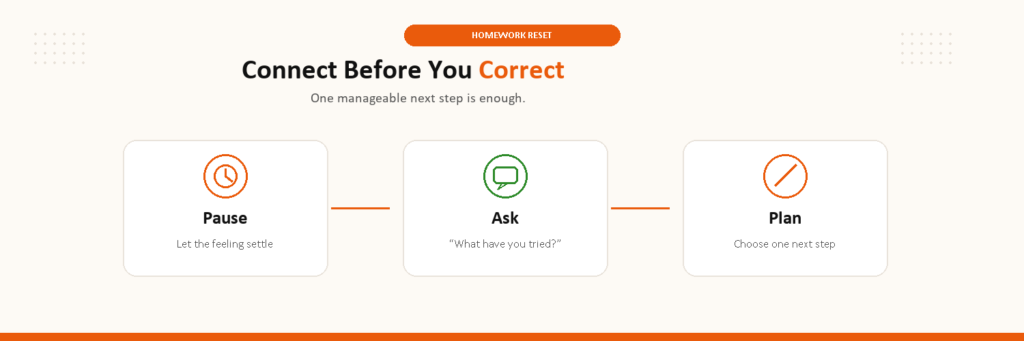
A useful rule: connect before you correct. Ask your child to explain their thinking before pointing out the answer. Their explanation often reveals the exact misconception, and it protects their sense of ownership.
A helpful maths homework routine is short and predictable. Begin by letting your child choose one question they feel ready to attempt. Ask them to read it aloud, circle what it is asking, and decide whether a drawing, objects, number line or estimate might help. If they are stuck for more than a few minutes, pause rather than pushing through frustration.
For younger children, maths confidence grows through ordinary life: sharing fruit, comparing prices, measuring ingredients, noticing patterns and counting change. For older children, ask for reasoning rather than only answers. ‘How did you know that estimate was sensible?’ is often more useful than ‘Is that correct?’
A good routine also includes a clean ending. Finish with one sentence that names a strategy: ‘You broke the problem into smaller parts.’ This is more useful than praise that labels the child. It gives them something they can repeat tomorrow.
What Does a Healthy Maths Homework Routine Look Like?
Reassurance is important, but it is not a substitute for noticing a persistent pattern. Speak with the teacher when a child repeatedly avoids maths, becomes distressed before assessments, loses confidence across several topics, or seems to understand at home but cannot show it in class. The question is not ‘Is my child weak at maths?’ It is ‘What is getting in the way of their access to the learning?’
The answer might be a missing foundation, a language issue in word problems, a pace mismatch, test anxiety or a specific learning need. A teacher can compare the child’s work over time and identify a useful next step. This is where an early conversation helps: it replaces labels with evidence.
For families looking at the best IGCSE schools in Bangalore or a progressive school in Bangalore, this is also a worthwhile question to ask on a school visit: how do teachers respond when children are stuck? Listen for an approach that values explanations, representations and revision, not only the right answer.
What Does Maths Confidence Look Like at Different Ages?
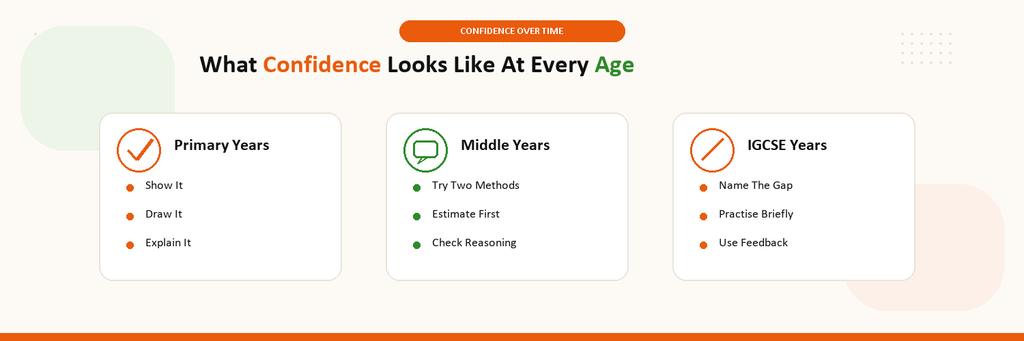
In the primary years, confidence often looks like willingness. A child may still count on fingers or need objects laid out in front of them. That is not a problem to hide. Ask them to show the quantity, draw it, or explain it in their own words. Physical models help children connect a symbol on a page with an idea they can see and touch.
In upper primary and early secondary, the pressure often shifts to comparison. Children notice who finishes first and may start to equate speed with intelligence. This is a useful time to ask for more than an answer: ask for two possible methods, an estimate before calculation, or a reason why an answer is reasonable. The child learns that mathematical competence includes checking and explaining.
By the IGCSE years, a child may be carrying a longer history with the subject. Do not reduce that history to motivation. If gaps have accumulated, name them clearly and plan a route back: identify one topic, use worked examples, practise briefly but regularly, and check understanding with a teacher. Confidence grows when a child can see evidence of progress, not when adults simply insist that confidence should appear first.
How Aurinko Academy Thinks About Maths Confidence
Aurinko Academy, a Cambridge International (IGCSE) school in Bangalore offering learning from Kindergarten to Grade 10, treats mathematical understanding as something children build through questions, representations and conversation. In a progressive classroom, a wrong answer is not ignored, but it is examined. What did the child notice? Which assumption did they make? What could they try next?
That approach is not a softer version of rigour. It asks children to explain, test and revise their ideas. Cambridge describes ‘thinking and working mathematically’ as making sense of ideas, challenging them and providing evidence for solutions. These habits matter because they give a child more than a method to memorise; they give them ways back into a problem when the first method fails.
At Aurinko, small classes and hands-on spaces such as the carpentry studio, clay modelling room, art spaces and garden areas support learning that is visible and discussable. Measurement, scale, pattern and problem-solving can move beyond a worksheet. The purpose is not to make every lesson entertaining. It is to make thinking concrete enough that children can talk about it, question it and own it.
Final Thoughts
When your child says, ‘I am bad at maths,’ do not feel you must produce the perfect answer. Start by making the sentence smaller. Ask what happened. Name one part they can attempt. Let them see that being confused is a stage of learning, not a verdict on who they are.
The most useful message is not ‘you are brilliant at maths’. It is ‘you can stay with a problem long enough to learn something from it.’ That is a confidence which travels far beyond maths.