The term gets used a lot. Progressive school. Progressive approach. Progressive curriculum. But ask ten parents what it means and you will likely get ten different answers, ranging from ‘child-led and play-based’ to ‘no exams and no discipline’ to ‘too unstructured for the real world’.
Most of these impressions are either incomplete or simply wrong. Progressive education is one of the most research-supported educational philosophies in existence and one of the most persistently misunderstood, particularly in the Indian context where academic rigour is (rightly) valued and where the dominant model of schooling has historically been deeply traditional.
This blog explains what progressive education actually is from its intellectual origins to its practical classroom reality. It addresses the most common concerns Indian parents raise. And it answers the question that matters most: is it right for your child?
What is Progressive Education
Progressive education is a philosophy rooted in one fundamental idea: children learn best when they are active participants in their own education, not passive recipients of information delivered by a teacher.
The philosophy is most closely associated with American philosopher and educator John Dewey, who argued in the early 20th century that education should connect to real life that learning happens through experience, inquiry, and engagement, not through the transmission of facts from teacher to student. His foundational text, Experience and Education (1938), remains one of the most cited works in educational philosophy.
But progressive education is not simply about making learning ‘fun’ or reducing academic rigour. Dewey was explicit about this. His critique was not of discipline or knowledge, it was of the specific, historically contingent method of delivering knowledge through lecture, rote repetition, and recall-based examination. He argued, with evidence that has only grown stronger since, that this method produces graduates who have memorised content but cannot think independently.
At its core, progressive education shifts the focus from what a child knows to how a child thinks. It does not abandon knowledge, it embeds knowledge in experience, investigation, and meaning-making, on the grounds that knowledge learned this way is deeper, more transferable, and more retained.
Progressive Education vs Traditional Education
The clearest way to understand progressive education is to contrast it directly with the traditional model that most Indian parents experienced themselves.
In a traditional classroom | In a progressive classroom |
|---|---|
Teacher delivers content; student receives it | Student actively constructs understanding through inquiry, experience, and discussion |
Curriculum is fixed and sequential | Curriculum is responsive to student interest and real-world connections |
Success is measured primarily through standardised tests | Success is measured through projects, portfolios, demonstrations, and ongoing assessment |
Subjects taught in isolation — Maths, English, Science separately | Learning is often interdisciplinary, connecting ideas across subjects |
Mistakes are marks lost | Mistakes are information, essential to the learning process |
Behaviour managed through external rules and rewards | Behaviour shaped through responsibility, community, and self-regulation |
The goal is correct answers | The goal is deep understanding, questions, and the capacity to think independently |
It is worth noting that this is a spectrum, not a binary. Many schools combine elements of both approaches, structured content delivery alongside project-based learning, standardised assessments alongside ongoing portfolio assessment. What distinguishes genuinely progressive schools is that the student’s active engagement and understanding, not coverage of content, is the organising principle.
What Research Says About Progressive Education
The most significant piece of evidence for progressive education’s effectiveness is also the oldest. In the 1930s, the Progressive Education Association conducted the Eight-Year Study, the largest educational experiment of the 20th century. Over 1,500 students from 30 progressive schools were matched with equal numbers from traditional schools and followed through college. The results: students from progressive schools were found to equal or surpass their traditionally educated peers on virtually every measure, academic achievement, intellectual curiosity, critical thinking, and leadership.
This was not an isolated study. Decades of subsequent research have built on it. A 2015 analysis by the Bill and Melinda Gates Foundation found that personalised, student-centred learning environments, a hallmark of progressive education, led to improved academic outcomes, particularly for students from disadvantaged backgrounds. Multiple meta-analyses have found that project-based and inquiry-based learning produce stronger long-term retention and application of knowledge than direct instruction alone.
Bank Street School’s analysis of progressive education notes that the underlying principles are being increasingly validated by research on human development and brain function. The brain learns through connection, emotion, and active engagement, all of which progressive education deliberately activates. Passive listening, by contrast, is one of the least effective modes of learning for long-term retention.
The research on social-emotional outcomes is equally strong. Progressive classrooms, where collaboration, responsibility, and self-regulation are built into the daily structure, produce students with stronger emotional intelligence, better peer relationships, and greater resilience than those from heavily compliance-based environments.
Common Misconceptions About Progressive Education
No educational philosophy is more frequently caricatured than progressive education. Here are the three concerns Indian parents most often raise — and what the evidence actually shows.
“Progressive education means no structure and no discipline”
This is the most widespread misconception. Bank Street School’s research notes that misconceptions about progressive education generally take two forms: it is either defined too narrowly, or an exaggerated, caricatured version is presented to justify dismissing the whole approach. The ‘no structure’ caricature is the most common example.
Progressive classrooms have structure. They have expectations, routines, and standards, sometimes more demanding ones than traditional classrooms, because students are expected to plan, research, create, and present, not simply receive and recall. What is absent is not structure but arbitrary compliance, rules and procedures that serve classroom management rather than learning.
Discipline in a progressive context is built on developing self-regulation, responsibility, and genuine understanding of consequences. Research consistently shows this produces more durable behaviour change than external rule enforcement and children who understand why, rather than just what.
“My child won’t be prepared for board exams or JEE/NEET”
This concern is understandable in the Indian context, and it deserves a direct answer. Progressive education is not opposed to academic rigour, it is opposed to academic rigour achieved purely through rote memorisation. The distinction matters enormously.
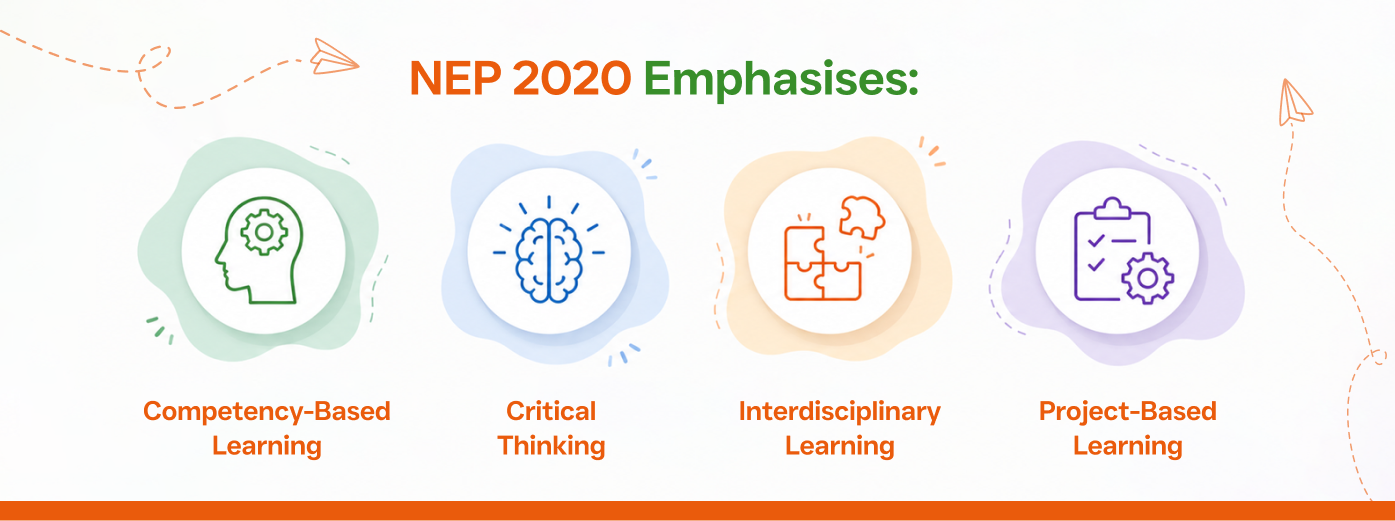
NEP 2020 — India’s most significant education policy reform in decades is explicitly aligned with progressive principles: competency-based assessment, interdisciplinary learning, reduced emphasis on rote recall, and greater focus on critical thinking and application. The policy direction of Indian education is moving toward progressive methods, not away from them.
Well-implemented progressive education produces students who understand concepts deeply, not just know answers. These students tend to perform well on application-based questions — the type that JEE and NEET increasingly emphasise, because they have learned to reason, not just to recall. The Eight-Year Study specifically found that progressive school students performed as well or better in college, including in structured academic environments.
The caveat: this is about well-implemented progressive education. A school that uses the label without the substance without genuine intellectual rigour, content depth, and skilled teachers will not produce these outcomes.
“It’s too child-led — children don’t know what they need to learn”
This misunderstands what child-led means in a progressive context. Progressive education does not simply ask children what they want to learn and then deliver it. It provides a structured environment in which students’ genuine questions, interests, and confusions are used as the entry point into rigorous content learning.
As U.S. News describes it, progressive schools give students agency in their learning through projects that have genuine meaning that connect to real problems, real communities, real questions. This agency is structured and teacher-supported, not abandoned. The teacher’s role shifts from transmitter to facilitator, a more demanding role, not a less demanding one. It requires expert teachers who know the subject deeply enough to guide inquiry wherever it leads.
Why India’s NEP 2020 is a progressive education document
NEP 2020 explicitly calls for:
→ A shift from rote learning to conceptual understanding and real-world application
→ Competency-based assessment rather than marks-only evaluation
→ Interdisciplinary learning and project-based approaches from primary school onwards
→ Arts, sports, and vocational learning as core, not peripheral
→ Student agency and critical thinking as educational goals
Every one of these principles is a foundational element of progressive education. India’s educational establishment has reached the same conclusions that progressive educators have held for a century. The question is which schools are actually implementing the spirit of NEP and which are implementing the paperwork.
Is Progressive Education Right for Your Child?
The honest answer is: it depends on your child’s learning style and temperament, and equally on the quality of the specific school implementing the approach.
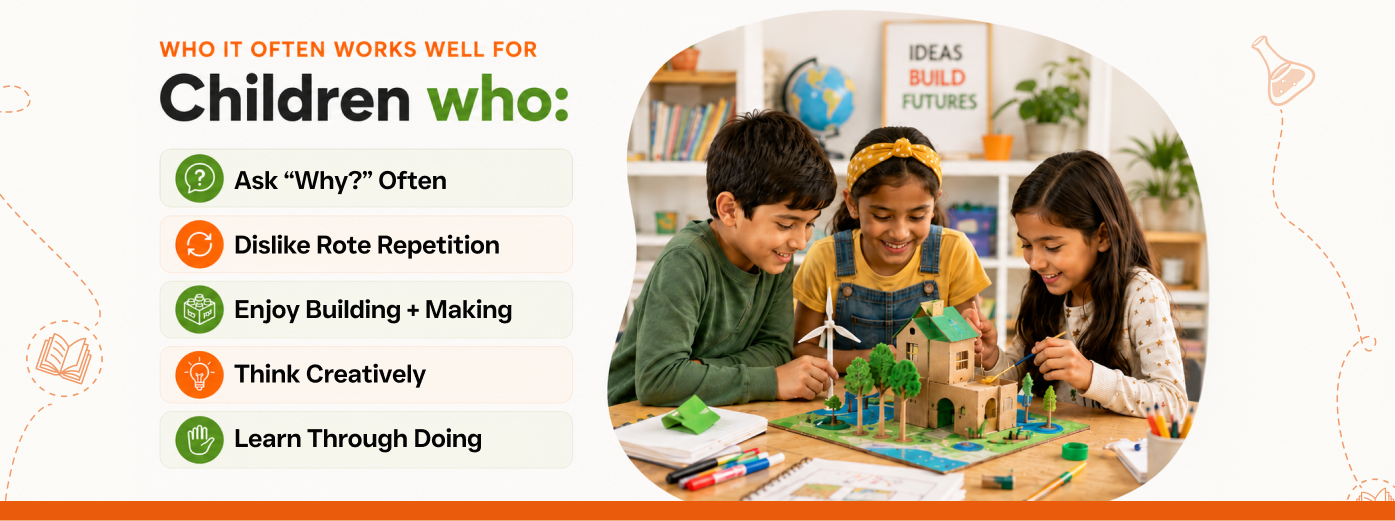
Progressive education tends to suit children who… | It may be a harder fit for… |
|---|---|
Child is curious and loves to ask ‘why’ | Child who thrives only on very explicit step-by-step instruction with minimal ambiguity |
Child learns well through projects and making things | Child who finds open-ended tasks anxious-making without significant support |
Child is easily bored by repetition and routine | Child with significant special educational needs that require highly structured settings (though good progressive schools can accommodate many needs) |
Child has interests that don’t fit neatly into standard subjects | Child or parent who values competitive ranking above all else |
Child struggles in traditional settings but is clearly intelligent | Family that wants very high certainty of specific content coverage at each stage |
Child is social, collaborative, and motivated by real-world meaning |
One important nuance: many children who appear to need heavy structure in a traditional setting are, on closer inspection, children who find traditional schooling so unstimulating that they have disengaged and disengaged children look disruptive, distracted, or compliant-but-absent. Some of these children flourish dramatically when placed in an environment where learning is active and connected to real meaning.
It is also worth distinguishing between a child who is not yet comfortable with ambiguity, which is a developmental stage that progressive environments can help with and a child who genuinely needs a fundamentally different approach. A good progressive school will tell you honestly which situation your child is in.
Questions to Ask Any School That Claims to Be Progressive
The word ‘progressive’ is used loosely. Some schools that claim to be progressive are genuinely inquiry-based and student-centred. Others have adopted the language without changing the practice. Here is how to tell the difference.
- “Can you show me an example of a project a student completed this year, what question drove it, what they built or produced, and how it was assessed?”
- “Can you show me an example of a project a student completed this year, what question drove it, what they built or produced, and how it was assessed?”
- “How do you cover required curriculum content within a project-based approach?”
- “How do you assess student learning, what does an assessment look like here?”
- “How do your students perform in board examinations, and what do you attribute that to?”
- “What is the teacher-student ratio, and how much time does each student get for individual interaction?”
- “How does the school handle a student who is disengaged or struggling, what is the actual process?”
A school that is genuinely progressive will have specific, confident answers to all of these. A school that uses the label without the substance will give you aspirational language without concrete examples.
How Aurinko Academy Implements Progressive Education
Aurinko Academy was built on the conviction that the traditional Indian school model, valuable as it is in many ways, does not, on its own, produce the kind of thinker the 21st century requires. Our approach is progressive not as a marketing label, but as a deeply held educational philosophy that shapes every decision about how teaching happens at Aurinko.
In practical terms, this means that a child at Aurinko is not spending their day receiving content. They are asking questions, investigating, building, making mistakes, trying again, explaining their thinking to a classmate, and making connections across subjects. A maths lesson may begin with a real-world problem, materials cost, space design, measurement, because real-world problems make mathematical thinking feel purposeful and therefore more deeply learned.
Our carpentry studio, clay modelling room, art spaces, and outdoor areas are not supplementary to our curriculum. They are where our curriculum happens. A child who builds a birdhouse learns measurement, proportion, material properties, planning, and the satisfaction of a completed real thing in a single project that a traditional lesson would split across four subjects and probably not make concrete.
On the question of academic outcomes: our students develop strong conceptual understanding because they learn through doing and questioning. This understanding holds up in assessment, not because we teach to the test, but because understanding is more durable than memorisation. We are transparent with parents about how we track learning progress and what evidence we look at beyond examination results.
Our teachers are recruited for their intellectual curiosity and their genuine love of children as learners, because a progressive classroom requires a teacher who is comfortable with not always knowing what question is coming next, and who finds that exciting rather than threatening. Small class sizes at Aurinko mean every teacher knows every child as an individual thinker, their specific interests, their productive confusions, and the kind of challenge that will unlock their best thinking.
We also involve parents actively in understanding our approach because a child in a progressive school benefits most when their home environment reflects similar values: curiosity welcomed, mistakes normalised, effort celebrated, and questions treated as the beginning of learning rather than evidence of not knowing.
Final Thoughts
Progressive education has been mischaracterised for as long as it has existed. It is not the absence of rigour, it is a different, research-supported form of rigour. It is not freedom without structure, it is structured freedom, in which children develop the capacity to direct their own thinking within frameworks that skilled teachers design and maintain.
Whether it is right for your child depends on your child. But the research is clear that for the majority of children and particularly for children who are curious, social, and frustrated by rote learning, a well-implemented progressive education produces deeper learning, stronger character, and better preparation for adult life than the traditional model alone.
The most important thing is not whether a school calls itself progressive. It is whether it can show you, concretely, specifically, in the classrooms you visit, what that means in practice for your child’s daily experience of learning.