Imagine a classroom where children are not memorising facts for a Friday test. Instead, they are designing a rain-harvesting system for a school garden, producing a documentary about their neighbourhood’s history, or building a working model of a solar-powered home. They are arguing, collaborating, failing, re-thinking, and trying again and learning more deeply in the process than any worksheet could ever achieve.
This is project-based learning (PBL) and it is rapidly being recognised as one of the most powerful approaches to education in the 21st century.
At Aurinko Academy, project-based learning is not a supplement to our curriculum. It is our curriculum. As a school that has been awarded Best Project-Based School, we have seen first-hand how this approach transforms children into confident, capable, and creative thinkers who are genuinely prepared for the complexities of real life.
In this guide, we explain exactly what project-based learning is, how it works in practice, what the research says about its outcomes, and why it may be the most important educational choice you make for your child.
What Is Project-Based Learning?
Project-based learning is an instructional approach in which students gain knowledge and skills by working for an extended period of time to investigate and respond to a complex, real-world question, problem, or challenge. Rather than learning content in isolated chunks, PBL integrates multiple subject areas into a single sustained inquiry that mirrors how the real world actually works.
The term was formalised by educational researchers and organisations like the Buck Institute for Education (now PBLWorks), but its philosophical roots go back much further to John Dewey’s early 20th century argument that education must connect to authentic experience. The core insight is simple and profound: children learn best when they are doing something that genuinely matters.
What Makes Project-Based Learning Different from a School Project?
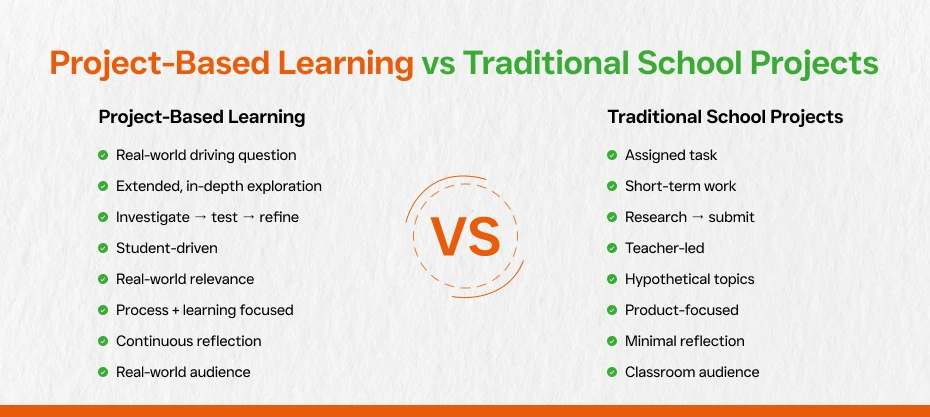
Many parents confuse project-based learning with the “projects” they remember from school, a poster about the rainforest, a diorama of the solar system, and a book report presented to the class. These are not PBL.
True project-based learning is characterised by several non-negotiable elements:
Driving Question: Every PBL unit begins with an open-ended, real-world question that cannot be answered by a simple Google search. For example: “How can we make our school more sustainable?” or “What should our city do about its waste problem?” The driving question anchors the entire project and keeps students motivated.
Sustained Inquiry: PBL unfolds over days, weeks, or even months. Students don’t just research and report, they investigate, test hypotheses, gather evidence, consult experts, and revise their thinking continuously.
Sustained Inquiry: PBL unfolds over days, weeks, or even months. Students don’t just research and report, they investigate, test hypotheses, gather evidence, consult experts, and revise their thinking continuously.
Student Voice and Choice: Within the structure of the project, students have meaningful agency, choosing research approaches, deciding how to present findings, and taking ownership of their learning process.
Reflection: Built-in reflection is essential to PBL. Students regularly step back to assess what they’ve learned, what isn’t working, and how they can improve. This metacognitive habit is one of the most powerful skills a young person can develop.
Public Product: At the end of a PBL unit, students present their work to a real audience, parents, community members, experts, or peers. The knowledge that their work will be seen and judged by the real world raises the stakes, the quality, and the pride.
How Does Project-Based Learning Work in the Classroom?
A typical PBL unit might look something like this:
A group of nine-year-olds is tasked with answering the driving question: “How can we help new families feel welcome in our community?” Over four weeks, they interview recent arrivals to the area, research immigration patterns, consult a social worker, write and design a multilingual welcome guide, build a resource directory, and ultimately present their completed guide to the local community centre, which agrees to distribute it.
In the process, these nine-year-olds have practised reading, writing, research, data analysis, graphic design, public speaking, empathy, and cross-cultural communication. They have collaborated under pressure, met deadlines, navigated disagreement, and produced something that genuinely helps people.
That is project-based learning at work.
Teachers in a PBL classroom are not lecturers, they are coaches, questioners, and facilitators. They design the project framework, ensure curriculum standards are met, provide targeted mini-lessons when students need specific skills, and guide reflection. The learning is student-driven, but never without expert pedagogical scaffolding.
The Research Behind Project-Based Learning
The case for PBL is not just philosophical, it is backed by a substantial and growing body of research.
A landmark study by researchers at the University of Michigan found that primary school students who learned science through project-based curricula significantly outperformed their peers on standardised assessments of both content knowledge and scientific reasoning. Crucially, the PBL students also retained their knowledge far longer.
Research published in the Journal of Educational Psychology found that PBL students demonstrated superior performance on real-world problem-solving tasks compared to students who received traditional instruction, even when the traditionally instructed students scored equally well on content tests.
Studies of secondary school students in PBL environments consistently show higher engagement levels, lower dropout rates, and stronger development of the “soft skills” , communication, collaboration, critical thinking, and creativity that employers consistently rank as their highest priorities.
Perhaps most compellingly, a long-term study tracking PBL students into adulthood found that they were significantly more likely to describe themselves as self-directed learners and to apply creative problem-solving approaches in their professional lives.
How Project-Based Learning Prepares Children for Real Life
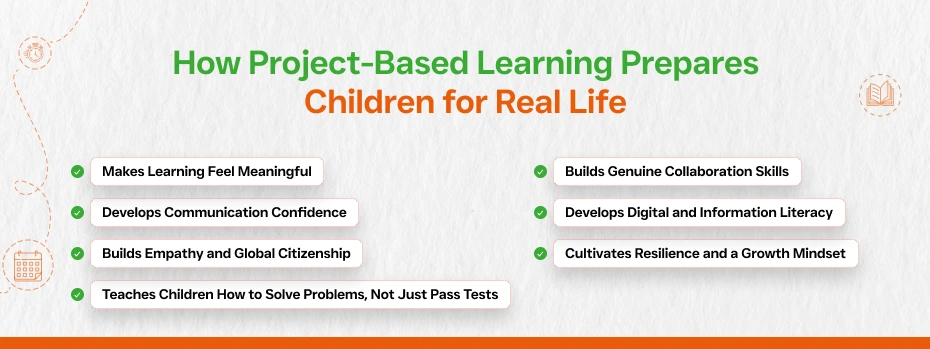
This is the question that matters most to parents. And the answer is deeply compelling.
1. Teaches Children How to Solve Problems, Not Just Pass Tests
Real life does not present problems with four multiple-choice answers. Real problems are messy, ambiguous, and require the ability to gather information, evaluate it critically, try solutions, fail, and try again. PBL trains children in exactly this process from a young age. By the time a graduate enters the workforce or higher education, problem-solving under uncertainty is second nature.
2. Builds Genuine Collaboration Skills
Working in a group at school usually means one person does the work while others watch. PBL is different. When a project requires genuine division of labour, real deadlines, and a public outcome, every child must contribute meaningfully. Students learn to communicate across different strengths, manage conflict, give feedback, and build on each other’s ideas, skills that are fundamental to every professional environment.
3. Develops Communication Confidence
The public presentation at the heart of every PBL unit might be the single most powerful preparation for adult life that a school can offer. Children who have presented their work to real audiences, defended their ideas, answered tough questions, and handled unexpected feedback, arrive in job interviews, university seminars, and boardrooms without the crippling communication anxiety that affects so many young adults today.
4. Cultivates Resilience and a Growth Mindset
In a PBL classroom, things go wrong. Designs don’t work. Research leads to dead ends. Presentations don’t land the way students hoped. And that is the point. Children who experience managed failure in a safe environment and who are guided to learn from it and try again, develop genuine resilience. They learn that difficulty is a signal to think differently, not a sign to give up.
5. Makes Learning Feel Meaningful
One of the deepest problems in modern education is the question every child inevitably asks: “Why do I need to know this?” In a PBL classroom, that question largely disappears. When you are trying to design a water-filtration system for a village, you understand exactly why you need to know about chemistry, measurement, materials science, and persuasive writing. Purpose drives engagement, and engagement drives deep learning.
6. Develops Digital and Information Literacy
Project-based learning requires children to research, evaluate, and synthesise information from multiple sources, including digital ones. In an age of misinformation and information overload, the ability to identify credible sources, cross-reference data, and think critically about what you read is among the most important skills a young person can possess.
7. Builds Empathy and Global Citizenship
Many PBL projects are designed to engage with real community issues: local, national, or global. When children research the impact of plastic waste on ocean ecosystems, interview elderly residents about the history of their neighbourhood, or design solutions for a food bank, they develop a sense of responsibility toward the world beyond their own lives. They become citizens, not just students.
Why Aurinko Academy’s Award-Winning PBL Approach Stands Apart
Winning Best Project-Based School is not something we take lightly. It reflects years of deliberate curriculum design, deep investment in teacher training, and an unwavering commitment to the belief that children are capable of extraordinary things when given the right environment and the right challenge.
At Aurinko Academy, our PBL programme is:
Curriculum-aligned: Every project is rigorously mapped to learning outcomes across literacy, numeracy, science, social studies, and the arts. PBL at Aurinko is never “instead of” learning core knowledge, it is the vehicle through which that knowledge is acquired and applied.
Expert-facilitated: Our teachers undergo extensive PBL-specific training. Designing a great project is a sophisticated pedagogical skill, and our staff are among the most accomplished PBL practitioners in the field.
Community-connected: We actively build partnerships with local organisations, businesses, and experts who participate in our projects as mentors, audience members, and real-world collaborators. This is what makes our projects genuinely authentic.
Reflective and iterative: Aurinko students maintain learning journals, participate in structured critique protocols, and engage in regular project retrospectives. Reflection is not an afterthought, it is built into the architecture of every unit.
Is Project-Based Learning Right for Every Child?
The short answer is yes with the right implementation. PBL is not a niche approach suited only to a certain “type” of learner. Research consistently shows that PBL benefits children across all ability levels, learning styles, and socioeconomic backgrounds. In fact, studies show that children who struggle in traditional academic environments often find their confidence and capability in PBL settings, because the approach values different kinds of intelligence and contribution.
That said, the transition to PBL can take adjustment for both children and parents. Children accustomed to being given clear, finite tasks may initially find open-ended projects uncomfortable. This discomfort is, in itself, a valuable learning experience. With the support of skilled teachers and a community of learners, almost every child comes to embrace the challenge.
Final Thoughts
The world your child will graduate into looks very different from the one that traditional education was designed to serve. The jobs, challenges, and opportunities ahead will demand people who can think critically, collaborate generously, communicate powerfully, and adapt creatively to change.
Project-based learning does not just prepare children for those demands, it gives them the lived experience of rising to meet them, every single term, from the very beginning of their education.
At Aurinko Academy, we are proud to be at the forefront of this approach. And we are proud of every child who has stood in front of an audience, presented their work, and discovered, sometimes to their own surprise just how much they are capable of.
Come and see it for yourself. Book a visit to Aurinko Academy and watch project-based learning in action.
Frequently Asked Questions
Q: Does project-based learning cover the standard curriculum?
Yes. At Aurinko Academy, every project is carefully designed to meet required curriculum standards across multiple subject areas. PBL does not replace core learning objectives, it integrates and deepens them.
Q: How are students assessed in a PBL environment?
Assessment in PBL goes far beyond tests and grades. At Aurinko, we use a combination of teacher observation, student self-assessment, peer review, portfolio documentation, and public presentation rubrics. This gives a much richer picture of a child’s actual capabilities.
Q: Will my child be prepared for exams and formal secondary school?
Absolutely. Research shows that PBL students perform as well as or better than traditionally educated peers on standardised assessments, and often significantly outperform them on tasks requiring critical thinking, writing, and problem-solving, which make up an increasing proportion of secondary school and university assessment.
Q: What age groups does PBL work for?
Project-based learning is effective from early childhood through secondary school and beyond. At Aurinko Academy, we adapt the complexity and scope of projects to be age-appropriate, while preserving the core elements of authentic inquiry at every level.