It is a question that most parents navigate by instinct, guided by their own upbringing, their anxieties about their child’s future, and the unspoken competition of school WhatsApp groups. How much should I be involved? Should I help with homework or leave them to it? Should I speak to the teacher or trust the school? Should I push and if so, how hard?
These are not trivial questions. How involved a parent is in their child’s schooling is one of the most studied variables in educational research and the findings are both more reassuring and more challenging than most parents expect.
Reassuring Because: parental involvement genuinely matters. A 2019 American Psychological Association review of 448 independent studies found that parental involvement in education is consistently associated with higher academic achievement, stronger school engagement, and better social-emotional outcomes.
Challenging Because: more involvement is not automatically better. The same body of research shows that the type of involvement matters enormously and that some forms of high parental involvement actively harm children’s academic performance, motivation, and wellbeing.
This blog untangles what the research actually says, explains the critical difference between involvement that helps and involvement that hinders, and offers a practical framework for parents who want to support their child’s education without undermining their independence. It is written with the Aurinko Academy parent community in mind, families who care deeply, think carefully, and want to get this right.
Does Parental Involvement Really Affect Academic Success?
The research case for parental involvement is strong and consistent across decades and geographies. A 2025 meta-analysis published in SAGE journals, synthesising findings from 22 first-order meta-analyses, confirmed that parental involvement practices have a meaningful positive association with children’s academic outcomes and notably, that subtle involvement at home was more effective than direct school-based involvement.
A Johns Hopkins University study found that school practices which actively encouraged families to support their child’s maths learning at home led to measurably higher maths proficiency scores. The mechanism is not mysterious: a child who knows their parent is interested in what they are learning is more motivated to learn it. A home where education is discussed, valued, and gently supported produces children who approach school with more engagement and less anxiety.
A 2025 SAGE study specifically on parental involvement and student self-regulation found significant correlations: children whose parents were appropriately involved showed stronger ability to plan, monitor, and manage their own learning, the self-regulation skills that predict long-term academic success far better than any single exam result.
The critical word in all of this is appropriately. Because the research that shows involvement helps is the same research that shows too much involvement hurts, often in ways that are difficult to see until the damage is done.
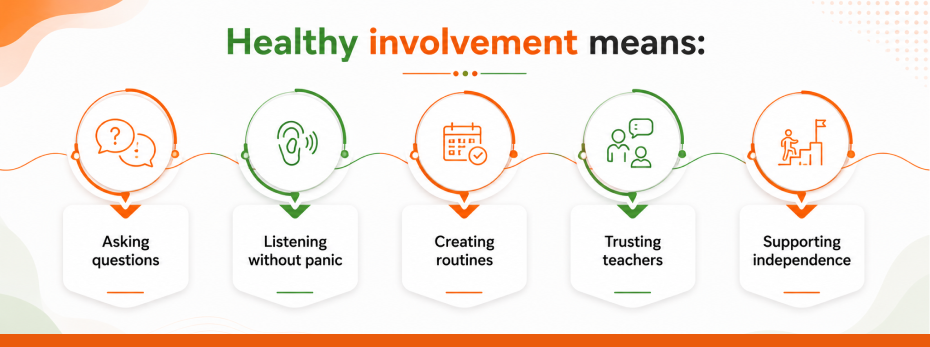
The Difference Between Healthy Support and Over-Involvement
In 2024, researchers from SAGE published the first validated scale for measuring helicopter parenting specifically among Indian teenagers, the Minor Teen Helicopter Parenting Scale, based on a sample of 425 students aged 13–17 in Delhi. They identified two distinct factors: Pressure and Intrusion.
Pressure, academic expectations, pushing for high performance was associated with worse academic outcomes and school-related stress. Intrusion, over-monitoring, making decisions that children should make themselves, excessive checking-in, was associated with poorer general wellbeing, lower self-reported happiness, and reduced health. Both, when elevated, produced measurably worse outcomes than moderate, balanced involvement.
A study on helicopter parenting and academic motivation found that children of overinvolved parents showed higher extrinsic motivation, perfectionist anxiety, and avoidance goals, meaning they were learning to avoid failure rather than to pursue understanding. They also showed higher rates of entitlement and lower academic self-efficacy: the belief that they could succeed through their own effort.
In plain terms: children who are over-managed by their parents stop believing they can manage themselves. And children who do not believe they can manage themselves do not, in the long run, manage well.
This is the central paradox of over-involvement: it comes from love and a genuine desire for the child to succeed, and it produces the opposite of what it intends.
Signs of Too Little vs Too Much Parental Involvement
Most parents sit somewhere between these poles depending on the day, the subject, and the stress level. The goal is not to occupy the green column perfectly at all times, it is to notice which direction you tend to drift, and to understand why.
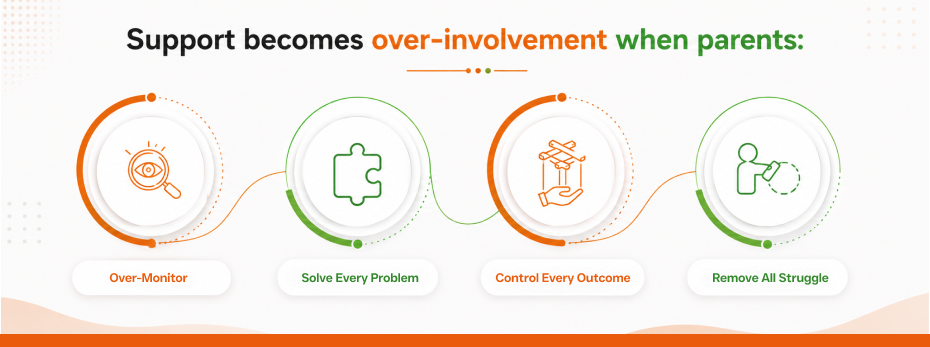
One important observation: the red flags in the right column are almost always driven by anxiety, not indifference. Parents who over-monitor, over-help, and over-intervene are not bad parents, they are anxious ones. Understanding the source of the anxiety is usually more useful than simply trying to stop the behaviour.
The Most Effective Types of Parent Involvement
The 2025 SAGE meta-analysis made a finding that should reshape how we think about this entirely: subtle parental involvement at home was more effective than direct school-based involvement. And parental warmth, the quality of emotional connection and interest, was a stronger predictor of positive academic outcomes than either autonomy support or control.
This is significant. It means the single most impactful thing a parent can do for their child’s education is not attend every school event, not check every homework task, not email teachers regularly. It is to be genuinely warm and interested, to create a home environment where learning is valued, where conversation flows, where the child feels seen and cared about.
The research identifies three types of parental involvement that consistently help:
1. Emotional involvement — interest without anxiety
A parent who asks “What was interesting today?” rather than “What marks did you get?” is communicating that learning matters more than performance. This distinction, sustained over years, shapes how a child relates to education entirely. Children of emotionally involved parents approach school with curiosity; children of performance-focused parents approach it with fear.
2. Structural involvement — environment, not supervision
Providing a consistent routine, a quiet place to work, a household where screens do not dominate evenings, and a general expectation that school is taken seriously, this is structural involvement. It does not require a parent to sit with the child through every homework session. It requires that the conditions for learning exist at home. This is among the most effective forms of parental involvement identified across multiple studies.
3. Collaborative involvement, the school partnership
Parents who treat the school as a partner, who attend meetings not to interrogate but to understand, who communicate concerns calmly and specifically, and who reinforce rather than undermine the school’s approach at home, produce children who experience school and home as a coherent whole. The research on this is consistent: children navigate school more confidently when they know their parents trust the teacher.
What does not help and what the research is equally consistent about, is controlling involvement: completing homework for the child, managing every social difficulty, disputing grades routinely, or communicating to the child, implicitly or explicitly, that the school cannot be trusted.
Why this is particularly relevant for Indian parents
Indian academic culture carries a specific set of pressures: board exams, entrance test culture, comparison between peers and cousins, and the deeply held belief that academic performance determines life outcomes.
These pressures are real. But research published in Frontiers in Psychiatry (2023) found that parental academic pressure is a significant predictor of anxiety and depression in Indian adolescents, independent of the child’s actual academic ability.
A 2021 Indian study found that children who perceived their parents as helicopter parents showed lower autonomous decision-making, greater dependence on external validation, and reduced ability to tolerate academic difficulty.
The goal is not to care less. It is better-directed care, rooted in the child’s actual development, not in the parent’s anxiety about outcomes.
How Parental Involvement Should Change as Children Grow
One of the clearest findings in the research is that appropriate parental involvement is age-sensitive. What counts as healthy involvement at age 7 is over-involvement at age 12, and intrusion at age 16. The amount of parental involvement that is helpful should be declining gradually, year by year, as the child’s capacity for independence grows.
Primary school years (ages 6–11)
High involvement is appropriate and beneficial at this stage. Children need parents to establish routines, check understanding, show interest in school life, communicate regularly with teachers, and be present for the emotional difficulties that arise. The research consistently shows that active parental involvement at this stage predicts better outcomes through secondary school.
Early secondary years (ages 11–14)
This is the transition zone where many parents get it wrong in both directions, either withdrawing too suddenly or continuing to manage as they did at primary level. What children need here is an interesting distance: a parent who knows what is happening, cares about how it is going, but leaves the child to navigate increasing amounts of it independently. Homework should largely be the child’s territory. Social difficulties should be listened to, not solved.
Later secondary years (ages 14–18)
The research is clear that adolescents whose parents maintain controlling, intrusive involvement at this stage show worse outcomes across all measures, academic performance, mental health, and social functioning. What adolescents need from parents is trust, availability, and the confidence that their parents believe they can manage. This does not mean disengagement. It means engagement that respects emerging adulthood.
What Healthy Involvement Actually Looks Like?
Theory is useful. But parents need to know what this looks like on a Tuesday evening when their child is struggling with a difficult assignment and they are not sure whether to step in.
Ask about learning, not just performance
- “What was the most interesting thing you thought about today?”
- “Was there anything that confused you?”
- “What is your teacher like? What do they care about?”
- These questions signal interest in the process of learning, not just the output. Children who are asked these questions regularly tend to become more reflective learners.
Let them struggle before you help
When a child gets stuck, the most helpful first response is to wait. Not forever, and not without warmth, but long enough to allow the child to attempt their own solution. Research on self-regulation consistently shows that children who are allowed to struggle before receiving help develop stronger problem-solving capacity than those who receive immediate assistance. The discomfort of not-knowing is where learning happens.
Communicate with teachers about concerns, not preferences
There is a difference between raising a genuine concern, “My child has seemed anxious about Maths for the past month, I wanted to flag it” and asserting a preference, “I think the homework is too easy” or “I don’t agree with this teaching approach.” The first invites collaboration. The second creates friction that often, ultimately, reaches the child. Trust the teacher unless you have specific, concrete evidence that trust is not warranted.
Talk about your own relationship with learning
Parents who share their own curiosity, their own reading, their own difficulty with things they are trying to learn, model the most important message: that learning is a lifelong, imperfect, and worthwhile endeavour. This costs nothing, requires no time at a homework table, and has an outsized effect on how children relate to the idea of education.
Final Thoughts
The question of how involved to be does not have a single, universal answer. It depends on the child’s age, temperament, and specific needs. It depends on the subject and the difficulty. It depends on what is happening in the child’s life at that moment. What the research offers is not a formula but a direction: be warm, be interested, be present — and step back more than your instinct tells you to.
The goal of parental involvement in education is not a child who performs well while you are watching. It is a child who can learn independently when you are not there. Everything you do as a parent in relation to school should be in service of that goal, including, sometimes, doing less.