Ask most parents how their child’s homework time goes and you will hear some version of the same story. There is a snack. There is some negotiation about when to start. There is a period of apparent work that upon closer inspection involves a great deal of pencil-tapping and staring at the middle distance. There is a moment where the parent gets involved that neither of them particularly enjoys. And eventually, somehow, the homework is done.
It works, in the sense that the assignment gets submitted. But it does not feel like learning. It feels like endurance.
The reason it feels that way is usually not the child, and it is not the homework. It is the absence of habits. Not rules, not systems, not supervision, habits. The small, repeated, eventually automatic behaviours that turn study time from a daily battle into a daily practice.
The difference between a child who finds studying manageable and one who finds it miserable is rarely intelligence or motivation. It is almost always a habit. And habits, unlike talent, can be built. This is what the research says, and what good teachers see confirmed every year in every classroom.
Here is what actually works for children from Grade 1 through to Grade 5.
Common Study Mistakes Elementary School Children Make
Before we talk about what works, it is worth clearing up what does not, because several widely used approaches actively get in the way of genuine learning.
Re-reading notes is not studying. It feels productive, it requires minimal effort, and it creates a comfortable illusion of familiarity with the material. But familiarity is not the same as understanding. A child who has read their science notes three times may feel ready for a test. What they have actually done is become comfortable with the look of the words on the page. The moment those words appear in a different context — a question framed differently, a concept applied to a new problem — the familiarity evaporates.
Highlighting is not studying for the same reason.
Copying out information is not studying, though it has the advantage of at least requiring active engagement with the content.
And cramming, the concentrated, last-minute push that many children and adults rely on produces short-term retention that degrades almost completely within forty-eight hours. It works for the test on Friday. It does not work for the exam in March, or for the understanding needed to build on this topic next year.
The study habits that actually work are the ones that require the brain to do something active with the material to retrieve it, apply it, explain it, connect it to something else. These are harder than re-reading. They are also incomparably more effective.
7 Effective Study Habits for Elementary School Students
Habit 1: Create a Consistent Homework Routine
Routine is the foundation that every other study habit depends on, and it is the one most families try to establish and most frequently allow to erode.
The brain responds to environmental and temporal cues in ways that are more powerful than most parents realise. A child who does their reading at the same time every day, in the same chair, with the same lamp on, eventually finds that sitting down at that time in that chair produces a mental state that is already oriented toward the work. The routine itself does part of the cognitive preparation.
The research on habit formation, most comprehensively summarised in work by habit scientist Wendy Wood, consistently shows that the three elements that make habits stick are a reliable cue, a consistent routine, and a clear sense of reward. For elementary children, this translates directly: same time, same place, and some form of positive acknowledgement when the work is done.
The timing question is one parents get wrong most often. The instinct is to give children a break after school before homework begins. For many children, particularly in the younger grades, this is correct, a child who has been concentrating for six hours needs physical movement and unstructured time before their brain is ready for more focused work. But the break needs a defined end. “Play until four, then we start”, is a routine. “Play until you feel ready” is an invitation for the evening to disappear.
For most elementary children, somewhere between thirty and sixty minutes of outdoor or active play after school, followed by a consistent start time for homework, produces better focus and less resistance than either going straight from school to the desk or leaving the timing open-ended.
Habit 2: Start with Easy Tasks to Build Momentum
This is a small change that makes a large difference, and it runs counter to most children’s instincts.
Most children, when they sit down to do homework or revision, either start at the beginning of the page or go immediately to the thing they find hardest. Neither of these is optimal. The first is arbitrary. The second front-loads the session with frustration and often derails the whole thing before it has begun.
Starting with something the child already knows and can do confidently serves two purposes. First, it activates prior knowledge, it warms up the cognitive circuitry before the more demanding material arrives. Second, it builds momentum. A child who has successfully completed two or three things feels capable. That feeling of capability is not incidental, it is the emotional precondition for attempting something difficult.
In practice, this means: before touching the hard maths problems, do two of the easy ones. Before writing the paragraph they are stuck on, read through the paragraph they already wrote and feel good about. Before the vocabulary they do not know, review the vocabulary they do.
This is not avoiding the hard work. It is preparing the brain for it.
Habit 3: Use Retrieval Practice Instead of Re-Reading
This is the single most evidence-supported study technique in cognitive science, and it is almost never taught explicitly to children. It goes by several names, retrieval practice, the testing effect, active recall, but the mechanism is simple.
Instead of reading information and trying to remember it, the child closes the book and tries to recall the information from memory. The act of retrieval, of pulling something out of memory before looking it up, strengthens the memory trace far more powerfully than re-reading does. Every time the brain successfully retrieves a piece of information, that information becomes easier to retrieve next time. Every time it fails and then checks, the correction is more memorable than a simple re-read would have been.
For elementary children, this does not require flashcards or formal testing. It can be as simple as: read the chapter, close the book, and tell me everything you remember. Draw a diagram of what you just learned without looking at the original. Write down everything you can recall about today’s science lesson before opening your notebook.
The discomfort of not being able to remember something, the effortful struggle before the answer arrives, is not a sign that this technique is not working. It is the mechanism by which it works. The effort is the learning. Children who are taught this explicitly, who understand that the difficulty of retrieval is productive rather than punishing, use it far more willingly than those who just find it hard and give up.
For parents at home, the simplest version is to ask your child, at dinner, what they learned today and genuinely listen to the answer. Not as a comprehension check, not as a performance, but as a real question. The act of explaining something to another person is one of the most powerful consolidation tools available. When a child cannot explain it clearly, they discover exactly what they do not yet understand, which is itself a form of learning.
Habit 4: Study in Short, Focused Blocks
This one requires trust, because it looks counterproductive until you understand the mechanism.
The Zeigarnik effect, a well-documented psychological phenomenon named after Soviet psychologist Bluma Zeigarnik describes the brain’s tendency to think about unfinished tasks more persistently than completed ones. Stopping work at a point of slight incompleteness, mid-problem, mid-paragraph, in the middle of something that the child knows how to continue creates a mental thread that the brain continues to pull on during the break.
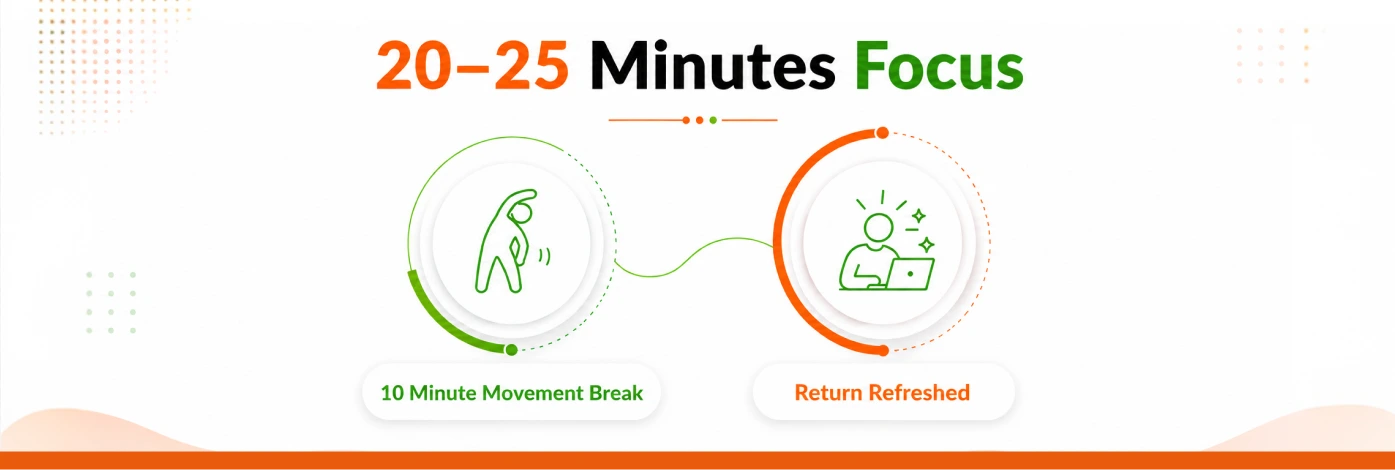
In practice: work for twenty to twenty-five minutes, stop deliberately before exhaustion sets in, take a genuine break involving physical movement, and return. The child who returns to their desk after a break frequently finds that the problem they were stuck on has become clearer. This is not magic. It is the resting brain continuing to process in the background, a phenomenon called diffuse thinking, while the body is doing something else.
For elementary children, twenty minutes of genuinely focused work followed by a ten-minute movement break is a more productive structure than forty-five minutes of increasingly unfocused sitting. The total work accomplished is higher. The frustration is lower. And the child ends the session feeling capable rather than ground down.
Habit 5: Encourage Children to Explain What They Learned
One of the most underused and most effective study habits available to children of this age is simply talking about what they are learning.
When a child explains a concept aloud, to a parent, a sibling, a soft toy, or genuinely to themselves, they are doing something cognitively demanding and extraordinarily valuable. They are translating their understanding into language, which requires them to organise it, sequence it, and identify the gaps. You cannot successfully explain something you do not understand. The attempt to do so reveals the gaps with a clarity that silent re-reading never achieves.
This is sometimes called the Feynman technique, after physicist Richard Feynman who maintained that if you cannot explain something simply, you do not yet understand it. For elementary children, it is enough to simply ask: can you teach me what you learned today? And then genuinely listen, ask follow-up questions, and let the child’s explanation, however approximate, however incomplete, do the cognitive work.
Children who regularly explain their learning out loud develop a metacognitive awareness, an ability to think about their own thinking, that is one of the strongest predictors of academic success across all subjects and all subsequent years of education.
Habit 6: Use a Brain Dump Before Bed
This is a habit borrowed from adult productivity research that translates surprisingly well to elementary children and has a specific benefit beyond pure study effectiveness.
At the end of the evening, before sleep, the child spends three to five minutes writing or dictating everything that is on their mind, worries, things to remember, unfinished thoughts, anything that feels pending. The purpose is to offload the working memory so the brain is not attempting to hold things overnight, which interferes with both sleep quality and the memory consolidation that happens during sleep.
For children who carry school anxiety home with them, who lie awake worrying about tomorrow’s test or an unresolved friendship situation, the brain dump creates a written record that the brain can trust to hold the worry, releasing the need to keep it active. It is not a cure for anxiety. It is a practical tool that reduces the cognitive load the brain carries into sleep.
The sleep that follows matters enormously for everything else on this list. Memory consolidation, the process by which the day’s learning moves from short-term to long-term memory, happens primarily during sleep. A child who studies well but sleeps poorly retains a fraction of what a well-rested child retains from the same study session. Sleep is not the recovery from learning. It is part of the learning.
Habit 7: Create a Distraction-Free Study Environment
The final habit is not really a study habit at all. It is an environmental design decision, but it has more impact on children’s ability to study than most of the techniques above it on this list.
A study environment that defaults to focus, same desk, consistent lighting, no devices that are not needed for the work, water available, a clock visible removes the need for willpower. Willpower is a limited resource, particularly in children at the end of a school day. Every decision the environment forces, should I check my tablet, where is my pencil, is it too loud in here draws from that resource. An environment that has already made those decisions removes the drain.
The most important single environmental decision for children in Grade 3 and above is the location of any screen device that is not being used for the work. Not face-down on the desk. Not in the pocket. In another room, or in a designated device basket that is not in the study space. The research on this is unambiguous: the visible presence of a device reduces cognitive capacity even when the device is switched off. The brain is using working memory to resist it.
This is not about distrust. It is about designing conditions that make the default behaviour the focused one. Children who study in well-designed environments need less parental oversight, experience less conflict around homework, and finish more quickly, not because they are working harder, but because they are not fighting their environment at the same time as they are working.
Why Unstructured Time Is Just as Important as Study Time
One final thing, because not everything about a child’s relationship with learning needs to be structured, optimised, or habituated.
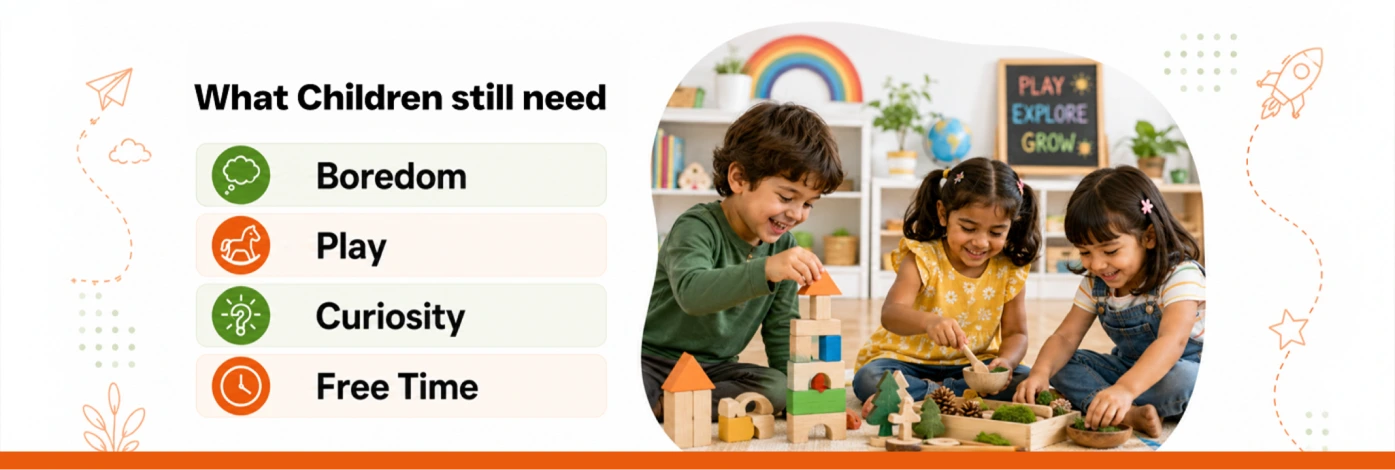
Children need unstructured time. Time where nothing is required, nothing is assessed, and nothing is building toward anything. Time where they read something purely because it interests them, build something purely because they want to, or do nothing in particular because they need the rest.
This time is not wasted. It is, in fact, where a significant amount of learning consolidation happens, where creative thinking develops, and where children build the intrinsic relationship with their own curiosity that sustains learning through the years when external motivation becomes less reliable.
The habits on this list are not meant to colonise the afternoon. They are meant to make the necessary work more effective so that the unstructured time that follows is genuinely free — not stolen by a homework session that dragged on for three hours because no one had a system.
Effective study habits create time. That time belongs to the child.
A Final Word
The child who has good study habits does not necessarily study more. They study better. They finish faster, retain more, and arrive at the next lesson with a foundation that actually holds weight. And because the work is more effective, it takes less time, which means there is more time for everything else that matters in a child’s day.
Building these habits takes weeks, not days. It requires consistency from parents and patience with the process. There will be evenings where the routine breaks down, where the focus evaporates, where it would be easier to just do it for them.
Do not do it for them.
Building these habits takes weeks, not days. It requires consistency from parents and patience with the process. There will be evenings where the routine breaks down, where the focus evaporates, where it would be easier to just do it for them.