There is a conversation that happens in Indian households every year, usually around exam season. A child comes home from cricket practice, or swimming training, or a football match and somewhere in the evening, a well-meaning parent or relative raises the question: is all this sport getting in the way of studying?
It is an understandable concern. Time on a field feels like time away from a textbook. And in a school system that still measures success primarily through marks, anything that does not directly produce marks can seem like a luxury at best, a distraction at worst.
The research tells a different story. Consistently, across countries and age groups, children who are regularly physically active and particularly those who participate in structured sport, perform better academically than children who are not. Not despite their time on the field. Because of it.
This blog is for parents who want to understand why.
Does Playing Sports Help Children Do Better in School?
The connection between physical activity and academic performance is not motivational folklore. It is neuroscience.
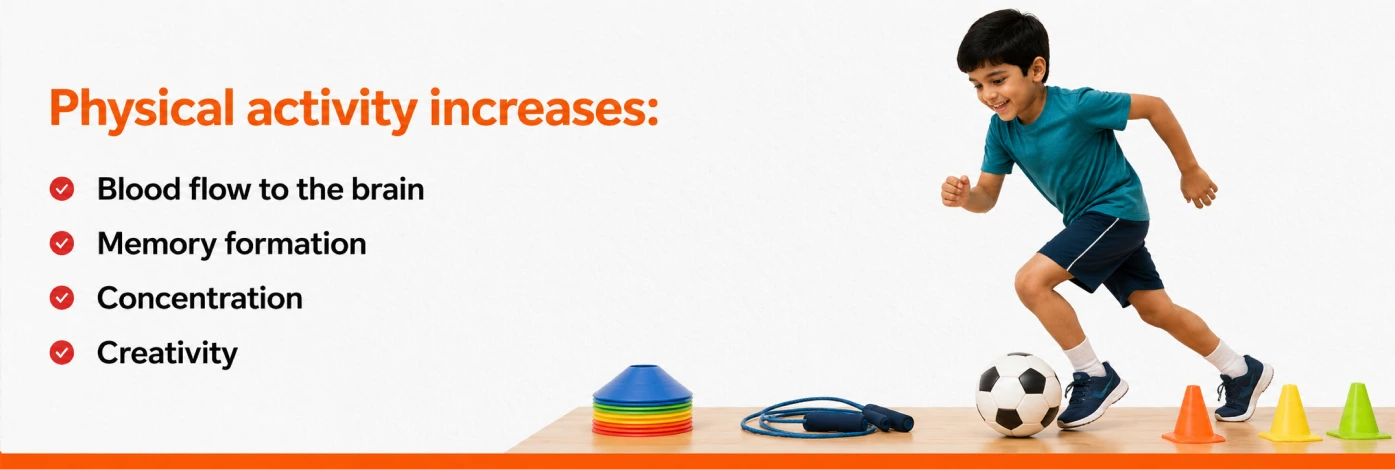
Exercise increases blood flow to the brain, which helps the body build more connections between nerves, strengthening concentration, enhancing memory, and stimulating creativity. When a child runs, swims, or plays a team sport, they are not just exercising their body. They are actively developing the architecture of the brain they will use to read, reason, and solve problems.
Regular physical activity leads to measurable adaptations in the hippocampus, the main centre of learning and memory in the brain. Research reviewing studies from 2000 to 2023 found that participation in sport during late childhood has a consistently positive effect on both cognitive and emotional function.
Structured physical activity has also been shown to improve attentional control and memory consolidation and its benefits extend to mathematical reasoning, language acquisition, and general academic achievement, not just physical fitness.
The mechanism matters here because it changes how parents think about the trade-off. When a child spends ninety minutes at football practice, they are not draining the mental resources they need for the next morning’s maths lesson. They are, quite literally, building them.
How Sports Develop Executive Function Skills
There is a set of cognitive skills that researchers call executive functions, the mental tools a child uses to plan, focus, control impulses, manage time, and shift attention when needed. These are the skills that determine not just whether a child knows the material, but whether they can sit down and actually do the work.
Children who play sports develop these skills, not as a side effect, but as a direct consequence of what sport demands of them.
A child on a cricket field has to read a situation, make a quick decision, execute a skill under pressure, recover from a mistake, and stay focused for the next delivery. A swimmer racing against the clock has to hold their technique together when their body is exhausted and their mind wants to give up. A child playing basketball has to track multiple moving variables simultaneously, communicate under pressure, and adapt when the plan stops working.
Structured physical activity and sport encourage the development of emotional regulation, cognitive processing, creative ability, and social competence. These are not soft extras. They are the cognitive scaffolding on which sustained academic performance is built.
A child who has learned to recover quickly after a bad over, to not let one mistake define the rest of their game has practised, in a high-stakes environment, exactly the mental resilience that will get them through a difficult exam or a subject they find hard.
What Research Says About Sports and Academic Achievement
The evidence here is not one or two encouraging papers. It is a consistent pattern across decades of research.
A longitudinal study using nationally representative data from Australian children found that sustained sports participation across the school years is directly linked to better academic outcomes, with measurable differences between those who kept playing and those who stopped.
Participating in sport has been shown to improve cognitive and memory functions in the brain, helping students perform better in tests and academics. The traits developed through sport, discipline, perseverance, the ability to work toward a deferred goal, contribute to academic achievement in ways that are distinct from raw intelligence.
Perhaps most directly relevant to the Indian context: a workforce survey found that only 14% of Indian graduates were considered prepared for professional environments, primarily because most could not apply their knowledge to real problems. That is not a knowledge gap. It is a thinking gap. And thinking, flexible, adaptive, pressure-tested thinking, is exactly what sustained engagement with sport develops.
The Time Management Myth: Do Sports Take Away from Studying?
One of the counterintuitive findings in this area of research is that children who play sport regularly do not typically struggle more with time management than children who do not. In many cases, they manage their time better.
Balancing sport and studies teaches children efficient time use, a critical skill for academic success. A child who knows that training runs from 4pm to 6pm and that homework needs to be done before dinner develops a relationship with time that an unscheduled afternoon does not produce. Constraints, when they are reasonable and meaningful, teach planning. And planning is one of the most transferable academic skills there is.
The discipline required to juggle sport and academic responsibilities often translates directly into improved focus and better academic outcomes, not in spite of the competing demands, but because of them.
This does not mean every child should be playing three sports simultaneously. Overcommitment is real, and a child who is exhausted does not learn well. The question is not whether a child does sport, it is whether the sport they do is balanced with adequate rest and genuinely enjoyed. A child who dreads training will not get these benefits. A child who is engaged, challenged, and improving will.
What Sport Teaches That a Classroom Cannot
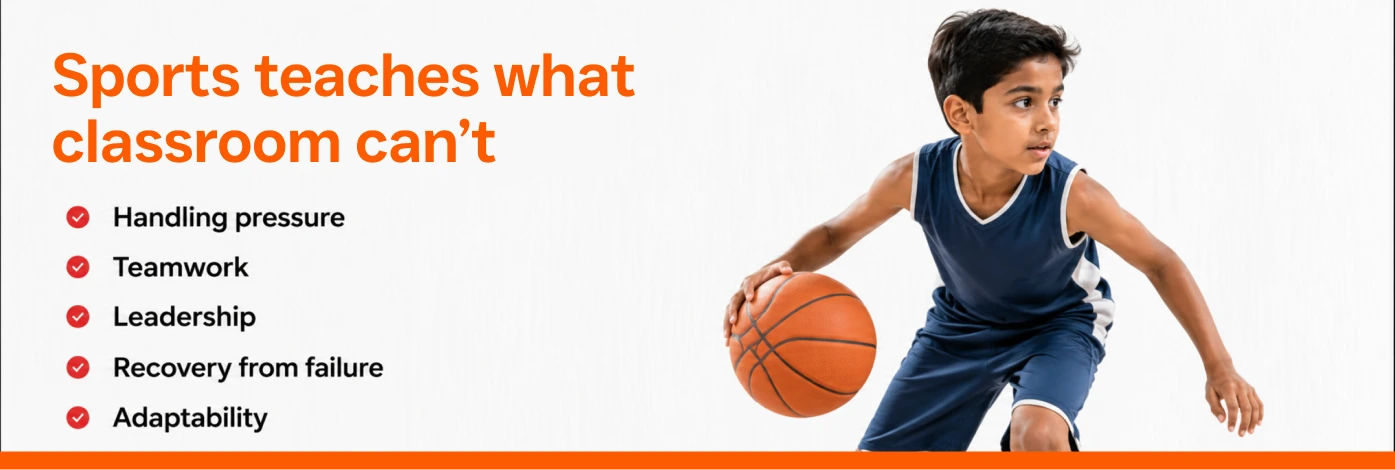
There are things a child learns on a sports field that a classroom is structurally unable to teach, not because teachers are not skilled, but because the conditions are different.
Losing without catastrophising
A child who has lost a match, processed the disappointment, showed up to the next practice, and eventually won something understands failure differently from a child who has only encountered it in the context of a test score. On a field, failure is immediate, public, and followed by another attempt. That is a powerful curriculum.
Performing under pressure
The state management required to take a penalty in the final minute, or to hold form in the last lap of a race, is the same state management required to stay focused in the last thirty minutes of a board exam. The child who has practised it in sport has an advantage that is genuinely difficult to teach any other way.
Reading people
Physical activity and team sport facilitate the development of teamwork, cooperation, communication, and a sense of belonging, built through real, high-stakes social interaction, not instruction. A child who has had to navigate team dynamics, different personalities, conflicting ideas, shared setbacks, is more socially intelligent than a child who has not. That social intelligence matters in group projects, in classroom discussions, and eventually in any professional environment.
Leading and following
Team sports teach students the value of setting goals, managing time, and leading others, and these skills translate directly into academic commitment and long-term personal development. Many students rotate through leadership roles during sport; the accountability they carry in that position does not leave them when they walk off the field.
The Concern Parents Actually Have
Most parents who worry about sport and academics are not worried about sport in principle. They are worried about a specific version of the trade-off: the child who misses revision for a tournament, who comes home too tired to concentrate, whose grades dip during sports season.
These are legitimate concerns and worth taking seriously.
The answer is not to reduce sport. It is to ensure the surrounding structure is right, that sleep is protected, that homework is planned around training schedules rather than in competition with them, and that the school environment understands and supports the child who is both a learner and an athlete.
A school that treats sport as a marginal activity, something tolerated rather than valued, will inadvertently create the conflict parents fear. A school that integrates physical activity as a genuine part of how children develop will find that sport and academics reinforce rather than undercut each other.
Signs Your Child’s School Values Sports as Part of Education
→ Sport has dedicated time in the timetable, not squeezed into what is left over
→ Teachers are aware of a child’s sporting commitments when setting deadlines
→ Physical activity is spoken about alongside academics, not below them
→ The school tracks growth in character and resilience, not just marks and medals
→ Children who compete or train intensively are supported with recovery time, not penalised for absence
How Aurinko Academy Approaches This
At Aurinko Academy in Bangalore, the separation between sport and academics does not exist, because it was never built into the school’s design.
Sport at Aurinko is not a scheduled break from learning. It is part of how children learn. The qualities that develop on the field, the ability to recover quickly, to read situations rather than follow scripts, to work toward a goal that requires sustained effort, are exactly the same qualities that make a child effective in a classroom, a project, or any environment that demands real thinking.
Our commitment to small class sizes means that teachers know each child as a whole person, not just a student, but an athlete, a maker, a thinker. When a child has had a demanding week of competition, that context does not disappear when they walk into a classroom. It informs how their teacher works with them, what they need, and how to keep them engaged without pushing them toward exhaustion.
We also do not treat assessment as the only measure of progress. A child who has spent a term learning to lead a team under pressure, or who has pushed through a physical challenge they did not believe they could complete, has grown in ways that a written test cannot capture, but that will shape every test they take for the rest of their life.
Final Note
The parent asking whether sport is getting in the way of academics is usually asking the wrong question, not because the concern is unreasonable, but because the framing assumes the two are in competition.
The child who plays, who loses, who gets back up and trains again, who learns to manage their time because the schedule demands it, that child is not sacrificing their academic future for a game. They are building it.
The field and the classroom are not two different places. For a child who is learning well, they are the same place.