Bangalore is one of India’s most education-conscious cities. Parents here research schools carefully, weigh curricula seriously, and think long-term about where their children are headed. And increasingly, one curriculum keeps coming up in those conversations: Cambridge IGCSE.
But for many families, the Cambridge curriculum remains a little mysterious. What exactly does IGCSE mean? How does it actually work in the classroom? How is it different from CBSE or ICSE? And how do you know whether it is the right fit for your child?
At Aurinko Academy, one of Bangalore’s leading IGCSE schools, we answer these questions every day. This guide gives you the full picture, clearly, honestly, and without the jargon.
What Is the Cambridge IGCSE?
IGCSE stands for International General Certificate of Secondary Education. It was developed by Cambridge Assessment International Education (CAIE), and today it is one of the most recognised and respected curricula globally for students aged 14 to 16.
Over 10,000 schools in 160 countries offer IGCSE, making it one of the most widely accepted secondary qualifications in the world.
When a student completes Cambridge IGCSE, their results are understood and valued by universities in the UK, USA, Canada, Australia, India, and beyond. This global portability is one of the biggest reasons families in Bangalore, many of whom have international career aspirations for their children, choose the Cambridge route.
Cambridge IGCSE provides students with a strong foundation for further studies and prepares them for university entrance and the workplace. The curriculum caters to learners of all abilities, including those whose first language is not English.
How the Cambridge Programme Is Structured
The Cambridge pathway is not just about the IGCSE years. It is a complete learning journey that begins in primary school and runs through to pre-university. Understanding the full structure helps parents see where the IGCSE fits.
Cambridge Primary is an education programme for young learners aged 5 to 11. Cambridge Upper Secondary, which is where IGCSE sits offers a variety of routes for learners with a wide range of abilities, improving performance by developing skills in creative thinking, enquiry, and problem solving. It is designed as a springboard to advanced study.
The IGCSE itself is a comprehensive two-year programme for Grades 9 and 10. Students take an internal school exam at the end of Grade 9, and the Cambridge IGCSE Board exam at the end of Grade 10.
After IGCSE, students typically move on to Cambridge AS and A Levels or the IB Diploma before university entry. The entire pathway is designed to be coherent, with each stage building meaningfully on the one before.
What Subjects Does IGCSE Cover?
This is where many parents are genuinely surprised by the scale and flexibility of the Cambridge offer. There are 70 subjects available at Cambridge IGCSE, including 30 languages, and schools can offer them in any combination.
The six subject groups are: Group 1 — English Language and Literature; Group 2 — Languages; Group 3 — Humanities and Social Sciences; Group 4 — Sciences; Group 5 — Mathematics; Group 6 — Creative and Vocational subjects.
Students can take a minimum of 5 and a maximum of 14 subjects, though most schools encourage 7 or 8 subjects to ensure a broad and balanced programme.
This breadth is deliberate. The Cambridge curriculum does not want students to specialise too early. A student can study Physics and History at the same time, or combine Computer Science with Art and Design. This flexibility is genuinely unusual compared to more rigid national curricula, and it reflects Cambridge’s belief that real-world thinking rarely stays within subject boundaries.
Subjects typically offered at IGCSE schools in Bangalore include English First Language, English Second Language, Mathematics, Physics, Chemistry, Biology (or Combined Sciences), History, Geography, Economics, Business Studies, Computer Science, Global Perspectives, Hindi, and a range of arts and creative subjects.
Core vs Extended: What Is the Difference?
One of the most important structural features of Cambridge IGCSE is that many subjects offer two levels: Core and Extended.
The Core curriculum is within the ability range of a large majority of students. It provides a full overview of the subject and is targeted at students expected to achieve grades C to G. The Extended curriculum has been designed for the more academically able and is targeted at those expected to achieve grades A* to E.
The Extended curriculum offers a more in-depth and rigorous experience, covering a wider range of topics at a higher level of difficulty. It is suitable for students who plan to pursue further studies in the subject or who are seeking a more challenging academic experience.
This two-tier system is one of the most parent-friendly features of IGCSE. It means that ambitious students can push themselves harder within the same qualification, while students who need more support can still access a full and credible curriculum without being written off as underperformers. Schools like Aurinko Academy work with each student to identify which level is right for them and that decision is made with care, not just automatically.
How Is IGCSE Assessed?
Assessment in Cambridge IGCSE is one of the things that most clearly sets it apart from national boards like CBSE or ICSE. It is far more varied and far more revealing of what a student can actually do.
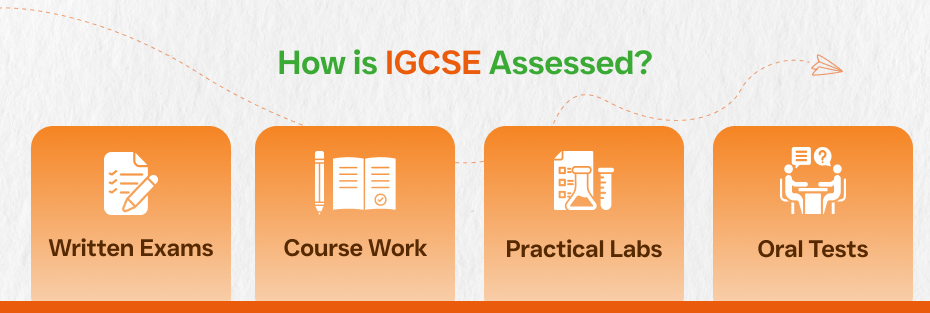
Cambridge IGCSE uses a variety of assessment methods, including written examinations, oral tests, coursework, and practical assessments. This comprehensive approach ensures a well-rounded evaluation of student abilities, encompassing knowledge, practical skills, and critical thinking.
Examinations are taken at the end of the two-year course in May or June, with an additional series in October or November. There is also an exclusive March series for students in India.
What this means in practice is that a student’s final grade is not determined by a single high-pressure paper. Depending on the subject, their mark may include a written examination, a practical or laboratory assessment, an oral component (particularly important in language subjects), and coursework completed during the course itself. This broadens opportunities for students to demonstrate their learning, particularly when their first language is not English.
How Are IGCSE Results Graded?
The IGCSE is graded from A* to G, with U denoting “ungraded.” In order to proceed to further education, students are generally expected to obtain a minimum of grade C in their core subjects.
The A* grade pronounced “A star” is the highest possible mark and is awarded to students who demonstrate exceptional mastery of the subject. It is internationally recognised and carries significant weight in university admissions, including at top institutions in the UK, USA, and across Asia.
For students in India comparing IGCSE to CBSE, it is worth understanding that the grading approaches are quite different. CBSE uses percentage-based marking. Cambridge IGCSE uses letter grades that reflect mastery of specific skills and understanding, rather than raw score percentages. Many Indian parents initially find this unfamiliar, but most come to appreciate how much more nuanced the picture it gives of a student’s actual capabilities.
What Makes Cambridge IGCSE Different from CBSE?
This is the question Bangalore parents ask most often, and it deserves a direct answer.
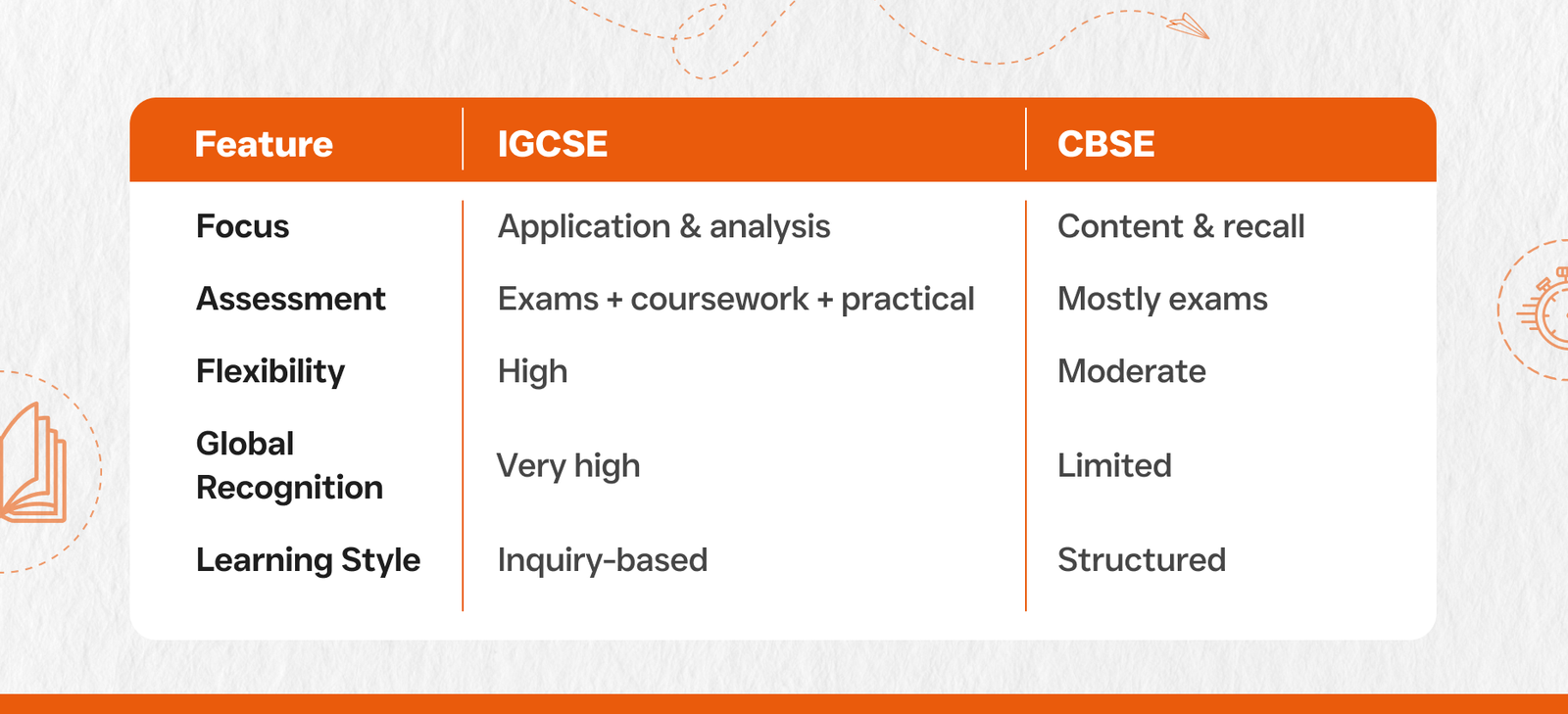
The most fundamental difference is in philosophy. CBSE, historically, has been built around content coverage, learning a defined syllabus and demonstrating recall in examinations. Cambridge IGCSE, while equally rigorous on content, places a much heavier emphasis on the ability to analyse, apply, evaluate, and communicate ideas.
Where CBSE is more theoretical with significant emphasis on examinations, IGCSE emphasises critical thinking, application-based learning, and prepares students for higher education worldwide. Assessments include written, oral, coursework, and practical components, catering to various learning styles.
A CBSE student may be asked: “State Newton’s Second Law of Motion.” A Cambridge IGCSE student is more likely to be asked: “A student conducts an experiment using the following setup. Identify the variables, predict the outcome if one variable changes, and explain your reasoning.” Both require knowledge. Only the second one also requires thinking.
This is why Cambridge IGCSE graduates are considered exceptionally well-prepared for international universities, institutions that place reading, writing, analysis, and independent thinking at the centre of what they assess and reward.
Is IGCSE Recognised for Indian University Admissions and Competitive Exams?
This is a genuine concern for many Bangalore families, particularly those weighing the IGCSE against CBSE because of JEE, NEET, or state-level entrance exams.
Cambridge IGCSE is recognised by universities across India, including the Indian Institutes of Technology, for admissions purposes. However, competitive entrance exams like JEE and NEET are based on the CBSE/NCERT syllabus, and IGCSE students who wish to sit these exams need to ensure they have covered the required content — which a well-designed IGCSE Science and Mathematics programme largely does, but with some supplementary preparation needed.
Yes, IGCSE students can crack NEET. While the IGCSE curriculum may differ slightly from the CBSE syllabus followed for NEET, the core concepts and subjects covered are largely similar.
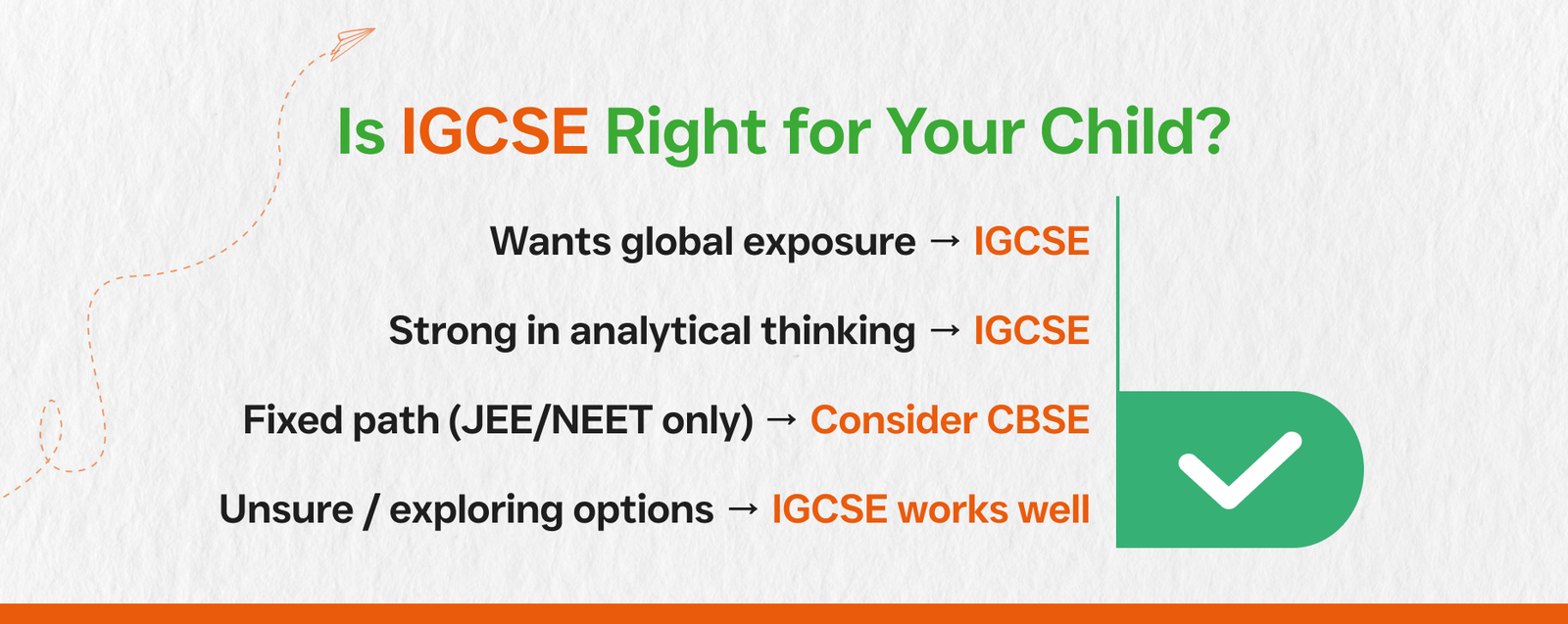
At Aurinko Academy, we are transparent with families about this. If your child is firmly committed to JEE or NEET, we will have that conversation openly. If your child has broader ambitions, including international university pathways, liberal arts, design, business, or technology Cambridge IGCSE is one of the strongest foundations they can build.
The Cambridge ICE Award: A Broader Achievement
One feature of IGCSE that is rarely explained to parents but is worth knowing about is the Cambridge ICE, International Certificate of Education.
Cambridge ICE is a group award for Cambridge IGCSE. It allows schools to offer a broad and balanced curriculum by recognising the achievements of learners who pass examinations in at least seven Cambridge IGCSE subjects from five different subject groups, including two different languages.
Students who earn the Cambridge ICE award have demonstrated breadth and depth across the curriculum, not just strength in one or two areas. In a world where universities and employers are increasingly looking for T-shaped individuals (deep expertise in one area, broad understanding across many), the ICE award is a meaningful signal of genuine all-round capability.
Why Aurinko Academy for IGCSE in Bangalore?
Choosing an IGCSE school is not just about the curriculum, it is about how well the school actually delivers it. The Cambridge brand is only as strong as the teachers, the environment, and the school culture behind it.
At Aurinko Academy, our Cambridge IGCSE programme is built on three pillars that set us apart.
The first is genuine inquiry-based learning. Our classrooms are not spaces where information is transferred from teacher to student. They are spaces where students are challenged to think, question, and construct understanding themselves. This is what Cambridge IGCSE is designed to reward and it is what we practice daily, not just in exam preparation.
The second is pastoral care and personalised guidance. Cambridge IGCSE is a demanding programme. Students who are properly supported, academically and emotionally perform far better than those left to navigate it alone. Every Aurinko student has access to dedicated academic mentoring and guidance that extends well beyond the subject content.
The third is university and career preparation. The IGCSE years are not just two years of school, they are the foundation for everything that follows. Our guidance team works with students from Grade 9 onwards to understand their strengths, interests, and ambitions, and to make subject choices that position them well for Cambridge A Levels, international university applications, and the careers they genuinely want.
Final Thoughts
Bangalore has no shortage of schools. But an IGCSE education delivered well is something genuinely different from what most schools offer. It is not just a foreign-sounding qualification. It is a proven framework for developing the kind of thinker, communicator, and problem-solver that universities and employers around the world are actively looking for.
The Cambridge curriculum has been trusted by schools across 160 countries for decades because it works. It produces graduates who can read critically, write persuasively, analyse confidently, and adapt intelligently, in any country, any field, and any context.
At Aurinko Academy, we do not just teach the Cambridge curriculum. We believe in it because we see what it does for students every single day.
Curious about IGCSE admissions at Aurinko Academy? Book a school visit and meet our academic team. We would love to show you what a Cambridge education looks and feels like here in Bangalore.
Frequently Asked Questions
Q: At what age do students start the IGCSE programme?
IGCSE is a qualification for students aged 14 to 16, typically covering Grades 9 and 10. Most students begin the programme at 13 or 14 and complete their board examinations at 15 or 16.
Q: How many subjects should my child take for IGCSE?
Students can take a minimum of 5 and a maximum of 14 subjects. Most schools encourage around 8 subjects to ensure a broad and balanced programme of study, while making exemptions based on individual student needs. At Aurinko Academy, we guide each family through subject selection based on the student’s strengths and future plans.
Q: How difficult is the IGCSE compared to CBSE Grade 10?
The IGCSE is widely considered to be at a comparable or higher level of rigour than CBSE Grade 10, but the nature of the challenge is different. CBSE rewards breadth of content knowledge. IGCSE rewards depth of understanding, analytical thinking, and the ability to apply knowledge to unseen situations. Many students find IGCSE deeply engaging precisely because it demands more than memory.
Q: Are IGCSE grades accepted by Indian colleges?
Yes. Cambridge IGCSE is accepted by universities across India. For competitive entrance exams like JEE and NEET, IGCSE students need to ensure their science and mathematics preparation aligns with the specific syllabus requirements of those exams, which our academic team can help with.
Q: What comes after IGCSE at Aurinko Academy?
After completing Cambridge IGCSE, students typically progress to Cambridge AS and A Levels, the internationally recognised pre-university qualification. Cambridge AS and A Level certifications are recognised by leading universities and employers worldwide and serve as an international passport to progression and success.
After completing Cambridge IGCSE, students typically progress to Cambridge AS and A Levels, the internationally recognised pre-university qualification. Cambridge AS and A Level certifications are recognised by leading universities and employers worldwide and serve as an international passport to progression and success.